Your Inquiry Form Is Costing You Customers

You built that form to save your team time. There's a decent chance it's quietly doing the opposite.
Let us tell you about a customer you've never met. You'll never meet her, either. That's the whole point.
It's 10:30 at night. She's on the couch, phone in hand, the house finally quiet. Her daughter turns seven in two weeks and she's been scrolling for a week looking for someone who can do the cake. She finds you. The photos are beautiful. The reviews are good. She's decided.
She taps Request a Quote.
She wants to know two things. Can you make her a cake? And what will it cost?
What she gets is twenty questions.
She starts in. Name, phone, email — easy. Then the form asks what date she needs it. Fine. Then what time she's picking up, and she pauses, because she doesn't know yet whether she or her husband is doing the pickup, and he's asleep.
She scrolls on through the cake sizes, from four-inch all the way up to three-tier. She reads the whole list because she doesn’t know which part she can skip.
She ends up stuck between two. The six-inch tall serves twenty, and so does the eight-inch standard. She’s feeding twenty people, so which one should she pick?
Flavor, required. Her daughter liked vanilla last year but asked for chocolate at her cousin's party, so now she's thinking she should probably ask her. Her daughter is asleep too.
Filling. She didn't know a cake had a filling separate from the flavor.
Frosting: buttercream or fondant. She opens a new tab.
Twenty minutes later she's watching a video about the difference between fondant and buttercream. She still hasn't typed anything into your form. It's 11:15 now and she's up at six.
"I'll finish this tomorrow."
Tomorrow is a Tuesday. Work happens. Soccer happens. Dinner happens. She never comes back.
Here's the part that should bother you: nothing shows up in your system. No inquiry. No email. No missed call. You don't know she was there. You don't know she was ready. You don't know you lost her, so you'll never fix it.
The short version
If you only read one paragraph, read this one.
Your inquiry form should ask the smallest number of questions you need to say yes, we can do that, and price. That's usually five or six fields: name, contact, event date, how many people, an inspiration photo and a short description of what they want. Everything else — flavor, filling, frosting, inscription, colors, pickup time — belongs in the check out after she's in. Not in the gate she has to get through to reach you.
That's it. The rest of this is the why, and the field-by-field.
Why bakeries build long forms in the first place
We want to be fair to bakeries here, because the thinking behind the long form is good thinking.
You've been through the back-and-forth. Someone emails "do you do custom cakes," you reply yes, they reply with a date, you reply asking how many people, they reply three days later, you ask about flavor, and eleven messages in you still haven't quoted a price. That's an hour of your life for one cake that may not even happen.
So you built the form. Get it all upfront. One submission, one review, one quote out the door. Clean.
The logic is sound. The problem is who you built it for.
You built the form for the person writing the quote, not the person asking for one.
Your decorator can answer every field on that form in thirty seconds. She knows what an 8-inch serves. She knows what ganache is. She knows fondant from buttercream by looking at it.
Your customer is not used to all that. For her, half those fields aren't questions, they're homework. And homework gets put off until tomorrow, and tomorrow never comes.
It's the same thing we wrote about in why you keep losing cake orders: somewhere along the way we started handing the customer the work. The inquiry form is where it happens first, and most invisibly.
Walking the form, field by field
Pull up your own form while you read this. It'll go faster.
1. The wall of text before anything starts
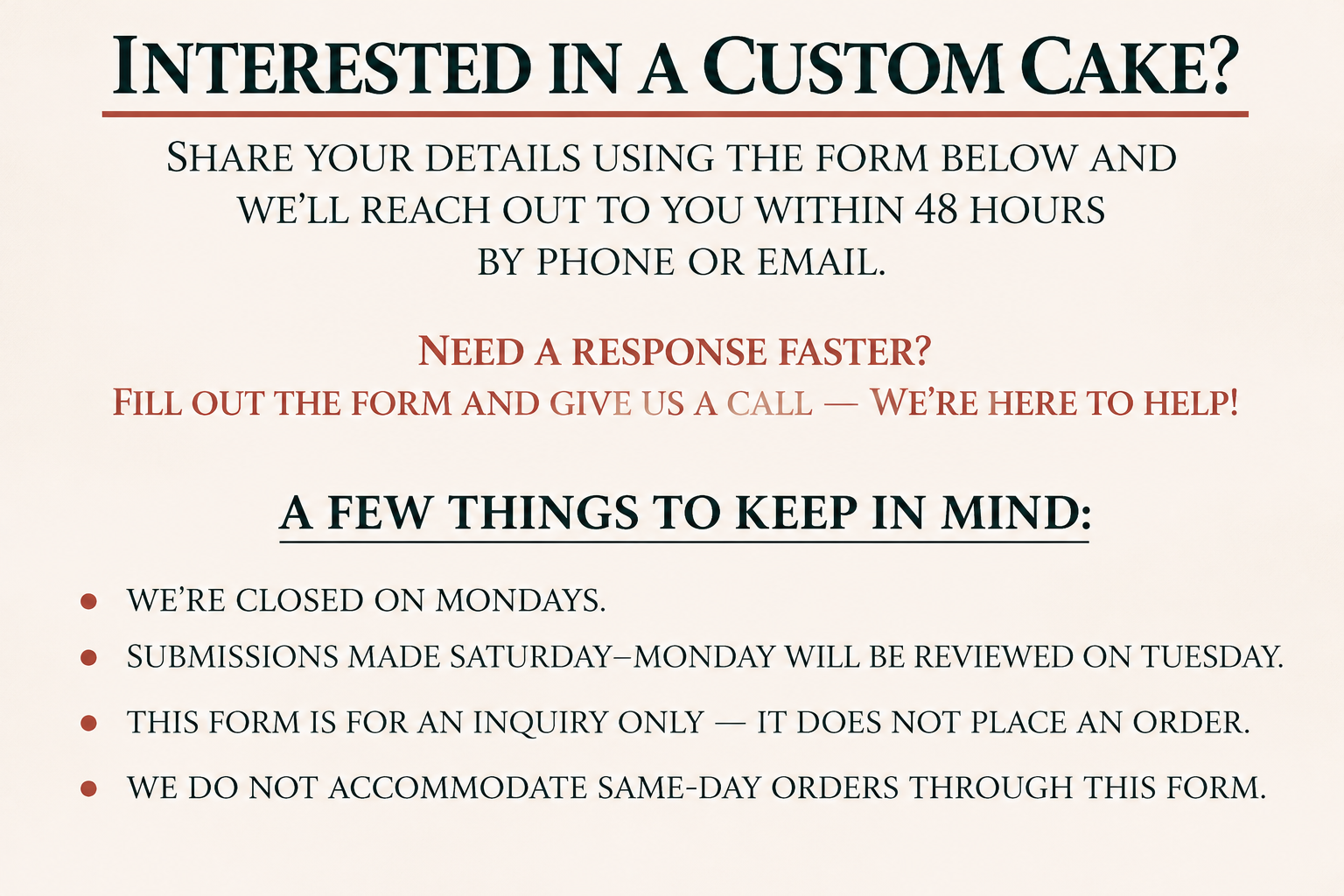
Most bakery forms open with a paragraph or four.
We are closed Mondays. Please allow 48 hours for a response. Submitting this form does not confirm your order. We do not accept same-day orders. For urgent requests, please call during business hours.
Every one of those sentences exists because something went wrong once. We get it. But she came to ask about a cake, not to read your terms.
You don't need to delete your policies. You need to move them to the moment they matter. Put the response time next to the Submit button, where it reassures instead of warns. Show your lead-time rule when she picks a date, not before. Tell her this isn't a confirmed order on the confirmation screen, when she'll actually read it.
2. Name, phone, email — keep all three, but make them real
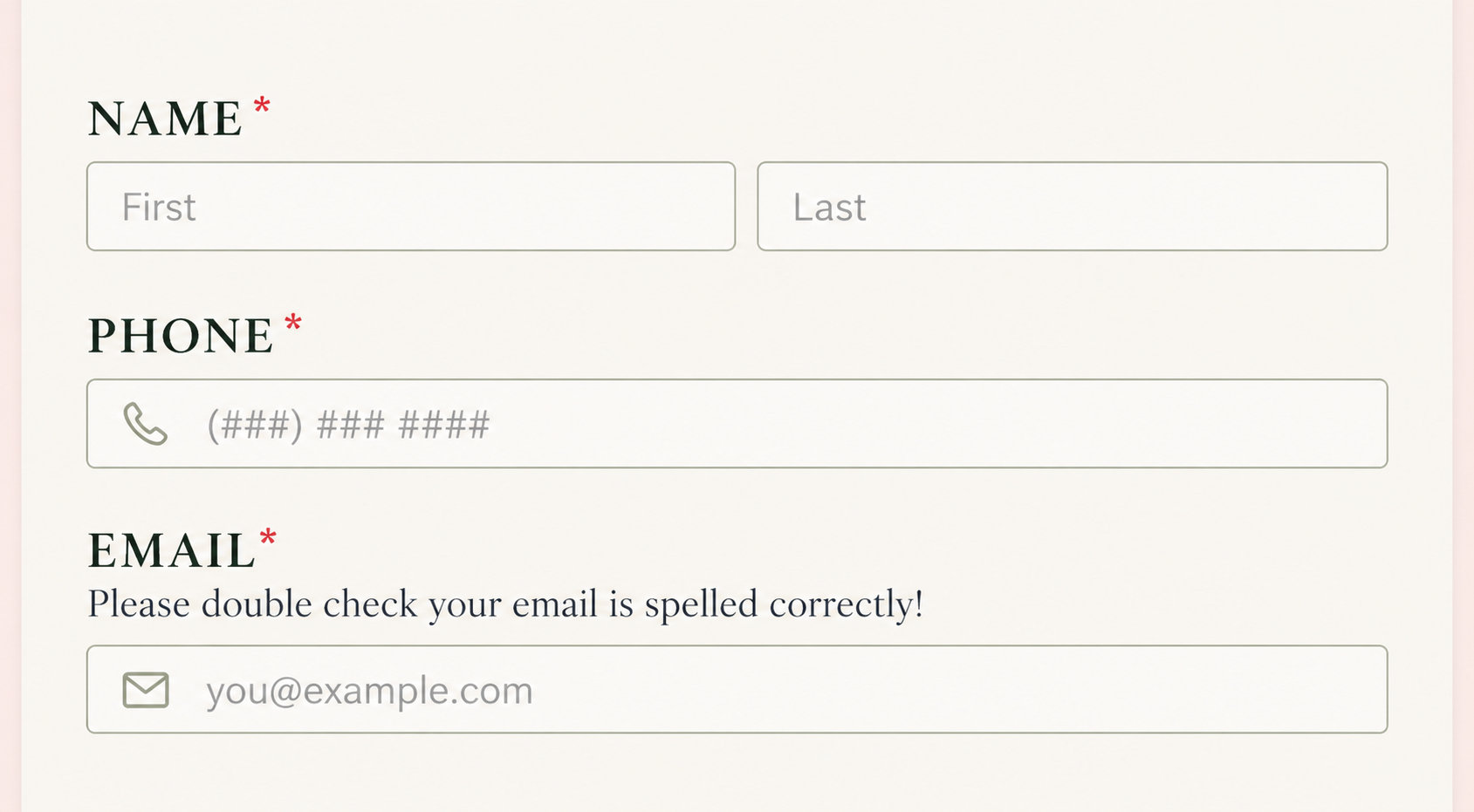
These stay. You need to reach her.
The problem here isn't too many questions, it's bad data. Someone fat-fingers an email. Someone types a phone number with a digit missing. Your team spends twenty minutes pricing the cake, sends the quote, and it bounces. They call and it rings nowhere.
Basic format checking on the email and phone fields catches most of it, and it costs the customer nothing. If you want to go further you can send a confirmation code. I'd only do it if fake inquiries are a real problem for you, not a theoretical one.
And remember: a correctly formatted email address is not the same as a real one.
3. "When do you need it?" is the wrong question
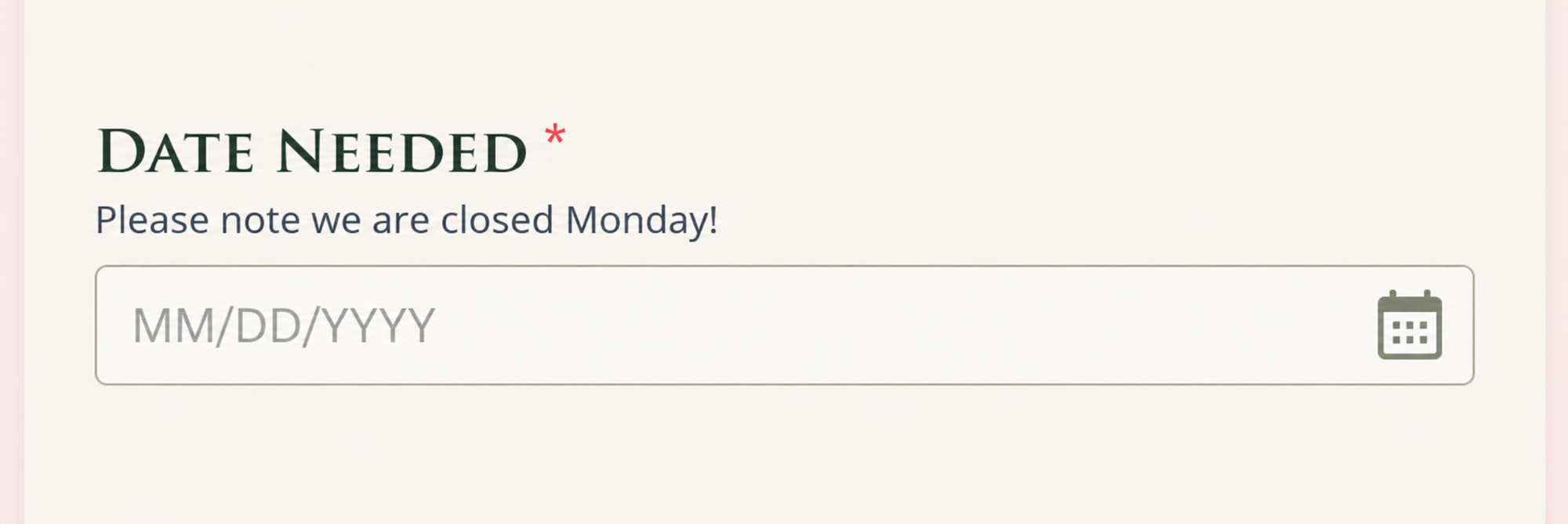
Asking about the date is right. Asking it the usual way costs you orders.
Say you're closed Mondays. Your form says so, maybe even blocks Monday on the date picker.
A customer needs a cake for a Monday afternoon party. She sees "no Monday pickups," decides you can't help, and leaves.
But she'd have been perfectly happy to collect it Sunday evening. She never wanted you to bake on a Monday. She needed the cake for Monday. Those are two completely different things, and your form just treated them as the same thing and sent her away.
4. Pickup time: one field, one family argument
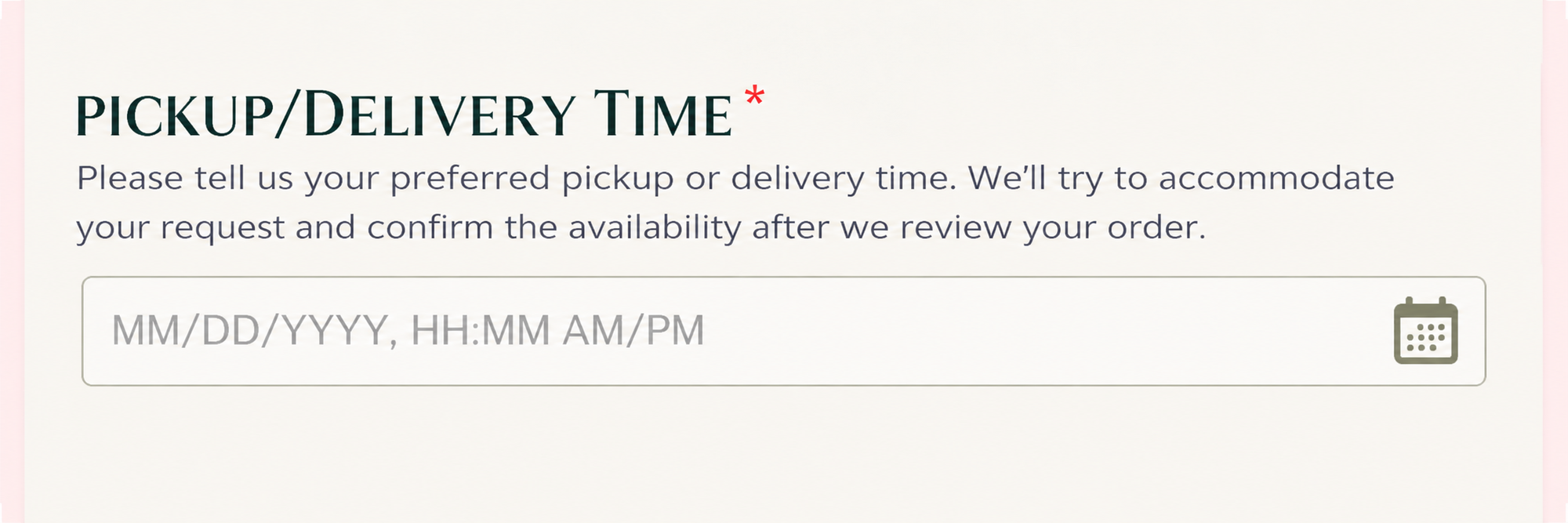
Now the form wants a pickup time.
Put yourself back on that couch. The party's across town. It's twenty minutes from home to your shop and twenty-five more from your shop to the party. Nearly an hour of driving before anyone sees the cake.
So she starts thinking. Do I go? Can he go? What time does he finish? Would it be easier if my sister grabbed it on her way? And now a dropdown has turned into a scheduling conversation with a man who is asleep.
She leaves the tab open to finish tomorrow. You know how that ends.
We can't tell you what share of people bail right here. Nobody can, unless you're measuring where people abandon your form, which is worth doing. But ask yourself the simpler question:
Do you need a pickup time to give her a price?
Almost never. The price comes from size, design and date.
5. Cake size: she thinks in people, you think in inches
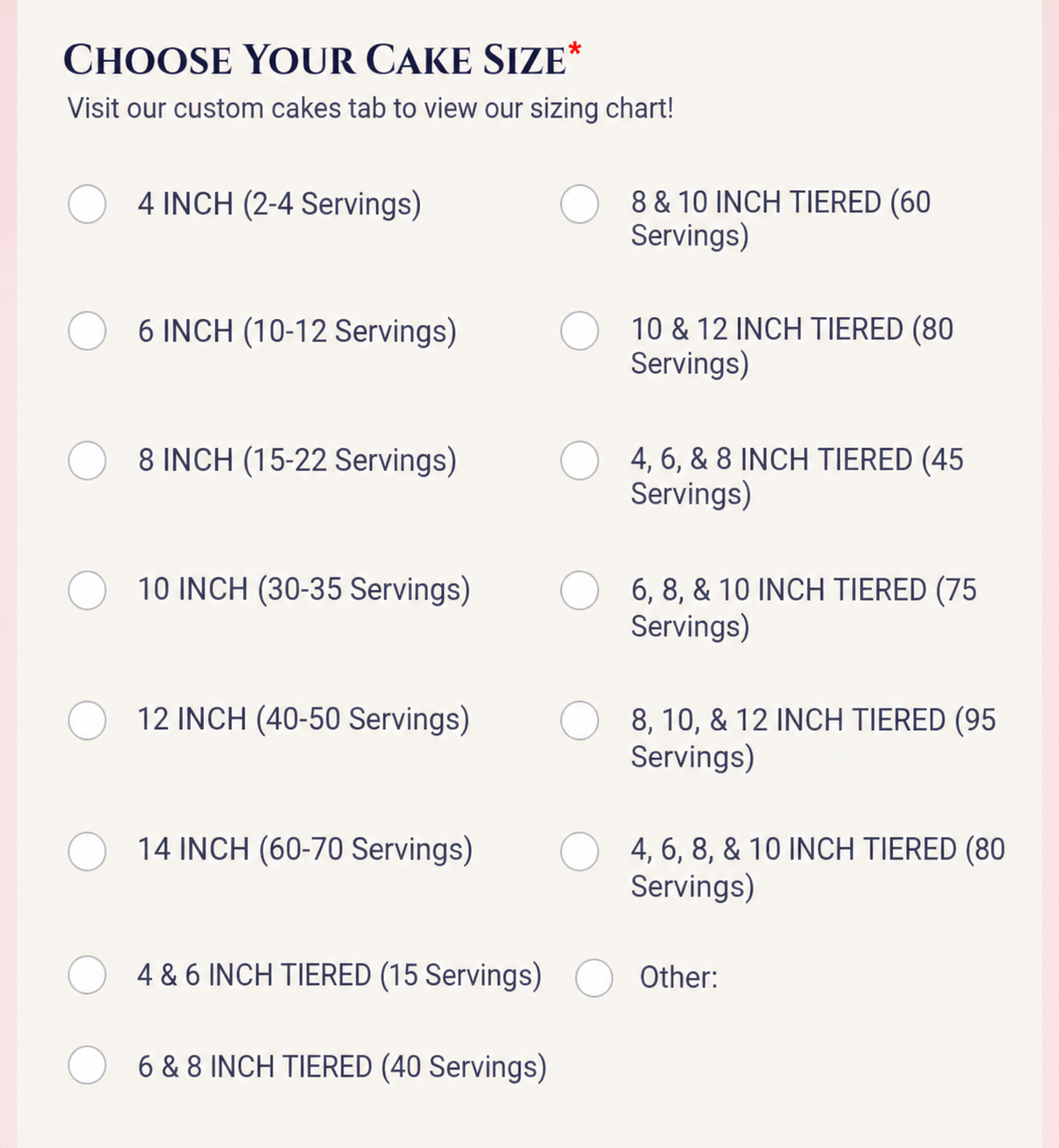
This is the big one.
Your form lists every size you make. Four-inch, six, eight, ten, twelve. Two-tier 6+8. Three-tier 6+8+10. Quarter sheet, half sheet.
To your team that's just the size chart. She goes through your entire list to figure out what size will work best for her 20 people party.
You've asked her to learn your sizing system before she's allowed to ask you a question.
She knows exactly one thing, and it's the only thing that matters: "I need a cake for about twenty people."
That's plenty to start with.
6. Flavor: the question that sends her to ask a seven-year-old
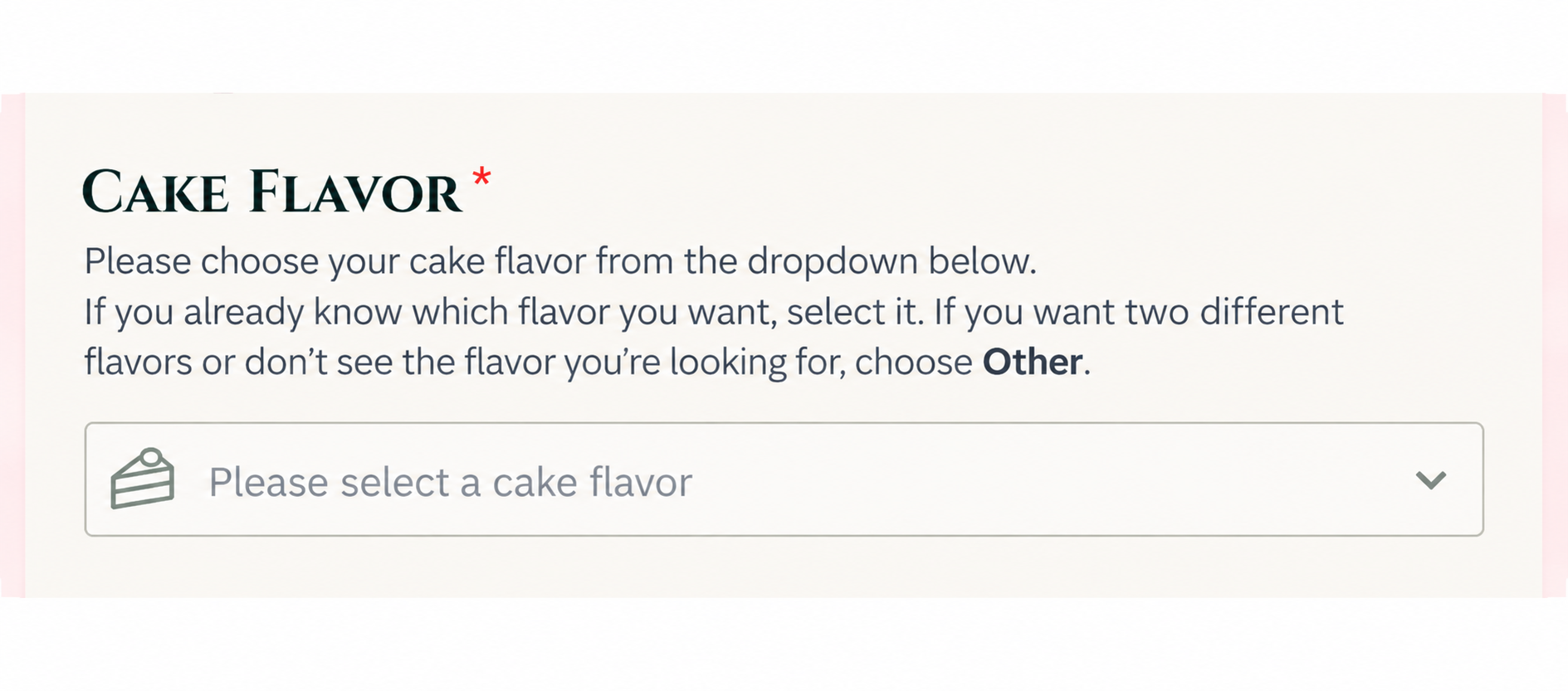
Flavor, marked required.
Vanilla, chocolate, red velvet, marble, lemon, strawberry, funfetti, almond. Eight good options.
And she thinks: she said vanilla last year, but she asked for chocolate at Mia's party. I should ask her.
Her daughter is asleep. The form stays unfinished.
Weddings are worse. A couple may be deciding whether each tier gets a different flavor, whether the groom's family will revolt over lemon, whether they should do a tasting first. They genuinely do not know yet, and they shouldn't have to. That's what a tasting is for.
Flavor matters enormously for the final order. It rarely matters for the first price.
7. Filling: most people don't know this is a separate thing
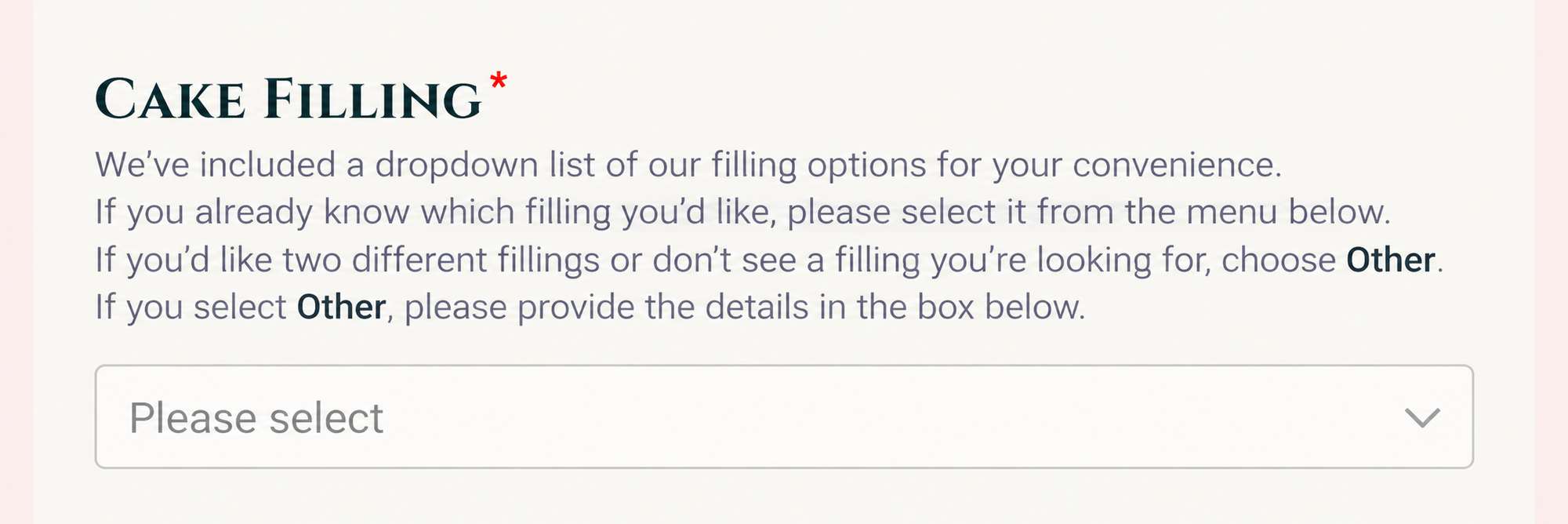
Chocolate ganache. Raspberry preserve. Bavarian cream. Lemon curd. Salted caramel.
To a regular custom-cake buyer, a great question. To most people, five words that produce five new questions: What's the difference between the flavor and the filling? Do I have to have one? Does it cost extra? What goes with vanilla?
So instead of submitting an inquiry, she's googling cake fillings. Or asking ChatGPT. You've handed her a research assignment, and research assignments get postponed.
8. Buttercream or fondant: the clearest own goal on the whole form
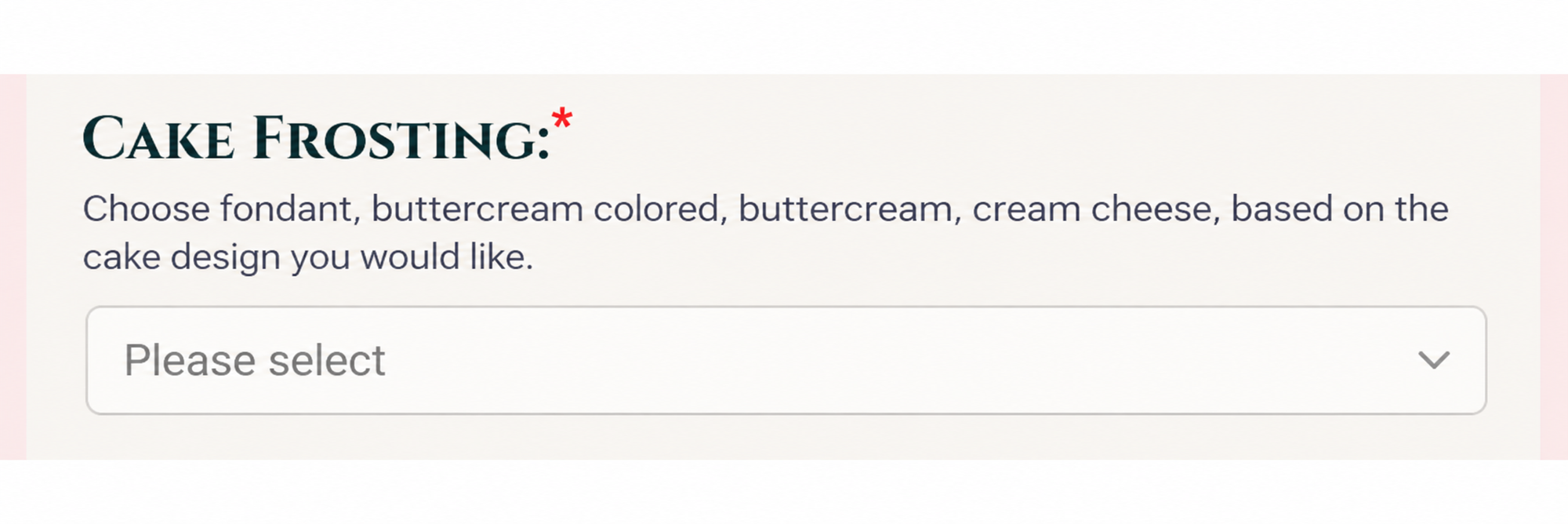
This one we see constantly and it's the easiest to fix.
Preferred finish: buttercream, fondant, whipped cream, or cream cheese.
For a baker, trivial. For her, a genuine unknown.
Here's what's actually happened: she saw a cake on Instagram, screenshotted it, and knows precisely how she wants hers to look. What she does not know is what that cake was made of. So she searches "fondant vs buttercream," reads about taste and texture and price, watches a video, and half an hour later she's better informed and still hasn't contacted you.
She shouldn't have to learn your craft to hire you for it.
9. Inscription and colors: nothing here needs deciding tonight
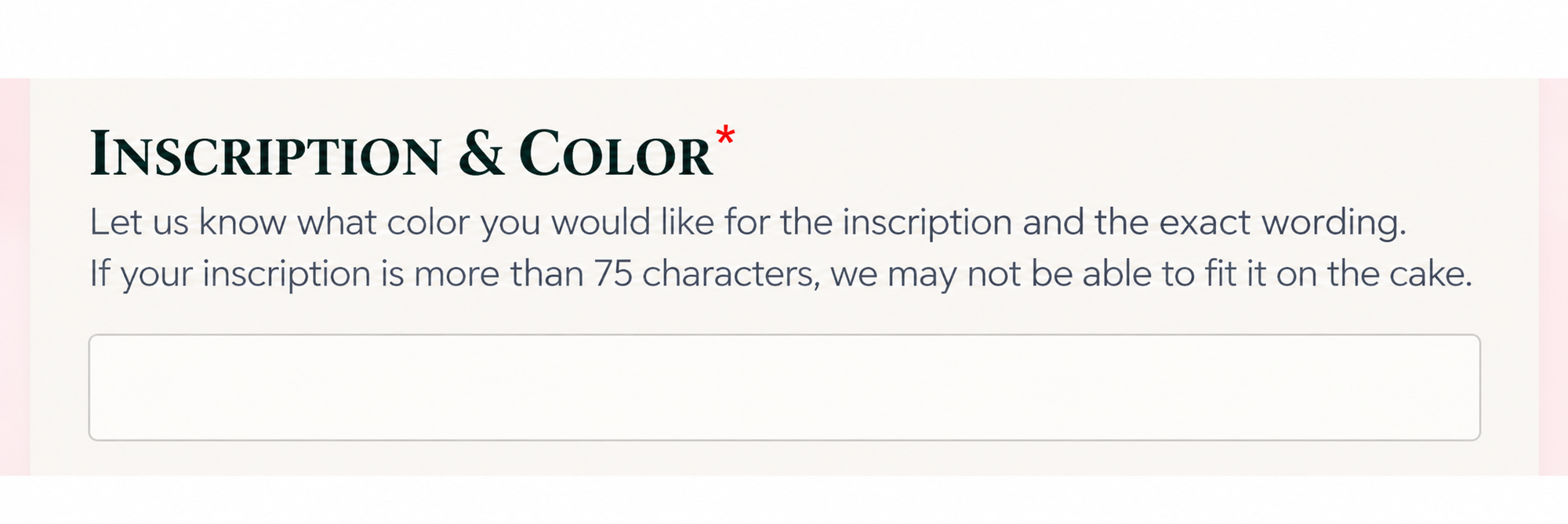
What should it say? What color lettering?
She may not have landed on the wording. She may be torn between pink and sage. And even when she picks, her pick might not work — someone's going to ask for black script on a dark chocolate finish, and your decorator is going to gently suggest otherwise.
These are conversations, and they go better when someone who understands cake decoration is in them.
10. The required reference photo: you're sending her to Instagram, on purpose
Asking for a reference photo is smart. A picture explains a cake better than three paragraphs ever will.
She's still on the couch. She hits the upload field. She doesn't have a photo saved — the one she liked, she just looked at, she didn't save it. So she opens Instagram to go find it.
You know what happens next, because it happens to you too.
There's a notification. She checks it. A Reel autoplays. Then another. Then a message from her sister. Thirty minutes evaporate.
Wait — why did she open Instagram? Oh. Right. The cake.
It's 11:15 now and she's tired.
Instagram is engineered by very expensive people to keep her exactly where she is. Pinterest and Google Images are no better. Every field that forces someone to leave your site is a bet that they'll come back, and you're making that bet against the best attention engineers in the world.
11. Budget: ask, but don't make her guess
Budget is genuinely useful. It tells you whether the three-tier gold-leaf design she sent is a real brief or a Pinterest dream, and it saves you quoting into a void.
But a first-time buyer has no idea whether that cake is $120 or $450. Make the field required and you've put her in an uncomfortable spot — lowball it and feel cheap, guess high and worry she's overpaying. Some people just close the tab rather than commit to a number in front of a stranger.
If you don't have those numbers firm, that's worth sorting out — how to price custom cakes or wedding cakes walks through building a rate card anyone on your team can quote from.
12. "Anything else we should know?" — keep this one
One open box, not required, no label longer than a sentence.
This is where you find out it's a surprise party, that grandma is coeliac, that the venue has no fridge, that last year's cake from somewhere else was dry and she's nervous. You cannot design a dropdown that catches any of that.
It's the cheapest field on the form and often the most valuable.
So what does the short form actually look like?
Six fields:
- Name
- Phone or email (or both, if you want both)
- When's your event?
- How many people?
- Tell us about the cake — open text, plus an optional photo upload
- Budget — optional
That's it. That's enough for a real human at your shop to reply with "Yes, we can do the 22nd. For twenty servings in that style you're looking at is $220. Want to talk it through?"
And the moment she reads that reply, something changes. She's no longer comparing four bakeries. She's talking to one. Now ask her about flavor, filling, finish, inscription, colors and pickup time. She'll answer every single one, in detail, cheerfully, because she's already chosen you.
"But won't I waste time on people who aren't serious?"
This is the honest objection and it deserves an honest answer.
Yes, a shorter form means more inquiries, and some of them will go nowhere. That's real.
But think about what you're trading.
Right now the long form is filtering your inquiries, just not the way you think. It isn't filtering for serious buyers. It's filtering for people who are comfortable with forms, who already know cake vocabulary, who happen to have twenty uninterrupted minutes, and who aren't doing this at 10:30 at night with a kid asleep down the hall. That last group is most of your customers.
Meanwhile the woman who was ready to spend $300 bounced at the fondant question, and the one who filled out all twenty fields is still going to want three design changes and a different date.
There's a practical middle, too. Two of the six fields do most of your filtering work for free:
- Event date tells you instantly whether it's even possible. Show your lead-time rule the second she picks a date, so she self-selects out before you ever see it.
- Budget ranges sort the real briefs from the window shopping without anyone having to be rude about it.
And the second half of this is speed, which matters more than the form does. A short form that sits unanswered for three days is worse than a long one answered in an hour. She's messaged other bakeries. First real reply usually wins. If quoting currently depends on you personally being free, that's the thing to fix next — the form is only the front door.
Find your own leaks this week
Start by putting yourself in your customer's shoes, someone who knows nothing about cake terminology.
Tonight, grab your phone, not your laptop. Open your bakery's website and pretend you're a customer ordering a birthday cake for two weeks from Saturday. Go through the entire inquiry process. Notice where you hesitate, get confused, or feel like giving up.
Better yet, hand your phone to someone who has never ordered a custom cake. Your neighbor, your cousin, or the teenager who works weekends. Don't explain anything. Just watch where they pause, what questions they ask, and where they struggle.
You'll learn more in five minutes of watching a real person than in a month of reviewing your own website.
Count three things:
- Taps and screens. Every one is a chance to leave.
- Questions you had to think about, not just type. Those are the expensive ones.
- Times you had to leave the site to find something.
Then make two changes this week, not twelve. Remove flavor & filling. Cut the pickup time. See what happens over the next month.
And if you want to know how many people are starting your form and never finishing, turn on form analytics or just add a simple counter — "started" versus "submitted." Most bakeries have never looked. The gap is usually the most interesting number in the business.
Where software fits, honestly
Some of this is just editing. Deleting required fields costs nothing and you can do it this afternoon.
Some of it isn't. Asking for servings instead of inches only works if someone can turn twenty servings into a size and a price quickly. Showing your lead-time rule when she picks a date means your form has to know your calendar. Moving the detail questions to after the yes means you need somewhere for that conversation to live, attached to the order, where the kitchen can see it too, otherwise you've just moved the mess from a form into a thread on somebody's phone.
That's the gap this part of BakeStreet is built for: a short inquiry up front, the full spec collected once she's in, photos and messages riding along on the order itself, and the kitchen seeing the same thing the counter sees. Not magic, just the order only getting written down once.
Whatever you use, the test is the same. Can a tired person on a phone at 10:30pm ask you for a cake in under a minute?
A few questions owners ask
How many questions should a custom cake inquiry form have? Five or six. Name, contact, event date, number of servings, a short description with photo, and optional budget. Anything that doesn't change your yes/no or your price band belongs in the follow-up conversation.
Should the reference photo be required? Yes, reference photos are helpful, but customers should be able to find inspiration right on your website. Sending them to Instagram, Pinterest, or Google to look for ideas takes them away from your inquiry form, and many never return.
Should I ask for cake size or number of servings? Servings. Customers think in people. Converting twenty servings into the right size and tier count is your expertise, and asking her to do it first is asking her to learn your job before she can hire you.
Do I need the flavor and filling upfront? Nope. Quote a starting price and say which options cost more in checkout. Flavor is a common reason people stall — they want to ask the person the cake is for, and that person is usually asleep.
Won't a shorter form bring in unqualified inquiries? Some, yes. But the event date and a budget range filter most of that out on their own, and the long form filters for form-tolerance rather than seriousness. More inquiries answered fast beats fewer inquiries answered slowly.
Here's the thing to hold on to.
A customer who gives up on your form doesn't complain. She doesn't call to tell you the frosting question was confusing. She doesn't appear in your numbers at all. She just quietly doesn't exist, as far as your bakery is concerned.
Which means the only way you'll ever find her is by going and looking.
So go be her tonight. Phone, couch, 10:30. See how far you get.