How to Price Wedding Cakes
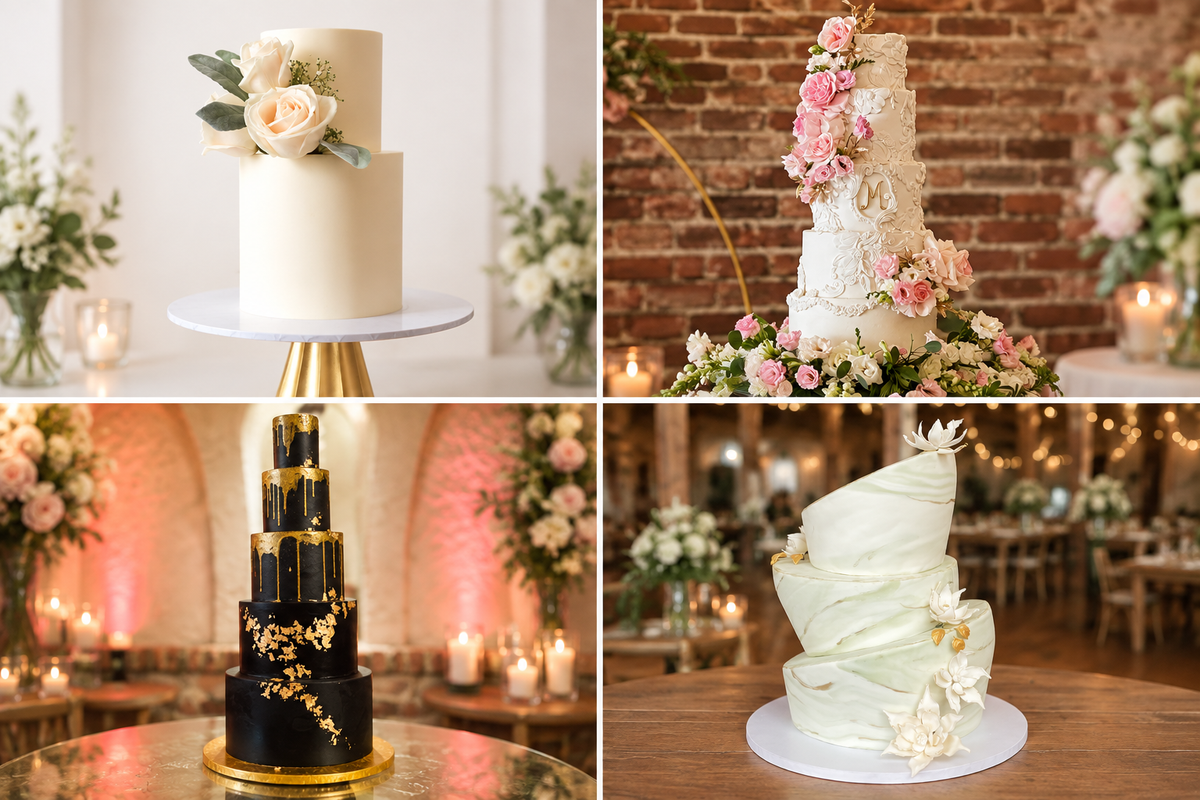
Wedding cake pricing works on a smaller slice and a higher rate per slice than any other cake you sell. The portion is about 1" × 2" rather than the 1½" × 2" party slice, so the same 10-inch round serves 38 instead of 28. The rate per serving goes up anyway. That's because a wedding cake arrives wrapped in a consultation, a tasting, a sketch, revisions, a contract, a venue delivery and on-site stacking — with no second chance.
Here's the sentence that changes how you quote weddings.
She is not buying 120 servings of vanilla cake.
She is buying the moment the doors open and everybody says oh. She is buying the photos her daughter will still have in thirty years. She is buying not having to worry about one single thing on that day.
There is no per-slice price on that. There never was.
That's why wedding pricing is its own subject. Quote a wedding cake the way you quote a birthday cake and you leave a lot of money on the table. Worse, you get compared on price to somebody who isn't doing the same job.
This is one of three detailed guides. For the shared method and the cost numbers underneath it, start with how to price cakes. Everything in how to price custom cakes applies here too, especially the decoration menu — this guide covers what's specific to weddings.
What this guide answers
- How much should I charge for a wedding cake?
- How many servings will each tier give?
- Why do wedding cakes cost more per slice than birthday cakes?
- Can I charge wedding prices in my town?
- How much extra per tier?
- How do I feed 150 without building five tiers?
- What do I charge for sugar flowers?
- Should her florist supply the fresh flowers?
- Should wedding cake tastings be free?
- How much deposit should I take?
- What belongs in a wedding cake contract?
- Should I charge for delivery and setup?
- A bride says another bakery quoted less — what do I say?
The same cake, three prices
Before anything else, look at what portion size alone does to a single 10-inch round.
| Slice size | 10" round yields | Rate per serving | Cake price | |
|---|---|---|---|---|
| Display / to-go | Generous, ~2" × 2½" | ~14 big slices | priced as a whole cake | $48 |
| Custom party cake | 1½" × 2" | 28 | $7.75 | $217 |
| Wedding cake | 1" × 2" | 38 | $10.50 | $399 |
Serving counts follow the standard portions in the Wilton chart. The $7.75 party rate is built from a real cost at a $24 loaded baker rate, a $32 loaded decorator rate and a 45% direct-cost target; the wedding rate is that number uplifted about 35% — the rest of this guide is why.
Same pan. Same batter. Forty-eight dollars to three hundred ninety-nine.
Two separate things are stacked in that jump, and it's worth pulling them apart because you'll need to explain both.
The wedding cake yields more servings because the slice is smaller. A 1" × 2" wedding slice is genuinely the standard, and it isn't stinginess. There's usually dessert as well, and people are dressed up and dancing rather than sitting down to cake. But it means the same pan feeds 38 instead of 28 — 36% more servings from one bake.
And the rate per serving is higher too. Smaller slice, higher price per slice. Which sounds backwards until you write down what actually comes with a wedding cake.
Where this breaks: the $399 assumes a single 10-inch tier. Real wedding cakes are stacked, and every tier above the first adds structure, stacking time and risk that a per-serving rate doesn't capture on its own. Price the tiers separately, as below.
The wedding portion chart
A wedding portion is about 1" × 2", roughly a third smaller than a party slice — so the same pan feeds noticeably more people.
Put this on your quote form. Both columns.
| Round | Party servings (1½" × 2") | Wedding servings (1" × 2") |
|---|---|---|
| 6" | 12 | 12 |
| 8" | 20 | 24 |
| 9" | 24 | 32 |
| 10" | 28 | 38 |
| 12" | 40 | 56 |
| Sheet | Party servings | Wedding servings |
|---|---|---|
| 7 × 11" | 24 | 32 |
| 9 × 13" | 36 | 50 |
| 11 × 15" | 54 | 74 |
| 12 × 18" | 72 | 98 |
One rule that will save you an argument: always tell the customer which portion size you quoted.
A bride comparing your $399 to another shop's $290 might be comparing 38 servings to 28. Put the portion size on the quote in writing, and a price objection becomes a math conversation — which you win.
Where this breaks: these counts assume a cake cut properly by someone who's done it before. Venues routinely cut short, and you get blamed for a cake that "didn't go round." Send a cutting guide with every wedding cake — it costs you nothing and it protects both the count you quoted and your name.
What justifies the uplift
You are not charging more for a smaller slice. You're charging for everything wrapped around it. Write it down, because most shops give all of this away without noticing:
- A consultation, often an hour, sometimes two
- A tasting box — real ingredient and labor cost, handed over before you have an order
- A sketch or design mock-up
- Two, three, sometimes five rounds of "can we see it in blush instead"
- A signed contract and a payment schedule you then have to chase
- Delivery to a venue on a schedule you don't control
- On-site stacking and setup, sometimes in a hot tent, sometimes up a flight of stairs
- Absolutely no second chance
Add those up in hours at your loaded rates and the uplift stops looking like a premium and starts looking like arithmetic:
Wedding rate = party rate × (1 + service cost per serving ÷ party rate)
Here's a typical 100-serving wedding, costed at a $32 loaded decorator rate:
| Service item | Cost | |
|---|---|---|
| Consultation | 45 min @ $32 | $24.00 |
| Tasting box | ingredients and labor | $18.00 |
| Sketch and revisions | 30 min @ $32 | $16.00 |
| Delivery and on-site setup | 2 hrs @ $32 | $64.00 |
| Total service cost | $122.00 |
$122.00 ÷ 45% = $271, spread over 100 servings = $2.71 a serving.
On a $7.75 party rate, that's a 35% uplift — which is exactly where the $10.50 in the table above came from. Not a round number somebody picked. Your own service hours, divided by servings.
There's a market signal supporting it, too. The Knot's 2026 Real Weddings Study puts the average US wedding cake at $540 (The Knot) — and that average includes sheet-cake-in-the-back weddings and supermarket cakes. Decorated tiered work sits well above it.
Where this breaks: the uplift is an average across weddings, not a rule for each one. A local pickup with no consult and no setup doesn't carry $122 of service, and charging as if it did will lose you the booking. Price the service you're actually providing, and let a couple opt out of the parts they don't want.
Where you are matters more than anywhere else
Wedding budgets vary more by geography than almost any other purchase, and it flows straight through to what you can charge.
From the same 2026 study: average total wedding spend runs $57,000 in New Jersey and $17,000 in Wyoming. New York City averages $88,000. That's a 3.4× spread between states in what the couples around you are used to spending on the same event.
Your cost side moves too, just less. The federal minimum wage is $7.25; in DC it's $18.40 (US Department of Labor).
So two things:
In a strong wedding market, price above what your costs justify. A cake that costs you $180 does not have to sell for $400 if couples in your area comfortably spend $700. Cost was only ever your floor.
In a soft market, high costs don't rescue you. You cannot walk into a $17,000-wedding town with a $900 cake and explain your butter invoice. She has a number in her head and it came from her sister's wedding. Your moves are a smaller cake, a simpler tier, a sheet cake behind the scenes for the back tables, or a different customer — not working for free.
Pricing the tiers and the structure
A tiered cake is not two cakes stacked. It's an engineered object, and the engineering is billable.
Charge at least $49 for every tier above the first, before any decoration goes on it.
Per-tier charge = (structure materials + stacking minutes × decorator rate) ÷ target
($6.00 of boards, dowels and internal support + 30 min @ $32) ÷ 45% = $48.89, call it $49.
That 30 minutes is leveling, stacking, and the simple fact that a stacked cake moves slower and boxes slower.
Three more structural notes worth pricing separately:
Dummy tiers. A foam tier finished to match is less material and often more decorating time than a real one, because you're covering a perfect cylinder with no forgiveness. Price it as a decorating job, not a discount. It's a good option for a couple who wants height on a small guest count — just don't let them think it's free.
A kitchen or back-table sheet cake. The classic way to hit a big guest count without a five-tier build. Price the display tiers at your wedding rate and the sheet at something closer to your party rate, and be explicit about it on the quote.
Where this breaks: anything needing internal armature — a topsy-turvy, a cantilever, a floating tier — comes out of the per-tier system entirely and gets priced by decorator hours, timed the way you'd set any other standard labor minute. A flat rate per tier assumes each tier is the same job. Once one of them is engineering, it isn't. See the decorator-hours method in the custom guide.
Flowers: the decision that moves the price most
Sugar flowers are priced as labor. Fresh flowers are priced as materials. And who sources the fresh ones swings the price nearly fourfold.
Sugar versus fresh is the single biggest swing on a wedding quote, and couples almost never understand why.
| Material | Your time | Charge | |
|---|---|---|---|
| Sugar flower — small filler, each | $0.40 | 15 min | $19 |
| Sugar flower — large focal (peony, rose), each | $1.50 | 60 min | $74 |
| Silk / faux flowers ($18 of stems) | $18.00 | 20 min | $64 |
| Fresh — you source, condition, food-safe wrap | $30.00 | 40 min | $114 |
| Fresh — her florist delivers, you place | $0 | 25 min | $30 |
(material + decorator time at $32/hour loaded) ÷ 45%.
Sugar flowers are a labor product wearing a floral costume. Seventy-four dollars for one large sugar peony sounds outrageous right until you watch someone make one. A cascade of eleven is eleven hours of a skilled decorator's week.
So quote them per flower, by size — "three large sugar peonies and seven filler blooms," never "sugar flowers, $200." The first line item loses you money. The second prices itself.
Fresh flowers are the reverse, and this is the conversation to have early: is your florist delivering them to the venue, or am I sourcing them? Those are a $30 job and a $114 job. Most couples assume the first and get quoted the second, or the other way round, and that's where the friction comes from.
Silk is worth offering. No seasonality, no wilting in a marquee, and she keeps them afterwards.
Where this breaks: fresh flowers on a cake are a food-safety question before they're a pricing one. Some blooms are toxic, most aren't grown for food contact, and every stem needs a barrier between it and the cake. If you aren't confident sourcing safely, quote the florist-delivers option or steer her to sugar. That one isn't a price decision.
Tastings, deposits and the contract
Charge for the tasting and credit it. Take a non-refundable deposit at signing. Put the portion size and the change cut-offs in writing.
The three things that protect a wedding price, and the three most shops handle loosely.
Charge for the tasting and credit it
A tasting box is real ingredients and real labor given away before you have a booking. Charge around $25 and credit it to the order. A serious customer pays nothing extra. A browser pays for what she used. And your booking rate on paid tastings will be noticeably better than on free ones.
Take a real deposit
Deposit = 25–50% of the quote, non-refundable, at signing Balance = the remainder, due 7–14 days before the event
A deposit does two jobs. It covers the design and consultation work you've already done, and it makes the date real. A non-refundable deposit of 25–50% at signing, with the balance due one to two weeks before the event, is standard and defensible. Get the balance before the day — chasing money at a wedding venue is a thing you only do once.
Put the price protections in writing
The clauses that matter, because each one is a way a good price quietly becomes a bad one:
- What portion size the quote is based on — the argument you avoid
- Final guest count due by a set date, and what happens if it rises (you re-quote) or falls (you don't refund below the booked count)
- Design changes after a cut-off date are billed, at your revision rate
- Delivery window and setup access — who's meeting you, where you can park, what surface the cake sits on
- Who is responsible after setup — once you leave, the cake is theirs
- Rental returns — stands, separators, pillars, with a deadline and a replacement cost
Price delivery and setup as skilled work
This isn't a favor and it isn't a courier job. Wedding setup is skilled work with no room for error, performed under time pressure, often in a hot room.
Price it as decorator hours plus mileage plus risk. That's the loaded cost of whoever drives and stacks, the travel time both ways, and a margin for being the last line of defence on the most photographed object at the event.
Free delivery is a discount. If you offer it, offer it deliberately above an order threshold, not because you felt awkward asking.
Where this breaks: a contract protects the price, not the relationship. If a couple's budget genuinely moves after signing, a rigid contract wins you the money and loses you the referral. Build one no-charge change into your terms, so you have room to be generous on purpose instead of under pressure.
The experience has no ceiling
One last idea, and it's the one that separates wedding pricing from everything else in your shop.
A cake has a price ceiling. Above a certain number, a cake is just a cake and nobody will pay it. The experience around the cake has no ceiling at all.
On your display case, you accept that — she wants a slice of cake and her car keys. On a wedding, the lever isn't the cake:
- The response time. Answering in an hour instead of on Tuesday. Worth more than anything else on this list and costs the least — and it's the one thing couples notice most and mention least.
- The consultation that ends with a sketch instead of a maybe.
- The tasting that arrives as a beautiful box, not four naked cubes in a clamshell.
- The confidence. A written quote, a contract, a payment schedule, a confirmed delivery window. Nobody is anxious about you.
- The setup. You in the room, stacking it, fixing the one bruised petal, photographing it, leaving.
- The follow-up. The photo you text her the next morning. The anniversary tier you offer to store.
None of that is on the ingredient list. All of it is on the invoice, if you decide it is.
So the practical version: when you can't raise the price of the cake, build more experience and charge for that. It's almost always easier than shaving cost. And it's the one thing a competitor can't copy off your website.
Where the price actually gets lost
One honest note to close on.
Wedding prices rarely fail at the quote. They fail in the six months between the quote and the cake. The revision nobody billed for. The guest count that went up and never got re-quoted. The extra tier agreed in a text message. The balance chased on the morning.
That's not a pricing problem. It's a record-keeping problem — the same one behind why you keep losing cake orders. The design notes, the portion size, the payment schedule and the delivery details need to live on the order itself rather than across an inbox, a phone and a notebook. Keeping the order, the deposits and the production list in one place (which is what BakeStreet is built around) is what makes the price you agreed the price you actually collect.
But you don't need software to start. You need the portion size on the quote and a deposit in the bank.
Wedding cake pricing FAQ
How much should I charge for a wedding cake?
Start from servings at the wedding portion, apply your rate for that design tier, then add everything a wedding carries that a birthday doesn't — consultation, tasting, sketch, revisions, contract, delivery and setup. A 10-inch tier serving 28 as a party cake serves 38 as a wedding cake, and at an uplifted rate it's a $399 cake rather than a $217 one. Nationally, the average US wedding cake is $540 including supermarket and sheet cakes, so decorated tiered work sits above that.
Why are wedding cakes more expensive per slice than birthday cakes?
Two reasons, only one of which is the cake. The wedding slice is smaller — about 1" × 2" versus 1½" × 2" — so the same pan yields more servings. And the cake comes with a consult, a tasting, a sketch, revisions, a contract, delivery on someone else's schedule, on-site stacking and zero margin for error. You're charging for what's wrapped around the slice, not the slice.
How many servings does a wedding cake need?
Use the wedding portion of about 1" × 2". A 6-inch round serves 12, an 8-inch 24, a 9-inch 32, a 10-inch 38, a 12-inch 56. Sheets: 9" × 13" gives 50, 12" × 18" gives 98. Always confirm which portion size your quote is based on, in writing.
How much should I charge per tier?
At least $49 a tier above the first, before any decoration — roughly $6 of boards, dowels and support plus 30 minutes of leveling and stacking at a $32 loaded decorator rate. Cakes needing internal armature, cantilevers or floating tiers come out of the tier system entirely and get priced by decorator hours.
How much do I charge for sugar flowers on a wedding cake?
Per flower, by size. A small filler bloom is about fifteen minutes and prices around $19. A large focal peony or garden rose is closer to an hour and prices around $74. Never quote "sugar flowers" as a single line — a cascade of eleven is eleven hours of work, and counting them is the only honest way to charge for it.
Should the couple's florist supply the fresh flowers?
It's usually the better answer for both of you, and it changes the price a lot. If her florist delivers to the venue and you just place them, that's about 25 minutes and roughly $30. If you're sourcing, conditioning, wiring and food-safe wrapping them, you've bought a job worth around $114. Ask early — most friction here is an assumption nobody stated.
Should wedding cake tastings be free?
Charge around $25 and credit it to the order. A tasting box is real ingredients and real labor given away before you have a booking. Crediting it means a serious customer pays nothing extra, and your booking rate on paid tastings will beat your booking rate on free ones.
How much deposit should I take for a wedding cake?
A non-refundable 25–50% at signing, with the balance due one to two weeks before the event. The deposit covers the design and consultation work you've already done and makes the date real. Collect the balance before the day — chasing money at a venue is something you do once.
Should I charge for wedding cake delivery and setup?
Yes, and price it as skilled work rather than a courier run. Cover the loaded hourly cost of whoever drives and stacks, travel time both ways, mileage, and a margin for being the last line of defence on the most photographed object at the event. Free delivery is a discount — offer it deliberately above an order threshold or not at all.
What should be in a wedding cake contract?
Six things. The portion size the quote is based on. A final guest count deadline, and what happens if it moves. A design-change cut-off after which revisions are billed. The delivery window and setup access. Who's responsible once you leave. And rental returns, with a deadline and a replacement cost. Each of those is a way a good price quietly becomes a bad one.
A bride says another bakery quoted much less. What do I say?
Find out what she's comparing. Very often it's a different portion size, or a quote with no delivery, no setup, no consult and no sugar work. Show her the portion size on your quote and what's included. Then give her a choice rather than a defence: the same design at a simpler tier, or display tiers plus a kitchen sheet cake for the back tables. Don't discount on the spot.
How do I price a wedding cake for a big guest count without a five-tier build?
Price the display tiers at your wedding rate and add a kitchen or back-table sheet cake at something closer to your party rate. It hits the count, keeps the photographs, and costs the couple less than tiers they don't need. Just be explicit about it on the quote so nobody is surprised by what comes out of the kitchen.
Sources
- The Knot — Real Weddings Study, average wedding cost. Average US wedding cake $540 (2026 study); average total wedding spend $57,000 in New Jersey to $17,000 in Wyoming; New York City $88,000.
- Wilton — Cake Baking and Serving Guide. Wedding servings by size; party portions ~1½" × 2", wedding portions ~1" × 2".
- US Department of Labor — State Minimum Wage Laws. Federal $7.25; District of Columbia $18.40 as of July 1, 2026.
- US Bureau of Labor Statistics — Occupational Outlook Handbook: Bakers. Median pay $17.86/hour, May 2025.
Figures current as of September 2026. All examples use a $24/hour loaded baker rate, a $32/hour loaded decorator rate and a 45% direct-cost target — substitute your own.