How to Price Custom Cakes
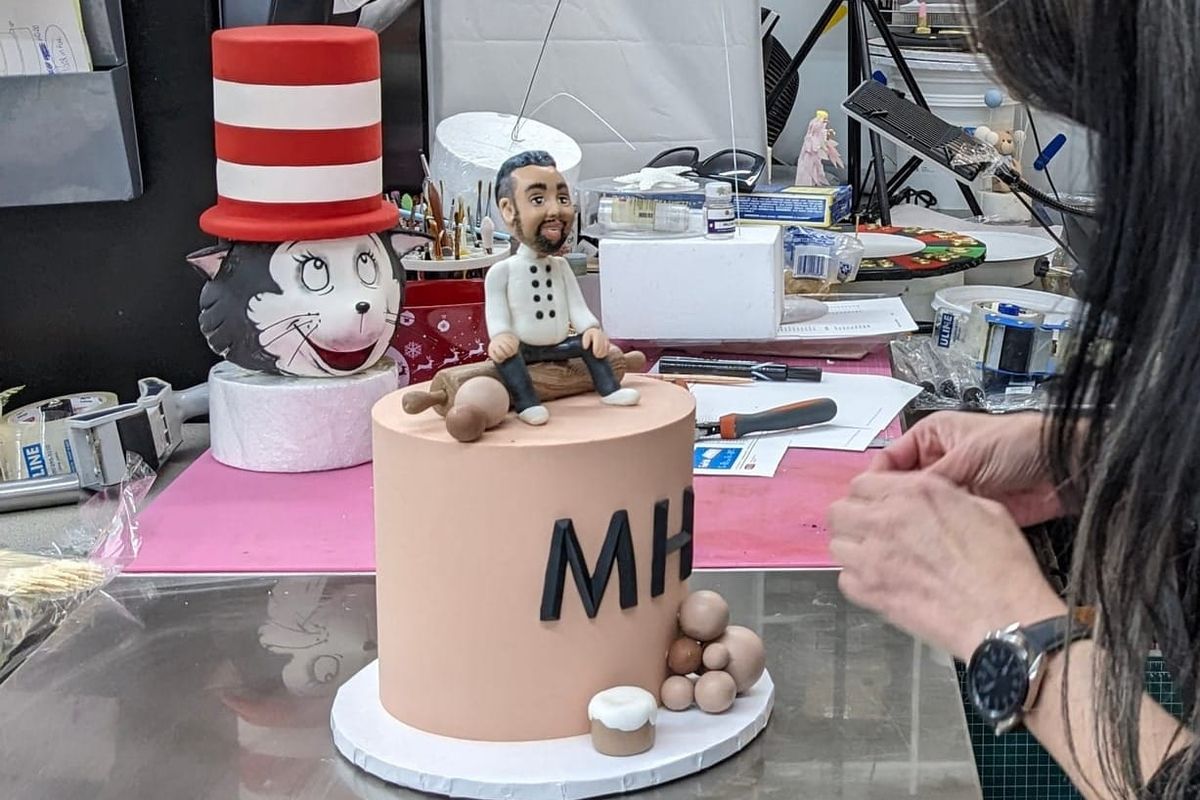
Custom cake pricing means quoting a price before the cake exists. Because ingredients are the small cost and decorating hours are the big one, the reliable method is to take whichever is higher — servings × your per-serving rate for that design tier, or your direct cost divided by your target percentage — and never go below your shop minimum. Decorations are priced by the hours they eat, not the materials they use.
Custom work is the opposite problem from your display case.
There, you make the cake and hope somebody buys it. Here, somebody buys it and then you find out what it takes. She said "something like this" and showed you a photo, you said a number, and three weeks later you're at the bench at eleven at night discovering that those ruffles are a four-hour job.
So four things are true about custom pricing that aren't true anywhere else in your shop:
- Ingredients barely matter. A $4 difference in filling is noise.
- Decorating hours are the entire bill.
- You commit to the price before you know the hours.
- Every single one is a little different.
Here's how to price it anyway.
This is one of three detailed guides. For the shared method and the two cost numbers underneath it, start with how to price cakes. Display cakes work differently — see how to price display cakes. Weddings have their own guide too: how to price wedding cakes.
What this guide answers
- How do I price a custom cake without losing money?
- What should I charge for a 6, 8 or 10-inch custom cake?
- How many servings are in each size?
- Do I need a minimum order, and what should it be?
- What's a fair price per serving?
- How do I charge more for a harder design?
- What do I charge for sugar flowers, fondant, gold leaf or hand-painting?
- Should I charge if the customer brings her own topper?
- How do I price a small cake with hours of detail on it?
- How do I price a cake I've never made before?
- How do I get my staff to quote the same cake the same way?
- Can I use AI to quote custom cakes?
Start by building one cake all the way down
Cost one real cake to the minute, at three sizes. Every rate, tier and minimum in this guide falls out of that one exercise.
Before you pick a method, cost one real cake to the minute. Everything else references this.
Here's the same simple buttercream custom cake at three sizes, at a $24/hour loaded baker, a $32/hour loaded decorator, and $22/hour for counter and admin time. (If you haven't built those rates yet, start with calculating labor cost per item.) Servings use the standard party portion of 1½" × 2" from the Wilton chart.
| 6" (12 servings) | 8" (20 servings) | 10" (28 servings) | |
|---|---|---|---|
| Ingredients | $6.00 | $9.50 | $13.50 |
| Board, box, dowels | $3.00 | $4.00 | $5.00 |
| Bake, fill, coat — minutes | 40 | 55 | 70 |
| Bake labor @ $24 | $16.00 | $22.00 | $28.00 |
| Decorating — minutes | 30 | 45 | 60 |
| Decorating @ $32 | $16.00 | $24.00 | $32.00 |
| Order handling — 30 min @ $22 | $11.00 | $11.00 | $11.00 |
| Direct cost | $52.00 | $70.50 | $89.50 |
| Price at 45% direct cost | $115 | $155 | $199 |
| Price per serving | $9.58 | $7.75 | $7.11 |
The $7.75 base rate and the $115 minimum used throughout this guide both come from this table. Change the rates and every number moves.
Three things fall out of that, and each one matters.
One: the order handling line
Thirty minutes per order. Taking the details, writing it up, answering the "could we do lavender instead" text, matching the inspiration photo to the order, handing it over at pickup.
That's real, it's the same whether the cake is six inches or fourteen, and most shops charge for it nowhere.
Two: small cakes cost more per serving
$9.58 on the 6-inch versus $7.11 on the 10-inch. That's not a mistake and it's not greed. The fixed work doesn't shrink when the cake does.
Three: this is where your minimum comes from
That $115 on the 6-inch isn't a number you picked to sound firm. It's what a real custom 6-inch costs to make plus the margin you need.
Your minimum is not a policy. It's arithmetic. And if yours is well under $100, this table is probably telling you why small orders feel like working for free.
Where this breaks: these are standard times for a competent decorator on a normal day. Time three real runs and use the middle one — not your fastest person, and not a training day. A cost build off your best hour prices every cake as if your best hour were typical.
Approach 1: Flat per serving
Multiply servings by one rate. Fastest to quote, and right for most of what you sell.
The industry standard, and the easiest thing to say on the phone.
Price = servings × your per-serving rate
From the table, the middle of the range is about $7.75 a serving. Hold a $115 minimum. Small cakes get protected by the minimum, big ones carry a little extra, and it evens out over a year.
For a market anchor: The Knot's 2026 Real Weddings Study puts the average US wedding cake at $540 (The Knot) — about $5.40 a serving on a 100-serving cake, including grocery-store and sheet-cake weddings. Custom decorated work sits well above that.
Use it for: phone quotes, your website, anything where you need to answer fast. Customers grasp per-serving instantly and it makes shapes and tiers comparable.
Where it breaks: a 6-inch with seven hours of sculpting. Twelve servings times anything won't cover seven hours. Fixed below.
Approach 2: Per serving × complexity tier
Keep one base rate and multiply it by how hard the design is — roughly 1.0× to 2.2× across four named tiers.
Now bring in style and amount of decoration. Same base rate, multiplied by how hard the design is.
Write down four or five tiers and name them so your team and your customers can see the difference:
| Tier | What it looks like | Multiplier | Per serving |
|---|---|---|---|
| 1 — Simple | Smooth or rustic buttercream, a border, a written message | 1.0× | $7.75 |
| 2 — Detailed | Textured finishes, drips, sprinkle work, fresh flowers, simple piping | 1.3× | $10.00 |
| 3 — Advanced | Fondant, sharp edges, hand-piped detail, some sugar work, multiple tiers | 1.7× | $13.00 |
| 4 — Custom art | Sculpted elements, hand-painted, structured, heavy sugar flowers | 2.2× | $17.00 |
| 5 — Showpiece | Carved, engineered, competition-level | Quote by the hour | — |
Multipliers apply to the $7.75 base from the table above. These are a starting shape, not a standard — validate each tier against your own hours.
Always check a tier against real hours. A 12-inch round at Tier 3 is 40 servings × $13 = $520. Actual direct cost — $19 ingredients, $6 packaging, 85 minutes of bake at $24, 4.5 decorator hours at $32, $11 handling — comes to $214. That's 41% direct cost, right where you want it. The tier holds.
Tiers also do something a flat rate can't: they let the customer choose the price. "I can do that design at $520, or the buttercream version of the same idea at $310" is a far better conversation than "no."
Set the tiers with photos. Four pictures on a page beats four paragraphs. She'll point.
Where this breaks: a multiplier scales with servings, but decorating hours don't. On a big simple cake the tier overcharges a little; on a small elaborate one it undercharges badly. That's what the greater-of rule is for — always check the tier price against the real hours before you send it.
Approach 3: Base price by size + add-ons
Set a base for a plain filled-and-frosted cake at each size, then itemize everything that goes on top of it.
Instead of a multiplier, set a base for a filled and frosted cake at each size, then charge separately for everything else.
| Size | Base (filled, frosted, plain finish) |
|---|---|
| 6" | $115 |
| 8" | $155 |
| 10" | $199 |
Then the decoration menu below, plus the extras that aren't decoration at all:
| Non-decoration add-on | Price |
|---|---|
| Premium ingredients (real vanilla, imported chocolate, seasonal fruit) | $10–$25 |
| Rush order (under 72 hours) | +25% |
| Delivery | by mileage |
| Second design revision and beyond | $25 |
This is where a lot of experienced custom bakers land, and it has one real advantage: the customer sees exactly what she's paying for. "Why is it $260?" becomes a list instead of an argument.
The catch is discipline. Every add-on has to actually make it onto the order before the cake is made. If your orders have a notes field where "she also wants gold leaf" goes to die, you'll do that work for free no matter how good your menu is.
The decoration menu: price the hours, not the stuff
This is the heart of custom pricing, and it's where most price lists are guessing.
Here's the thing that reorders everything once you see it: decorations don't cost what they look like they cost. They cost hours.
A fresh peony on top of a cake looks expensive and costs you thirty dollars of flowers and forty minutes. A sugar peony looks the same in a photograph and costs you a dollar fifty of gumpaste and an hour of a skilled decorator's life.
Sort by material versus time and the price list writes itself:
| Decoration | Material | Your time | Direct cost | Charge |
|---|---|---|---|---|
| Customer-supplied toy or figurine | $0 | 8 min | $4.27 | $10 (handling) |
| Toy or figurine you source ($12 item) | $12.00 | 10 min | $17.33 | $38 |
| Edible image / photo print | $4.00 | 10 min | $9.33 | $20 |
| Chocolate or caramel drip | $1.50 | 12 min | $7.90 | $18 |
| Airbrush or stencil work | $2.00 | 25 min | $15.33 | $34 |
| Textured buttercream finish | $2.00 | 25 min | $15.33 | $34 |
| Full piped rosette or ruffle coverage | $3.00 | 45 min | $27.00 | $60 |
| Isomalt sail or sugar glass | $3.00 | 45 min | $27.00 | $60 |
| Fondant cover, smooth (8") | $8.00 | 50 min | $34.67 | $77 |
| Fondant sharp edges (on top of cover) | $1.00 | 25 min | $14.33 | $32 |
| Fondant appliqué or cut-outs | $4.00 | 40 min | $25.33 | $56 |
| Delicate fondant — ruffles, pleats, draping | $12.00 | 3 hrs | $108.00 | $240 |
| Royal icing — lace, string, brush embroidery | $1.50 | 1.5 hrs | $49.50 | $110 |
| Hand-painted design | $3.00 | 2 hrs | $67.00 | $149 |
| Gold leaf (real) | $15.00 | 30 min | $31.00 | $69 |
| Sugar flower — small filler, each | $0.40 | 15 min | $8.40 | $19 |
| Sugar flower — large focal (peony, rose), each | $1.50 | 60 min | $33.50 | $74 |
| Silk / faux flowers ($18 of stems) | $18.00 | 20 min | $28.67 | $64 |
| Fresh flowers — you source, condition, wrap | $30.00 | 40 min | $51.33 | $114 |
| Fresh flowers — florist delivers, you place | $0 | 25 min | $13.33 | $30 |
| Sculpted 3D topper | $5.00 | 2 hrs | $69.00 | $153 |
| Each tier above the first | $6.00 | 30 min | $22.00 | $49 |
Every charge is (material + decorator time at $32/hour loaded) ÷ 45%. Put in your own rate and your own minutes, but keep the structure.
What that table is really telling you
Royal icing and delicate fondant are the most underpriced things in this industry. Look at the material column. A dollar fifty of royal icing. Twelve dollars of fondant. Nothing. And they eat ninety minutes, three hours, five hours. There's no ingredient cost to point at, so decorators discount them by instinct and then wonder where Saturday went.
Sugar flowers are a labor product in a floral costume. Seventy-four dollars for one large sugar peony sounds outrageous until you watch someone make one. Price them individually and per flower, never "flowers, $60." A cascade of eleven is eleven hours.
Fresh flowers are the reverse. Most of the cost is the flowers and the time is modest — but only if the customer's florist delivers them. The moment you're sourcing, conditioning, wiring and food-safe wrapping, you've bought yourself a $114 job. Offer both and let her choose.
Silk flowers sit in between and are worth offering: no seasonality, no wilting, and she keeps them.
Toys and figurines are almost free to you, and that's fine. A customer bringing her own figure costs you eight minutes. Charge a small handling fee and move on. Two notes: anything non-food-safe needs a barrier between it and the cake, and if you're sourcing the item, mark it up like retail — you're carrying the shopping, the cost and the risk it arrives broken.
Every tier above the first is real money. Boards, dowels, structure, leveling, and the fact that a stacked cake is slower to move and slower to box. Forty-nine dollars a tier minimum, before any decoration goes on it.
Where this breaks: the menu prices each decoration in isolation, but decorations interact. Fondant plus sharp edges plus hand-painting on one cake takes longer than the three added together, because each has to wait for the last to set. On a heavily layered design, price the hours directly rather than totalling the menu.
Two rules for using a decoration menu
Quote per piece, not per cake. "Sugar flowers" is not a line item. "Three large sugar peonies and seven filler blooms" is. The first loses money; the second prices itself.
The menu has to be on the order. Every decoration your team agrees to has to end up on the actual order, priced, before the cake gets made.
Approach 4: Decorator hours
When no tier fits, price the hours directly: ingredients plus bake time plus decorator time, divided by your target.
Some cakes fit no tier. The three-tier structured cake for a 40th. The carved guitar. The one she found on Pinterest that nobody should have posted.
For those, price the hours:
Price = (ingredients + packaging + bake hours × baker rate + decorator hours × decorator rate + delivery) ÷ target percentage
Or run a flat studio rate — an all-in number per decorator hour that already carries overhead and profit, usually somewhere in the $75–$110 range depending on your market, plus materials at cost × 1.5.
The hard part isn't the formula, it's estimating hours honestly. Two habits fix it:
- Log actual decorating time on every custom cake for sixty days. Start and stop, written on the order. You'll be shocked, and then you'll be accurate. This is the same discipline behind standard labor minutes — set the time a competent decorator takes on a normal day, not your fastest hour.
- Add 25% to your first estimate on anything you've never made. You will use it.
Where this breaks: hourly pricing punishes you for getting faster. As your decorator's skill improves, the same cake quotes lower — which is backwards. Set a standard time for designs you repeat and price those off the tier table. Save hourly for genuine one-offs.
The rule that ties it all together
Here's the one thing to take from this guide. Don't pick a single method — pick a rate and a floor, and take the higher number.
Price = MAX(servings × tier rate, direct cost ÷ target), floored at your minimum
Price = the greater of: (a) servings × per-serving rate for that tier, or (b) direct cost ÷ your target direct-cost percentage — and never below your shop minimum.
Watch it work on the cake that breaks everything else. A 6-inch, Tier 4, seven hours of sculpting:
- (a) 12 servings × $17 = $204
- (b) direct cost is $6 ingredients + $4 packaging + $16 bake + $224 decorating + $11 handling = $261. Divided by 45% = $580
Quote $580. Not $204.
If $580 is more than she wants to spend — and it might be — now you have a real conversation instead of a loss. Move her to a 10-inch at Tier 3 for $364. Simplify the sculpting to a topper. Or let it go, politely.
The $204 quote is the one that hurts you. You'd have worked seven hours, lost money doing it, and been too busy that week to take the wedding cake that would have paid.
Where even this breaks: the greater-of rule protects your margin, not your calendar. A cake can clear your target and still be a bad booking if it eats the Saturday you needed for three others. When you're at capacity, check what each job earns per decorator hour, not just whether it hits 45%.
A price list is only worth what actually gets quoted
Here's the honest problem with everything above.
You've now got a per-serving rate, four design tiers, a twenty-two line decoration menu, a minimum, and a greater-of rule.
Now picture Saturday at ten in the morning. There's a queue, the phone's going, and somebody at the counter says my daughter wants a unicorn cake for the 22nd, about thirty people.
Whoever fields that has to hold your entire rate card in their head, in ninety seconds, in front of a line. They won't. Nobody would. So one of three things happens:
They guess low. Round number, sounds about right. The sugar flowers never make the order. Neither does the third tier. You find out Friday.
They say "let me check with Maria." Now you're the bottleneck on every quote in the building, and Maria is elbow-deep in buttercream.
Two people quote the same cake differently. One says $260, one says $340, and eventually those two customers meet.
None of that is a pricing problem. Your prices are fine. It's a quoting problem, and it's why shops do this exercise, feel good for a month, and slide back to guessing.
There's a timing half too. Your customer messages when she thinks of it — bath time, the drive home, half nine at night scrolling Pinterest. If your answer lands Tuesday, she's already asked two other bakeries and you'll never know she was there. Silence is friction too, and friction is quiet — nobody tells you they went elsewhere.
So a quote has two jobs your price list can't do alone: be consistent no matter who answers, and be available when nobody's answering.
The fix for the first is putting the rate card somewhere it applies itself — the spec gets built, the price falls out, the decoration menu gets charged because it's on the screen, the minimum holds because the system holds it. The real win isn't speed. It's that the person answering the phone no longer has to be you: a new hire quotes the same cake at the same price as your head decorator, in week two.
The fix for the second is letting the obvious ones answer themselves. A photo of a two-tier buttercream with a drip and some flowers, thirty people, three weeks out is a Tier 2 cake at a size you make constantly, and your rate card already has one right answer for it.
That's where BakeStreet's Cake Builder and AI Quote fit. Cake Builder is the rate card made operational — your team builds the spec, the system prices it from your numbers. AI Quote goes further: the customer sends an inspiration photo or describes what she wants, and it reads the design, works out size and complexity, and returns a price from your rate card at nine at night without pulling anyone off the bench.
Two caveats, because they're the difference between this working and not. A quote tool doesn't set your prices — it applies the list you built, so a low rate or a guessed decoration menu just gets automated faster. And keep a human on the hard ones: showpieces, structural builds, anything you've never made. The value is taking the routine eighty percent off your bench so you have time for the twenty percent that needs you.
Custom cake pricing FAQ
How do I price a custom cake?
Take whichever is higher: servings × your per-serving rate for that design tier, or direct cost ÷ your target percentage. Never go below your shop minimum. The two-route rule protects you on the cakes per-serving math gets wrong — small cakes with enormous decorating hours.
How much should a custom cake cost per serving?
There's no single number — it depends on your wages, your design complexity and your market. Built from a real cost, a simple buttercream 8-inch serving 20 comes to about $7.75 a serving at a 45% target. For a national anchor, The Knot's 2026 study puts the average US wedding cake at $540, roughly $5.40 a serving including grocery-store cakes. Custom decorated work sits above that.
How many servings are in a 6, 8 or 10-inch cake?
At the standard party portion of about 1½" × 2": a 6-inch round serves 12, an 8-inch serves 20, a 9-inch serves 24, a 10-inch serves 28, a 12-inch serves 40. Wedding portions are smaller, about 1" × 2", so the same 10-inch serves 38. A 9" × 13" sheet gives 36 party servings.
Do I need a minimum order for custom cakes?
Almost certainly. Every custom order carries fixed work that doesn't shrink with the cake — the consult, the write-up, the photo matching, the pickup. On a small cake that can be a third of the job. Cost out your smallest real custom cake, divide by your target percentage, and that's your minimum. For many shops it lands north of $100.
How do I price a small cake with hours of detail on it?
By the hours, not the servings. A 6-inch sculpted cake with seven hours of decorating comes to about $204 on per-serving math and about $580 on hours. Quote the $580. If that's out of range, offer a larger cake at a simpler tier, or simplify the sculpting to a topper — but don't quote the $204 and work a Saturday for free.
How do I price cake decorations?
By the hours they take, not the materials they use: (material + decorator minutes × your loaded decorator rate) ÷ your target percentage. A chocolate drip is twelve minutes and prices around $18. Royal icing lace is ninety minutes of skill on a dollar fifty of material and prices around $110. Decorations that look expensive and decorations that are expensive are rarely the same ones.
How much should I charge for sugar flowers?
Per flower, and by size. A small filler bloom is about fifteen minutes and prices around $19. A large focal peony or garden rose is closer to an hour and prices around $74 at a $32 loaded decorator rate. Never quote "sugar flowers" as one line — a cascade of eleven is eleven hours, and counting them is the only honest way to charge.
Should I charge if the customer brings her own topper or figurine?
A small handling fee, usually $10 to $15. It's only a few minutes, so don't overreach, but it isn't free either. Anything not food-safe needs a barrier between it and the cake. And if you're sourcing the item, mark it up like retail — you're carrying the shopping, the cost and the risk it arrives broken.
How do I price a cake I've never made before?
Estimate the decorating hours, then add 25%. You will use it. And log the actual time on the order when you're done — sixty days of real times will make you accurate in a way no guess will.
Should I charge for the consultation?
If it's a real sit-down consult with a sketch at the end, yes — or build it into your minimum so it's covered whether you itemize it or not. What you shouldn't do is give away an hour, three rounds of revisions and a tasting box and then price the cake as if none of that happened.
What should I charge for a rush order?
A common approach is +25% inside 72 hours. It isn't punishment — it's what it costs to reshuffle a production schedule that was already full, and it gives you a reason to say yes instead of no.
How do I get my staff to quote cakes consistently?
Take the rate card out of their heads. A per-serving rate, four tiers, a decoration menu and a minimum is more than anyone can apply accurately at the counter on a Saturday morning with a queue.
The fix is to make the spec the input and the price the output. Your team picks size, portion, tier, decorations and delivery, and the number falls out — so the decoration menu gets charged because it's on the screen, and the minimum holds because the system holds it.
That's what BakeStreet's Cake Builder is: your rate card, made operational at the counter. You set the rates once; anyone can quote from them. A new hire gives the same number as your head decorator in their second week, and you stop being the bottleneck on every quote in the building.
Whatever you use, the test is the same. If two people in your shop can quote the same cake differently, eventually those two customers will meet.
Can I use AI to quote custom cakes?
For the routine ones, yes. A customer sends an inspiration photo or describes what she wants, and the system reads the design, works out size and complexity, and returns a price built from your own rate card — not a generic estimate.
The reason it matters isn't speed for its own sake. It's that most custom enquiries arrive when no one is at the bench: bath time, the drive home, half nine at night. If your answer lands Tuesday, she's already asked two other bakeries. AI quoting closes that gap without putting a staff member on call.
BakeStreet does this with AI Quote — it reads the photo or the description, sizes the cake, judges the complexity, and prices it against the rates, tiers, decoration menu and minimum you've set. Its companion, Cake Builder, is the same rate card for your team: they build the spec at the counter and the price falls out, so a new hire quotes the same cake at the same number as your head decorator.
Two limits worth knowing before you turn anything on. It applies the price list you built, so it can only be as good as your rates and decoration menu — do the work in this guide first, or you'll just automate a low number faster. And showpieces, structural builds and anything you've never made should still route to a person. The point is taking the routine eighty percent off your bench so you have time for the twenty percent that needs you.
Sources
- Wilton — Cake Baking and Serving Guide. Round cake servings: 6" = 12, 8" = 20, 9" = 24, 10" = 28, 12" = 40 party servings. Party portions ~1½" × 2"; wedding portions ~1" × 2".
- The Knot — Real Weddings Study, average wedding cost. Average US wedding cake $540 (2026 study).
- US Bureau of Labor Statistics — Occupational Outlook Handbook: Bakers. Median pay $17.86/hour, May 2025.
- US Bureau of Labor Statistics — Employer Costs for Employee Compensation, March 2026. Private industry benefits 30.1% of total compensation.
- Internal Revenue Service — Topic No. 751, Social Security and Medicare Withholding Rates. Employer share 7.65%.
Figures current as of September 2026. All examples use a $24/hour loaded baker rate, a $32/hour loaded decorator rate, a $22/hour counter rate and a 45% direct-cost target — substitute your own.