AI Cake Requests: How to Handle the Photo and the Long Description
A practical guide for custom cake bakeries. Every shop mentioned is named, linked and dated at the bottom, and quoted from a post they published themselves.
Quick answer
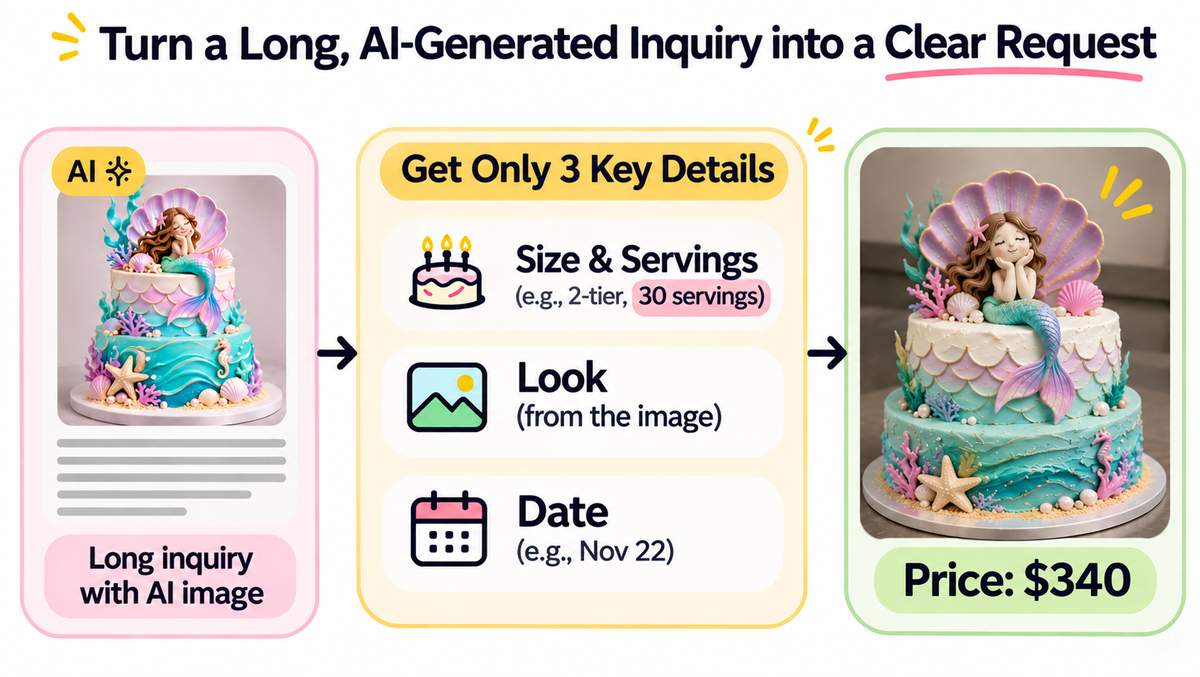
When an inquiry arrives with an AI-generated picture and a very long description, treat the picture as inspiration rather than a blueprint, and reduce the description to three points: size & servings, the look you are taking from the image, and date. Send those three points and a price in the same message, then answer the specific questions that come back. To make the inquiry easier at the source, cap the description field on your form at around five hundred characters and ask for four facts: date, servings, inspiration photo, and a budget range.
The rest of this is the detail, the wording, and what other bakeries have said about it.
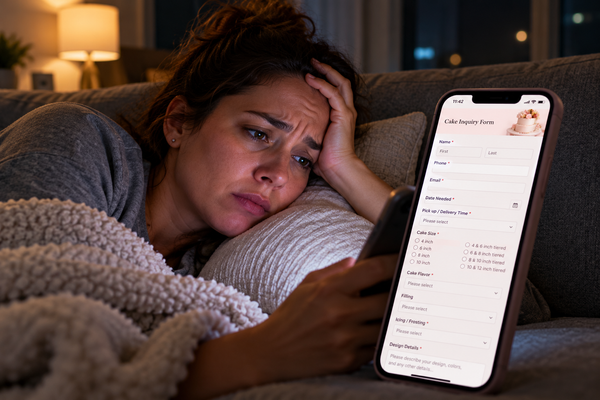
It's half nine at night and there's a new inquiry in the inbox.
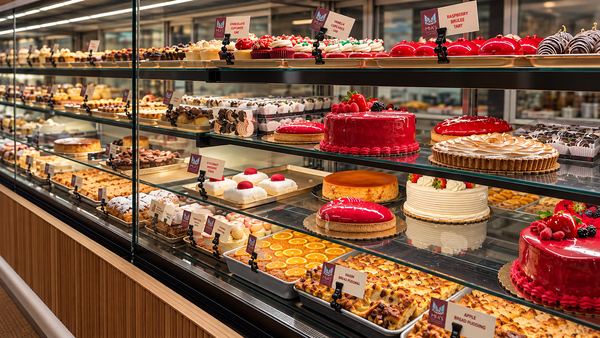
The photo is lovely. Three tiers, a mirror finish, sugar roses that appear to hang in mid air, a ribbon of caramel curling off the side with nothing beneath it.
Underneath, six paragraphs. The cake should be moist and delicious. The flavor should feel warm and nostalgic. Somewhere in the fourth paragraph there's a serving count, and further down, a date.
You read it twice looking for a budget. There isn't one.
What's actually arriving
Two things have changed at once: the picture may not show a cake anyone has baked, and the wording may not be the customer's own.
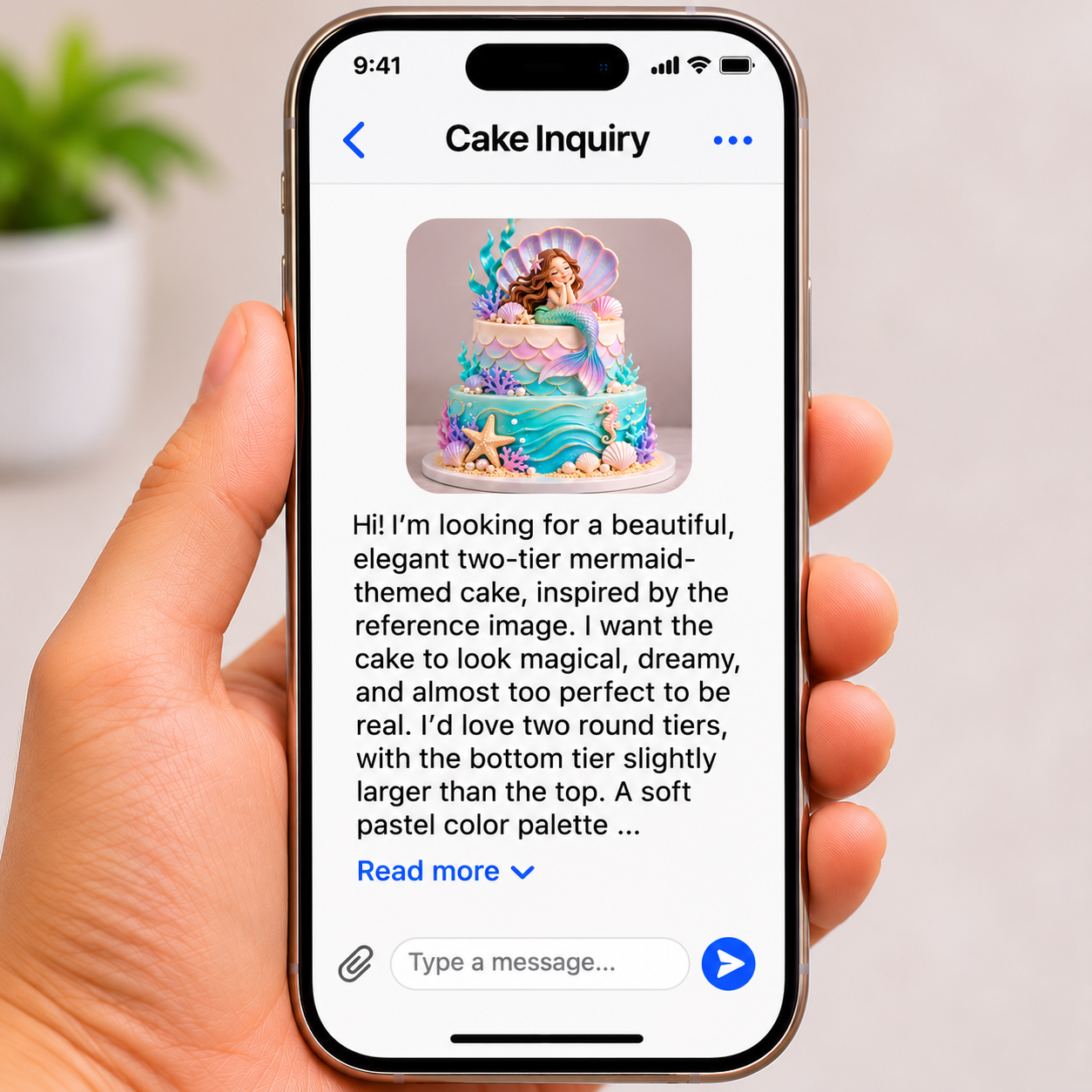
The image comes from a tool that doesn't have to account for gravity, structure or what buttercream does at 85 degrees. Fondant can't float and buttercream doesn't shine like glass, but the pictures are convincing enough that experienced decorators say they sometimes have to look twice. A customer looking at one has no particular reason to doubt it.
The description is the second half. A few lines typed into a chatbot can come back as eight hundred words, and most of that wording belongs to the tool rather than to her. She sends it because it looks thorough and she wants to give you what you need.
Both halves come from the same place: someone trying to be a good customer with the tools in front of her. The reply works better when you start there.
What bakeries have said about it
Shops in the United States and the United Kingdom have described this publicly over the past year, which is how most owners discovered it wasn't only happening to them.
Instagram post from Anges de Sucre: "The harsh truth about why we are turning away customers with AI briefs"
Screenshot of a long AI-written cake brief with the caption "How many words do we have to read to be told nothing?"
AI-generated 80th birthday cake with football crests and a London skyline, captioned "If you could just write to your cake maker asking for an elegant 80th cake with some football club stuff, London stuff, and a Big 80, I guarantee you they would come up with something MUCH nicer"
Four slides from one carousel by Reshmi Bennett, founder and head chef at Anges de Sucre, London.
Bennett set out her reasons in that post: briefs that run to several screens, designs that can't be built in sugar, and the hours the reading takes. The example widely reported was a 784 word WhatsApp brief for a two tier 13th birthday cake serving ten, with a £100 budget. She has floated a minimum of £1 per word for AI written briefs, and she asks instead for four facts: location, date, budget and servings. Her summary of the problem is an operational one. "Reading is time, and I have to spend time dealing with enquiries." Her fourth slide is worth sitting with on its own: an elegant 80th, some football club details, some London details, a big 80. In her view the customer's own short version would have produced the better cake.
Facebook post from The Parlor Bakery & Cafe announcing it will no longer accept AI-generated cake inspiration images Dustin Todd Rennells, The Parlor Bakery & Cafe, Chillicothe, Missouri, 5 November 2026.
The Parlor Bakery & Cafe took a different route and said it would stop accepting AI-generated inspiration images, explaining that AI suggests flavors and fillings the shop doesn't carry and details no hand can produce, and that the customer is the one left disappointed. The post offers an alternative for anyone who still wants that look: solid color cakes at a reduced rate, with a topper the customer brings. "Buttercream is unforgiving," it reads, "and we are doing our absolute best to make something pretty for your special occasions."
Instagram post from Bake-A-Licious Cheshire: "I'm sick of seeing bakers using AI to alter their cake photos. Customers should be able to see the cake you actually made, including its finish, proportions and details." Rhian, Bake-A-Licious Cheshire.
Rhian raised the other side of it, about cake photos retouched with AI before they go on a grid, and asked that customers be able to see the cake as it was actually made, finish and proportions included. Rebecca Cook at Becca's Bouqcakes in Bristol has written about the same thing, describing images with flawless edges and textures that don't occur, and the small businesses left to account for the difference.
Different shops, different answers. What follows is one way of working through it, offered as an option rather than as a verdict on anybody's.
Where the time goes
The cost of a long brief is in the reading and the delay rather than in the baking.
Eight hundred words takes four or five minutes to read properly. Then you work out which parts bear on the price, then you write back for the two details it didn't cover. She answers tomorrow, you quote the day after, and by then she may have booked whoever replied within the hour. Repeat that eight times a week and the reading alone is half a day.
The natural response is to work through the brief point by point, settle every detail, then quote. It's a conscientious approach and it's the slow one. It turns a single inquiry into a long thread, and threads cool.
The document is closer to a mood board than to a specification. That's the useful way to read it.
How to quote it: three points and a price
Reduce the brief to the three things that change the cake or the price, send those three points and the quote together, and answer whatever comes back.
Step one. Use the picture as inspiration, and say so. No argument with the image, and no explanation of the technology. You'll take it as the reference for the look and build your version.
Step two. Pull out three points. Only three:
- Size & servings
- The look you're taking from the picture
- The event date
The rest of the wording either restates one of those or doesn't affect the cake.
Step three. Send the summary and the price in one message. Not the summary, then approval, then a price. The price is what earns a reply.
Step four. Let her correct you. Three lines to check is a different ask from eight hundred to re-read. If a point is wrong she'll say so in a sentence.
Send a digital quote with payable link
Thanks for all that detail, it really helps. One note on the picture: it looks like it may have been AI generated, so the floating ribbon and that mirror shine aren't things real cake can do. It's a lovely reference though, and I'd like to use it as the inspiration and build you my version of that look.
Details:
Two tiers, serving about 30, so 6 inch on 8 inchDusty blue and gold, smooth buttercream finish, fresh flowers in place of the sugar onesPick up Saturday the 14th, choose your flavors in checkout
Price $340.
If I've got any of those three wrong, just tell me which one. And if there's something specific in your notes you'd like me to look at, point me at that part and I'll answer it.
That last line matters. It invites a question rather than a second copy of the document.
How to answer when a design can't be made
Say what's good about the image, name only the parts that can't be built, and offer the version you can make in the same message.
She isn't testing you. She came up with something beautiful and had no reason to think it can not be made. Being told it's fake can land like being told she has poor taste, which is a difficult feeling to move past mid conversation.
So the order helps. Say what you like about the image, specifically, because that shows you looked. Name the one or two elements that don't translate into sugar. Then give the alternative straight away. "That flame detail can't stand up in buttercream, but I can airbrush the fade and build the flames in wafer paper so it still reads from across the room."
Two photos of your own work alongside the quote do the rest. Real cakes, real light.
Reducing it at the inquiry form
A character limit on the description field and four short questions will do more than anything you write afterwards.
Cap the description box at four hundred to six hundred characters, roughly eighty to a hundred words, with the counter visible as she types. That's room to describe a cake, and the counter is what prompts someone to get to the point. Let the helper text work too: tell us the occasion, the size, and anything that has to be on it, and a photo helps more than a paragraph.
Ask for the three facts that set the price. Event date, servings, and a budget range. Three fields tell you more than eight hundred words and take about ten seconds.
If you want to state a position
There are three workable approaches, and the right one depends on what you can hold to.
Say nothing, and handle it inquiry by inquiry. Most shops are here. It costs reading time and nothing else.
Set the expectation in one line on the inquiry & quote. Something like: we'll use any picture you send as inspiration rather than as a copy, since a lot of cake images online are AI made and can't be baked as shown. It travels ahead of the conversation and nobody has to be told no.
Decline AI images, and say where else to go. This fits a shop whose identity is handmade work. The part that makes it work is the alternative, because the customer who doesn't know her picture is AI needs somewhere to land rather than a rule she thinks she's broken.
All three are being used right now by shops doing good work. Pick the one that matches how you'd want to be read on a Tuesday night.
A note on your own gallery
What a bakery posts becomes the reference the next customer brings in. That's the practical argument for a gallery of cakes exactly as they were made, finish and all: it's the clearest thing you own to show what a real cake looks like, and it's the easiest thing to send when an AI picture arrives.
Questions bakery owners are asking
How do I know if a customer's cake photo is AI generated? Look at edges and repeats: piping identical the whole way round, text that almost spells a word, flowers with no stems, a tier with no visible support. Don't spend long on certainty. The reply is the same either way: that's the inspiration, here's my version, here's the price.
What do I say when a customer sends a design that can't be made? Compliment the image specifically, name only the elements that can't be built in sugar, and offer your alternative in the same message. Keep the explanation of the technology short.
Should I quote before she confirms my summary? Yes. The quote is what earns a reply, and a wrong point gets corrected in a sentence.
How long should a custom cake inquiry form let someone write? Four hundred to six hundred characters in the description field with a visible counter, plus four short fields for date, servings, collection or delivery, and budget range.
A customer sent a very long brief and a small budget. Is it worth replying? Yes, once, with the three points and your honest starting price. A long brief with a small budget usually means a first time buyer who hasn't bought a custom cake before. Many say yes to a smaller version of the same idea.
Should I discount to meet a budget the picture doesn't match? That's your call, and it's worth knowing what you're deciding. The gap between the image and the budget came from a tool, not from either of you. A smaller cake made properly tends to leave everyone happier than a large one made to a number.
The short version
A photo and a long description aren't a brief. They're raw material, sent in good faith.
Use the picture for the look. Take three points from the words. Send the summary and the price together. Answer the specific question rather than the whole document.
Then put a character counter on that text box.
How this was put together
Every bakery here is named, and every point is linked to that baker's own post or to published reporting. Nothing has been combined into a composite example, and no customer is named or identifiable. The shops quoted have each taken a different approach, and none of them is being held up as the right or wrong one.
Sources
- Anges de Sucre, Instagram, November 2026
- The Parlor Bakery & Cafe, Facebook, 5 November 2026
- Bake-A-Licious Cheshire, Instagram, October 2026
- Baker charges $1 per word of AI-made cake requests after receiving 784-word brief, The Cool Down, October 2026
- AI cake photos are creating unrealistic expectations for bakers, Becca's Bouqcakes, May 2026