How to Run a Wedding Cake Tasting and Consultation
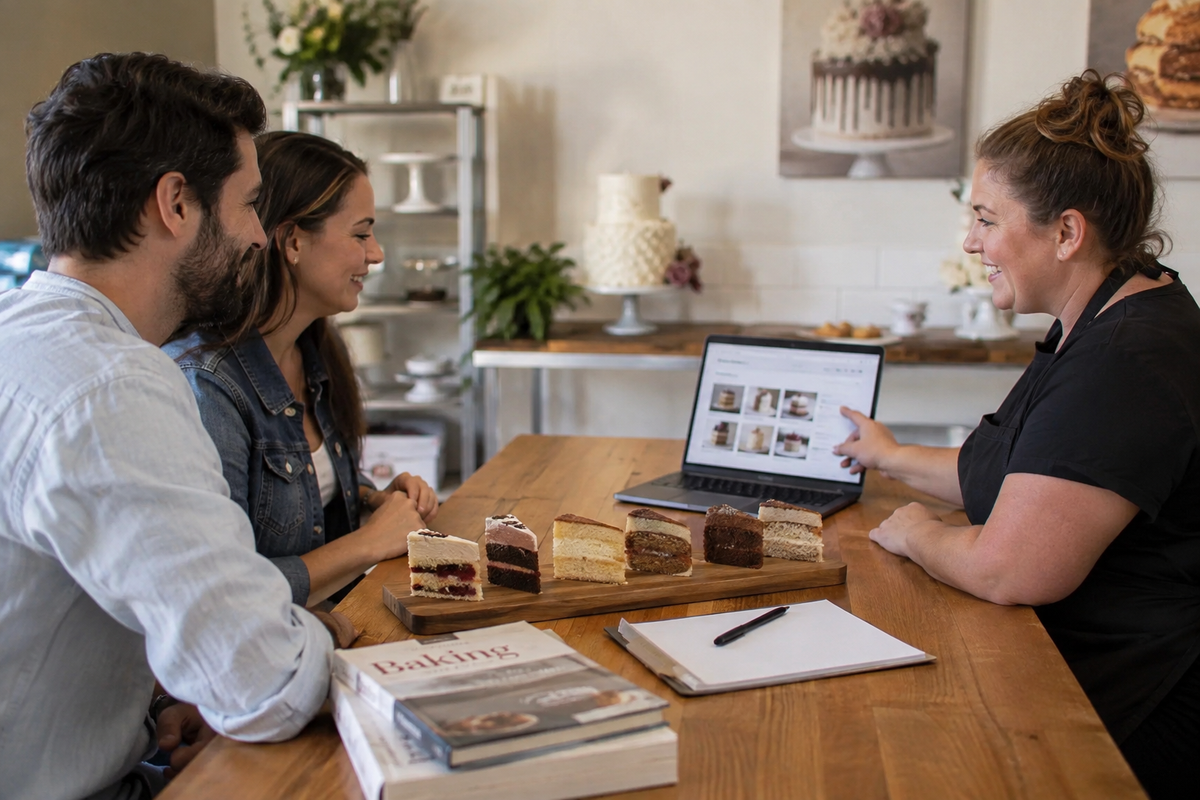
A wedding cake tasting and consultation is a 45–60 minute appointment where a couple tastes a set of your flavor combinations and leaves with a design, a price and a booked date. It should be scheduled within days of the inquiry when the wedding is 3–8 months away, held in the evening or at a weekend, offered in person or by video call with a shipped tasting box, and run as a guiding session rather than a question-and-answer session. Done properly it ends with a signed order and a deposit, not with a follow-up email.
Here's the part most bakeries get backwards.
Customers are not paying you for the cake at the tasting. They won't eat that cake for another six months. They are paying for how you made them feel in that hour, whether they walked out relieved or walked out with more questions than they came in with.
Your photos and reviews got them in the door. Every good bakery in your town has photos and reviews. What they don't have is your hour.
This guide is about running the session and the messages around it. For what to charge, see how to price wedding cakes.
Wedding cake tasting best practices
Based on thousands of wedding cake orders processed through BakeStreet, here is what we recommend as a starting point for most bakeries.
| Question | Our recommendation |
|---|---|
| Tasting length | 45–60 minutes |
| Time from inquiry to tasting | Days, not weeks, for weddings 3–8 months out |
| Best times to hold them | Evenings and weekends, in two or three fixed windows |
| Flavors offered | 5–7 combinations that you choose |
| Tasting fee | Around $25-$50, charged at booking, credited to the order |
| Consultation questions | 5 core questions, asked already during inquiry |
| Quote timing | During the consultation, before they stand up |
| Deposit | 25–50%, taken at the table |
| Channel | Text mostly, payment and order confirmations on email |
| Automation | Messages set up once and sent automatically |
| Follow-up | Same-night recap text, within one to two hours |
| Virtual option | Shipped or pickup tasting box plus a video consultation |
| Messages after booking | About six, all initiated by you |
Every one of those is explained below, including where it doesn't apply.
What this guide answers
- Best practices at a glance
- What is a wedding cake tasting and consultation?
- How soon after an inquiry should the tasting happen?
- When can a tasting wait?
- What time of day should I schedule wedding tastings?
- How do I stop losing couples in the back-and-forth?
- Should couples book and pay for the tasting online?
- The bride and groom live in different towns — now what?
- Should I offer virtual wedding cake tastings?
- What does the whole communication lifecycle look like?
- How many flavors should I offer?
- What questions should I ask before consultation?
- What does a guiding session sound like?
- How fast should I get them a price?
- How do I close the booking at the table?
- Sales tips for wedding cake consultations
- What to do and what not to do
What is a wedding cake tasting and consultation?
It is one appointment doing two jobs at once. The tasting proves you can bake. The consultation proves you can be trusted with the day. The second one is what gets booked.
A good session has six parts, in this order:
| # | Part | Roughly |
|---|---|---|
| 1 | Welcome, and tell them how the session will run | 3 min |
| 2 | Taste 5–7 finished flavor combinations | 15 min |
| 3 | Five questions confirmed — date, location, servings, design, budget | 5 min |
| 4 | Your recommendations, out loud, with reasons | 15 min |
| 5 | The price, the sketch, and the whole timeline | 10 min |
| 6 | Deposit and booking | 5 min |
Notice that the biggest block is you talking, not them deciding. That's the whole method.
What it should produce, every time: a chosen flavor, a design direction, a written price, a payment plan they can actually manage, and a date on your calendar.
How soon after an inquiry should a wedding cake tasting happen?
Book the tasting by how far away the wedding is, not by when your calendar happens to open up. For weddings 3–8 months out, that means the next slot you have — days, not weeks.
A four-week wait for a tasting is not a scheduling decision. It's an answer. It tells a couple you're busy, which they'll read as she doesn't need my wedding.
But it isn't the same for every inquiry. Sort them by the date:
| Wedding is… | Book the tasting… | Why |
|---|---|---|
| 12+ months out | Whenever suits you both. Weeks out is fine. | Nothing is decided yet. Venue may not even be booked. |
| 8–12 months out | Within two to three weeks. | She's shopping, not deciding. Stay warm. |
| 3–8 months out | Next available slot. Days, not weeks. | She is booking vendors right now, in order. |
| Under 3 months | As soon as possible, or be honest that you can't. | Somebody let her down, or she's late. Either way, fast wins. |
The three-to-eight-month window is where cake actually gets booked. She has the venue. She has the dress. Cake is next on the list and she is working down it. Whoever answers first and sits her down first gets the deposit. Not because the cake is better, but because the list is long and she wants to cross something off.
The Knot's 2026 Real Weddings Study, which surveyed 10,474 US couples married in 2025, found couples hire 13 wedding vendors on average (The Knot). Thirteen. She is not waiting four weeks for one of them.
From BakeStreet's data. Across the wedding orders processed through BakeStreet, tastings held within 7-14 days of the inquiry convert to a booked cake over 60% of the time.
A real example. Mia's Bakery in New York had a simple problem: they were taking too long to respond to wedding cake inquiries. New inquiries were handled together on Mondays, which meant couples waited an average of three days for a reply and weeks for a tasting appointment.
The bakery changed the process. They started responding to inquiries the same day and created fixed time slots for cake tastings and consultations.
Nothing else changed. The cakes, pricing, and photos stayed the same. Inquiry volume stayed about the same, too. But orders increased.
The difference was speed. Couples could get answers and schedule a tasting sooner, so the bakery was no longer losing potential customers simply because another bakery responded first.
So what we recommend: for weddings three to eight months out, offer a tasting slot within seven days of the inquiry. If you can't hold that consistently, add one fixed evening window before you add anything else to your marketing.
Where this breaks: speed without room to do the work is worse than a wait. If your Saturday is a 200-serving delivery, don't jam a consultation into the gap. Offer Tuesday evening instead — an early slot at an odd hour beats a good slot a month out.
What time of day should wedding cake tastings be?
Evenings and weekends. Two working people are not coming in at 11 a.m. on a Wednesday. They'll say yes, then reschedule twice, then go quiet.
Pick two or three fixed windows a week and hold them. Tuesday and Thursday 6–8 p.m., Saturday afternoon. Fixed windows mean you bake tasting boxes once for the week instead of five times, and it stops tastings from eating the middle of your production day.
And send them a choice, not a question. "What works for you?" is homework. "Thursday at 6:30 or Saturday at 2 — which is easier?" is a booking.
How do I make the tasting easy to book?
Every message between "we'd love a tasting" and a slot on your calendar is a place a couple falls out.
Count the normal version. She messages Sunday night. You reply Tuesday with three times. She checks with him and replies Thursday asking about a fourth. You confirm Friday. Five days gone and nobody has tasted anything. Meanwhile the bakery across town had her booked Monday morning.
None of that is a busy problem. It's a booking problem, and it's fixable in an afternoon.
Put your evening and weekend windows on a booking link. She picks a slot herself, at eleven at night, in her pajamas, with him on the sofa next to her. It lands on your calendar. She gets a confirmation with the what-to-expect note already attached. Nobody sent a single message.
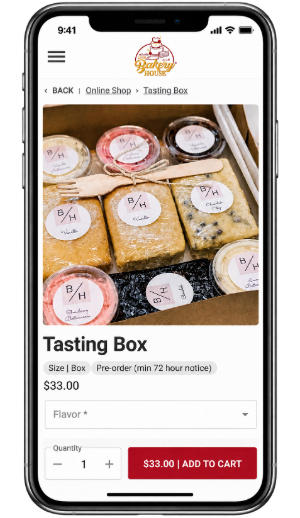
Put the tasting box in your online store as something she can just buy. Pick a flavor set, pick a date, pick pickup or delivery, pay. Now the out-of-town couple books itself at midnight instead of writing you an email you'll answer Thursday.
Take the tasting fee at the time of booking. Around $25, credited to the order. It costs a serious couple nothing and it all but ends no-shows — a slot somebody paid for is a slot somebody turns up to.
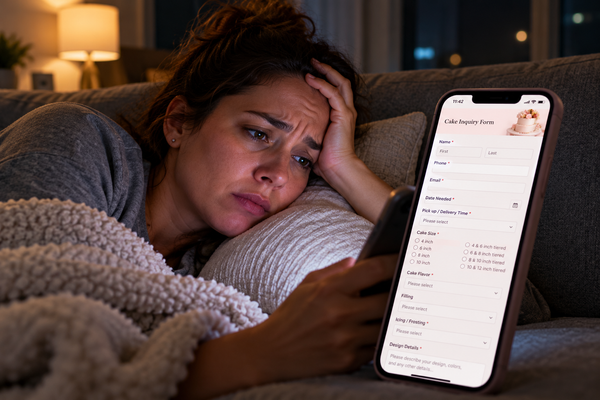
Ask your five questions on the inquiry form, not in the room. Date, location, servings, design, rough budget. Two minutes of typing for her, and you walk in already knowing what to recommend.
So what we recommend: for most bakeries, a good starting point is two weekday evening windows and one weekend afternoon, published on a booking link, with the tasting box also listed in your online store for couples who can't come in. Put the five questions on the inquiry form.
Where this breaks: a booking link with no real slots in it is worse than an email, because now she's been told no by a machine. Keep genuine availability in there, and when weddings are stacked, open one extra evening rather than letting the link run empty.
What if the bride and groom live in different towns?
Ask this. Because almost nobody does, and it changes everything about the session.
Where are the two of you actually located?
Because very often she's in one town and he's in another. They can both drive in for a tasting. They may even offer to. But you've just made two people rearrange a weekend for something that should have been easy.
So build a second path:
- A tasting box they buy online, shipped or dropped off. Same flavors, packed properly, labeled, with a card telling them which is which.
- A video call scheduled for right after it lands. Both of them, in their own kitchens, forks in hand.
- The same guiding conversation, screen shared, sketch on screen.
You can run the identical session over a video call. Nothing about the advice changes. And the couple who couldn't have made an in-person slot at all just became a booking.
In person still wins when it's easy. Nothing beats the room, the smell, the case, the boxes tied with ribbon. Offer it first. But always give the online option in the same breath, so nobody has to ask for it and feel like they're being difficult.
So what we recommend: put one line — "If you two aren't in the same town right now, just say — we ship the tasting box and do the whole thing on a video call." It costs you nothing and it recovers bookings you currently never hear about, because a couple who can't make it usually just goes quiet rather than asking.
Where this breaks: a shipped tasting box has to survive shipping. Buttercream doesn't travel the way a cake pop does. If you can't get it there in good shape, ship a smaller flavor set that does travel, and say so — a couple that opens a bruised box has already learned something about you.
The wedding cake communication lifecycle
A wedding cake is about fifteen communications spread over time.
Two decisions make that work, and neither is complicated.
Text, not email. She reads a text in ninety seconds. She reads an email once a day, if at all.
Automate the lot, then get out of the way. Every message below is the same message every time, with a name and a date dropped in. Set them up once and half of them go out on their own. The bakery only steps in when the couple asks something a template can't answer — and because the couple is on text, that question arrives as a text too, in the same thread, where you can answer it in one line while the tray's in the oven.
| # | Stage | When | Sends itself? | The one job |
|---|---|---|---|---|
| 1 | Quote/Price | Within minutes, max few hours | 🧑 You | Details with price. Here's the booking link. |
| 2 | Ballpark price (if details are not sufficient) | Within minutes, max few hours | 🧑 You | A real number, so nobody wastes an evening. |
| 3 | Booking confirmation | Instant | ⚙️ Auto | Time, address, parking etc |
| 4 | Day-before note | 24 hrs ahead | ⚙️ Auto | What'll happen, so nobody arrives braced. |
| 5 | Box shipped (virtual) | On dispatch | ⚙️ Auto | Tracking, how to store it, call link. |
| 6 | Tasting session | The appointment | 🧑 You | Guide, price, sketch, deposit. |
| 7 | Recap | Within 2 hrs | 🧑 You | Decisions in writing. Deposit link with expiration |
| 8 | Nudge | Day 3 | ⚙️ Auto | One honest line. No pressure. |
| 9 | Release the date | Day 10 | ⚙️ Auto | Let it go gracefully. Leave the door open. |
| 10 | Welcome + roadmap | On booking | ⚙️ Auto | Every date. "Nothing needed from you till April." |
| 11 | Sketch approval | ~8 weeks out | 🧑 You | One approval, one free round of changes. |
| 12 | Final count + balance | ~3 weeks out | 🧑 You | Numbers lock. Balance date. |
| 13 | Delivery plan | Week of | ⚙️ Auto | Venue's sorted. Nothing needed from her. |
| 14 | Morning-after photo | Next day | 🧑 You | The referral engine. Costs nothing. |
| 15 | Google review request | 7 days later | ⚙️ Auto | The review you forgot to ask for. |
And the sales tip hiding in the table: Almost half of the fifteen happen after the money is paid. That's not customer service overhead. That's your referral pipeline, and weddings refer harder than any other cake you sell. Every guest at that reception is somebody's future bride.
When she asks something real
This is the part that matters. Automation isn't there to keep the couple at arm's length. It's there so that when she does ask a question, you have the time and the head to answer it properly.
Jenna: Sorry, one more thing — could one tier be gluten free? My sister can't have wheat.
You (2 minutes later): Of course. GF vanilla, baked first thing on a clean bench. Adds $30 to that tier. Want me to add it? 🙂
Two minutes. One line. Then the automation picks back up at the sketch reminder like nothing happened.
So what we recommend: set all of communication up once, then treat any inbound question as the only thing that needs you. If you're answering more than one or two per couple, that's a signal — the templates are missing something, and it's usually price or delivery.
How many flavors should you offer at a wedding tasting?
Choose your best five to seven combinations and serve those. Do not run a build-your-own menu at a tasting.
Left to a blank page, someone will ask for vanilla with strawberry compote and lemon curd. You'll make it. It'll be fine. Nobody will love it, and they'll remember the tasting as okay.
Your top flavors are top for a reason. You've made them a hundred times, the ratios are right, the fillings hold, and they cut clean at room temperature after two hours in a marquee. That is what a tasting is for — showing your best work, not testing an idea in front of the customer.
Serve them as finished combinations. Cake, filling, frosting, together, the way it'll come out on the day.
So what we recommend: for most bakeries, a good starting point is six — two vanillas, one chocolate, one citrus or berry, one caramel or spice, and one that's yours. Rotate the weakest one out twice a year based on what actually gets booked, not what gets complimented at the table.
Where this breaks: allergies and dietary needs are not customization, they're a requirement. Ask on the inquiry form, not at the table.
What questions should you ask before a wedding cake consultation?
Five. That's the whole list.
- The date and the location
- Roughly how many people
- Inspiration photos
- Roughly what they hoped to spend
- Anything either of you can't eat
Everything after that is you talking during the session.
If they filled the booking form in, you already have all five and can skip straight to recommendations — which is a genuinely impressive way to start a session. "So, June 14th at the Grainery, 120 people, and you sent me that draped ivory cake. Let me tell you what I'd do."
What a guiding session actually sounds like
This is the heart of it, and it's the part that separates you from every other bakery she's visiting.
A bad tasting is an interview. Fifty questions. Fondant or buttercream? Sharp edge or rustic? Real flowers or sugar? Round or square? Half of them she can't answer. So the session ends with a list of things for her to go figure out, and a promise to come back to you.
She won't come back. She'll go to the next bakery, who will not ask the same fifty questions, and she'll book whoever asked the fewest.
A good tasting is a recommendation. Here's the difference, in real sentences.
On flavors:
❌ "So what flavors were you thinking?"
✅ "You've got a dessert table as well, and guests coming in from all over. So I'd steer you to the vanilla and raspberry for the two big tiers — it's the one that pleases a whole room, and it's what we do most for weddings your size. Then the dark chocolate and salted caramel up top for the people who came for chocolate. That's the combination I'd put money on."
On outdoor summer weddings:
❌ "Did you want buttercream or fondant?"
✅ "You're outdoors in July, so let's talk about that for a second. A sharp-edged buttercream cake and an eighty-five degree tent are not friends — it'll still taste perfect but it'll soften and it won't photograph the way it does in my pictures. Two options I'd trust: fondant, which holds up in the heat, or a textured buttercream where a bit of softening just looks like the design. If you were indoors with air conditioning I'd have said the smooth buttercream you liked. Outdoors, I'd go textured."
On budget, without saying the word "budget":
❌ "That design is going to be over your budget."
✅ "Your inspiration is that four-tier draped cake with the gold. At 120 people, four tiers is more cake than you need and more money than you need to spend. Here's what I'd do instead — three tiers with the drape and the gold, exactly the same photograph, and a kitchen sheet cake in the same flavor for the back tables. Same guest count, same pictures, about three hundred dollars less."
On color:
❌ "What shade of blush did you want?"
✅ "That's a gorgeous palette. I'd take the blush out of the buttercream and put it in the flowers, though. Colored buttercream photographs heavier than people expect — it reads pink in a way ivory-with-blush-flowers doesn't. You'll get more of the look you're after with less of the color."
On something they can't answer:
❌ "Think about whether you want the monogram and let me know."
✅ "Don't worry about that one now — I'll assume no monogram, and if you change your mind before April it's a five-minute change and it doesn't cost anything."
Notice what's happening in every one of those. She gave you five facts. You gave her a cake.
One hard rule: no homework. If a question comes up they can't answer, you answer it. Never let a couple leave with a to-do list. Every item on it is a chance for them to stall, and a stalled couple books somebody else.
Where this breaks: guiding is not steamrolling. If she says she wants square tiers and you think round is better, say why once, then build what she asked for. Confidence sells. Overriding doesn't.
How fast should you send a wedding cake quote?
Before they stand up, if you can. A tasting that ends with "I'll send you a quote" ends with nothing.
She leaves warm. Then Tuesday happens, and Wednesday, and by the time your quote lands she's had two more tastings and yours is just an email with a number in it.
The gap is almost never laziness. It's that the price lives in your head. You need a quiet evening, the calculator and the notebook to work it out — so it waits for a quiet evening you don't get.
Fix it once, with a rate card. Servings by tier size at the wedding portion. A rate per serving. A flat charge per tier above the first. A decoration menu with a number against each item. Delivery and setup priced by the hour. Build it once and quoting a wedding stops being an evening's work and becomes arithmetic you can do at the table while they finish the chocolate. How to price wedding cakes is the whole method.
Two things fall out of having one:
Anybody can quote. If only you can price a wedding, every inquiry queues behind you being free. With a cake builder, whoever picks up the phone gives the same number you would. Two brides who compare notes should hear the same price.
The quote can go out before the tasting. For a couple five months from their wedding, a same-day ballpark from an inspiration photo is often what wins the tasting in the first place.
That last one is where software earns its keep. BakeStreet's AI Quote reads the inspiration photo or her description, works out the size and how involved the design is, and prices it against the rates, tiers, decoration menu and minimum you set — so an inquiry that lands at half nine at night gets a real number that night. Cake Builder is the same rate card for your counter: your team builds the spec and the price falls out, so a new hire quotes a three-tier the way your head decorator would.
Where this breaks: neither one fixes a bad rate card, it just sends a bad number out faster. Get the pricing right first. And showpieces, structural builds and anything you've never made should land on your bench, not in an automatic quote.
How to close the booking at the table
By the end of the session there should be nothing left for them to wonder about. Answer the questions before they form.
Say it out loud and hand it over on paper:
| Step | When | What happens |
|---|---|---|
| Book today | Now | Deposit, signed order, the date is yours |
| Final flavors and sketch | ~8 weeks out | You send the sketch, they approve it |
| Final guest count | ~3 weeks out | Numbers lock, price confirms |
| Balance due | 1–2 weeks out | Paid before the day, not on it |
| Delivery and setup | The day | You coordinate with the venue and planner directly |
Then the sentence that closes more weddings than any discount:
"From here, you don't have to do anything except approve the sketch. I'll talk to your planner. I'll handle the venue."
She's juggling thirteen vendors. You just took one of them off her plate entirely.
Take the deposit before they leave
The session should end with a booking, not a follow-up email.
You've just spent forty-five minutes being the most organized person in her wedding. That is the moment of maximum confidence. A day later it's competing with a florist and a seating chart.
So make paying boring:
- Take any payment they want. Card, cash, check, tap, phone. Whatever's in their hand.
- Lower the bar to get in. If the standard is 50% and they're hesitant, take 25%. Take a few hundred dollars to hold the date. A booked couple at 25% is worth more than a lost couple at 50%.
- Offer a payment plan. Split the balance over the months to the wedding, on automatic. Most couples say yes instantly, because it turns one scary number into a small monthly one.
- Take it before they leave the room — or before you hang up the video call.
So what we recommend: ask for 25% at the table rather than 50% later. For most bakeries a 25% deposit taken in the room beats a 50% deposit chased by email, and the balance split monthly onto a card costs you nothing to offer.
And if they do want to think about it, that's fine. Don't push. Send template 7 that same evening while the hour is still fresh.
Where this breaks: a deposit taken from a couple who felt cornered turns into a refund request and a review you'll be reading for years. Make the close easy, not heavy. If it's a no today, be the bakery that was lovely about it.
Nine sales tips for wedding cake consultations
1. Put a price range in your very first reply. It disqualifies kindly, it saves you both an evening, and it tells her you're a real business. The couples it scares off were never going to book.
2. Offer two slots, not a calendar. "Thursday 6:30 or Saturday 2?" gets a one-word answer. "When are you free?" gets silence.
3. Say the number, then stop talking. "It's thirteen hundred and twenty dollars." Then be quiet. Most owners lose money in the three seconds after the price, filling the silence with a discount nobody asked for.
4. Sell up before you sell down. When the number lands heavy, the first move is not a lower price. It's a different shape at the same value — three tiers plus a kitchen sheet instead of four tiers, or silk flowers instead of sugar. Cut the cake, not your margin.
5. Make the deposit smaller before you make the cake cheaper. A hesitant couple is usually cash-flow hesitant, not price hesitant. $330 today and the rest monthly is an easier yes than $200 off.
6. Never negotiate against yourself. If she says "that's more than we hoped," the answer is "tell me what you were hoping for and I'll show you what that buys" — not an immediate discount. Half the time the gap is $80 and she'd have paid it.
7. Book the next step in the room. Not "I'll be in touch." Either the deposit, or a specific date you'll follow up, said out loud and written on the quote.
8. Send the recap the same night. Not the next morning. Better still, don't send it at all — build the order in the room so the recap text goes out on its own two hours later, while she's still telling her mother about you.
9. Ask for the review a week later, not the wedding. She has nothing to say the day of the wedding. A week later, with the photos, she'll write you three paragraphs.
Wedding cake tasting: what to do and what not to do
| Do | Don't |
|---|---|
| Reply within the hour, even just to confirm the date is open | Batch your wedding inquiries to one day a week |
| Offer evening and weekend slots | Offer only store hours and wonder why they reschedule |
| Let her book herself online at midnight | Trade five messages to find a mutual Thursday |
| Charge $25 at booking and credit it | Give away tasting boxes and take no-shows on the chin |
| Ask five questions, on the form, before the session | Interview her for forty minutes at the table |
| Serve 5–7 combinations you chose | Run a build-your-own flavor menu |
| Tell her what you'd do, and why | Ask her to decide between things she's never seen |
| Answer the questions she can't answer | Send her home with homework |
| Say the price out loud and then stop talking | Talk yourself into a discount in the silence |
| Change the cake to fit the budget | Change the price to fit the budget |
| Take any payment method she has | Insist on 50% today |
| Put every date in writing before she asks | Say "I'll be in touch" |
| Contact the venue yourself | Ask her to introduce you to her planner |
| Set the template messages up once | Retype the same booking confirmation 40 times a year |
| Answer real questions in one line, fast | Let an auto-reply stand in for a real answer |
| Use real scarcity, only when it's real | Invent a competing inquiry to force the close |
Why any of this works
Every bakery she visits has good photos. Several of them can bake as well as you. The cake she books is not the best cake she tasted that month — she genuinely cannot tell in a one-inch cube six months out.
She books the bakery that made her feel like the wedding was going to be fine.
Fast reply. A slot she booked herself at eleven at night. Six flavors instead of a menu. Recommendations instead of an interview. No homework. A price in her hand before she stood up. Every next step written down. A payment she could actually make today.
That's the whole product. The cake is how you deliver it.
And it only holds together if the details from that session — the sketch, the flavors, the venue contact, the payment plan, the delivery window — live on the order instead of across a notebook, an inbox and your phone. That's the same problem behind why you keep losing cake orders, and it's what keeping orders, deposits and production in one place (which is what BakeStreet is built for) is meant to solve.
But you don't need software to start. You need to answer faster, ask fewer questions, and write the recap the same night.
Wedding cake tasting FAQ
What is a wedding cake tasting and consultation?
A 45–60 minute appointment where a couple tastes a set of your flavor combinations and leaves with a design direction, a written price and — done well — a booked date. The tasting proves you can bake. The consultation proves you can be trusted with the day. The second one is what actually gets booked.
What are the best practices for a wedding cake tasting?
Keep the session to 45–60 minutes. Serve five to seven combinations you chose. Charge around $25 at booking and credit it. Hold tastings in the evening and at weekends, in two or three fixed windows. Ask five core questions, ideally on the booking form. Quote before or during the consultation rather than afterwards. Take a 25–50% deposit at the table. Send a recap the same night. And always offer a shipped tasting box plus a video call as an alternative to coming in.
How soon after an inquiry should I schedule a wedding cake tasting?
Go by the wedding date. Twelve months or more out, whenever suits you both is fine. Three to eight months out, book the very next slot you have — that's when couples are actively booking vendors in order, and the first bakery to sit them down usually gets the deposit. Under three months, this week or be honest that you can't take it.
What time of day should wedding tastings be?
Evenings and weekends. Two working people won't come in midweek at eleven in the morning. Hold two or three fixed windows a week — Tuesday and Thursday evening and Saturday afternoon, say — so you bake tasting boxes once and keep tastings out of your production day.
Should couples be able to book a cake tasting online?
Yes. Back-and-forth messaging is where wedding inquiries quietly die — five days of "does Thursday work?" and she's booked elsewhere. Put your evening and weekend windows on a booking link, sell the tasting box as a product in your online store, take the fee at booking, and ask your six questions on the form.
Should I charge for a wedding cake tasting?
Charge around $25 and credit it to the order. A tasting box is real ingredients and real labor handed over before you have a booking. Take it at the time of booking, not at the session — a slot somebody has paid for is a slot somebody turns up to.
Should I offer virtual wedding cake tastings?
Yes, always as an option. In person is better when it's easy, but couples are often in two different towns, and making them both travel loses you bookings you never hear about. Ship or drop off a tasting box and run the same guiding session on a video call once it lands.
How many flavors should I offer at a wedding tasting?
Five to seven finished combinations that you choose. Not a build-your-own menu. Your best combinations are best because you've made them a hundred times — a customer inventing vanilla with strawberry compote and lemon curd at the table will get something fine, and remember the tasting as fine.
What questions should I ask at a wedding cake consultation?
Five: the date and venue, roughly how many guests, an inspiration photo or two, roughly what they hoped to spend, and any allergies. Ask them on the booking form if you can. Everything after that should be you making recommendations.
What should I say at a wedding cake tasting?
Recommendations, with reasons. Not questions. "You're outdoors in July, so I'd put you in fondant or a textured buttercream — a sharp-edged buttercream cake and an eighty-five degree tent are not friends." That sentence sells cake. "Did you want fondant or buttercream?" sends her home to think about it.
What should I send before a wedding cake tasting?
A short note 24 hours ahead with how long it will take, what will happen, what to bring, and one line that matters more than the rest: you don't need to have decided anything, that's my job. A couple who knows what's coming relaxes. A couple who doesn't spends the first fifteen minutes bracing.
How quickly should I send a wedding cake quote?
Before they stand up, if you can. "I'll send you a quote" means the number arrives days later, competing with two other tastings. The only reason quoting takes an evening is that the price lives in your head — build a rate card and the quote becomes arithmetic you can do at the table.
Can I quote a wedding cake from an inspiration photo?
Yes, and for a couple in the three-to-eight-month window a same-day price or ballpark is often what wins you the tasting.
Can anyone on my team quote a wedding cake?
They should be able to. If only you can price a wedding, every inquiry waits for you to be free — which is the same thing as waiting four weeks. A written rate card, or a cake builder that applies it, means whoever picks up the phone gives the number you would.
How do I get the booking at the tasting instead of a "we'll think about it"?
Remove every remaining unknown before they leave. Give them the price, the design direction and the whole timeline in writing — when flavors lock, when the count locks, when the balance is due, how delivery works. Then make paying easy: any payment method, a smaller deposit if that's what it takes, and a monthly plan on automatic.
How much deposit should I take at a wedding cake tasting?
Whatever gets the date booked. The standard is 25–50% non-refundable at signing, but a few hundred dollars to hold the date beats losing the couple over the number. Then put the balance on a payment plan. See how to price wedding cakes for full deposit and contract terms.
What do I say when a couple says the cake is too expensive?
Ask what they were hoping for, then show them what that buys — don't discount on the spot. The usual fix is a different shape at the same value: three tiers plus a kitchen sheet cake instead of four tiers, or silk flowers instead of sugar. Change the cake, not the price.
How do I follow up after a wedding cake tasting?
Three texts, then stop, and all three should be automatic. A recap within two hours with the price, the sketch and a hold date. A short honest nudge on day three. And on day ten, a message releasing the date gracefully — that last one books more cakes than the nudge does, because it arrives without pressure and sits in her phone.
Should I text or email wedding cake customers?
Text. A bride reads a text in ninety seconds and an email on Sunday, if at all — wedding admin happens on a phone, between other jobs. Keep every message short enough to read quickly, and keep the whole nine months in one thread so she can scroll back and find her delivery time without hunting through an inbox.
Can wedding cake messages be automated?
Mostly, yes. Every message from the inquiry reply to the review request is the same message every time with a name and a date dropped in, so set them up once and they send themselves. Also, automation isn't there to keep the couple at arm's length — it's there so that when she does ask a real question, you have the time and the head to answer it in one line, fast.
How many times should I contact a couple between booking and the wedding?
About six, and some of them should be automatic texts: the welcome roadmap on booking, sketch approval at eight weeks, final count and balance at three weeks, the delivery plan the week of, and the review request.
What if the couple wants a design I don't think will work?
Say why once, clearly and kindly — a knife-edge buttercream cake in an August tent, say. Then build what they asked for. Guiding is giving them a confident recommendation, not overruling them.
Sources
- The Knot — Real Weddings Study, average wedding cost. 2026 study of 10,474 US couples married in 2025; couples hire 13 wedding vendors on average; average US wedding cake $540.
- How to price wedding cakes — portion charts, wedding rate uplift, per-tier and flower pricing, deposits and contract terms. All dollar figures in this guide use the same $32/hour loaded decorator rate and 45% direct-cost target.
Figures current as of September 2026. Example prices are illustrative — substitute your own rate card.