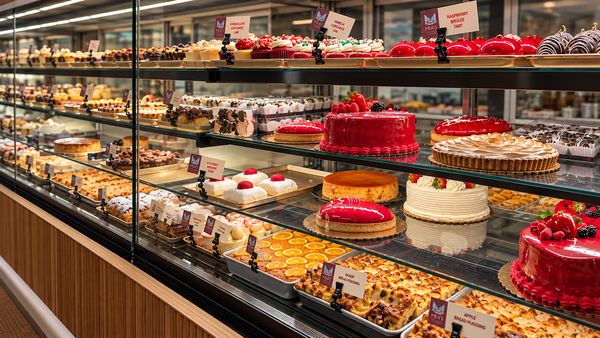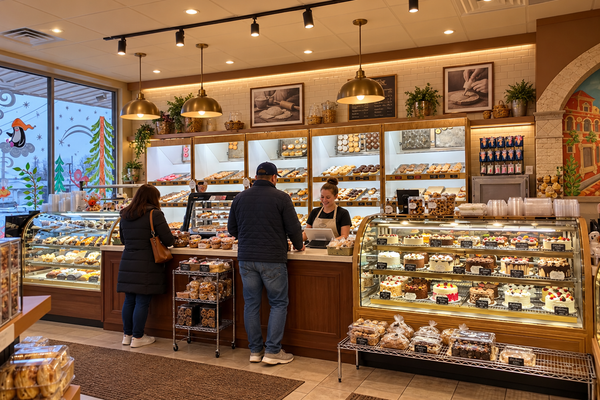
How to Price Cakes: A Simple System for Bakery Owners
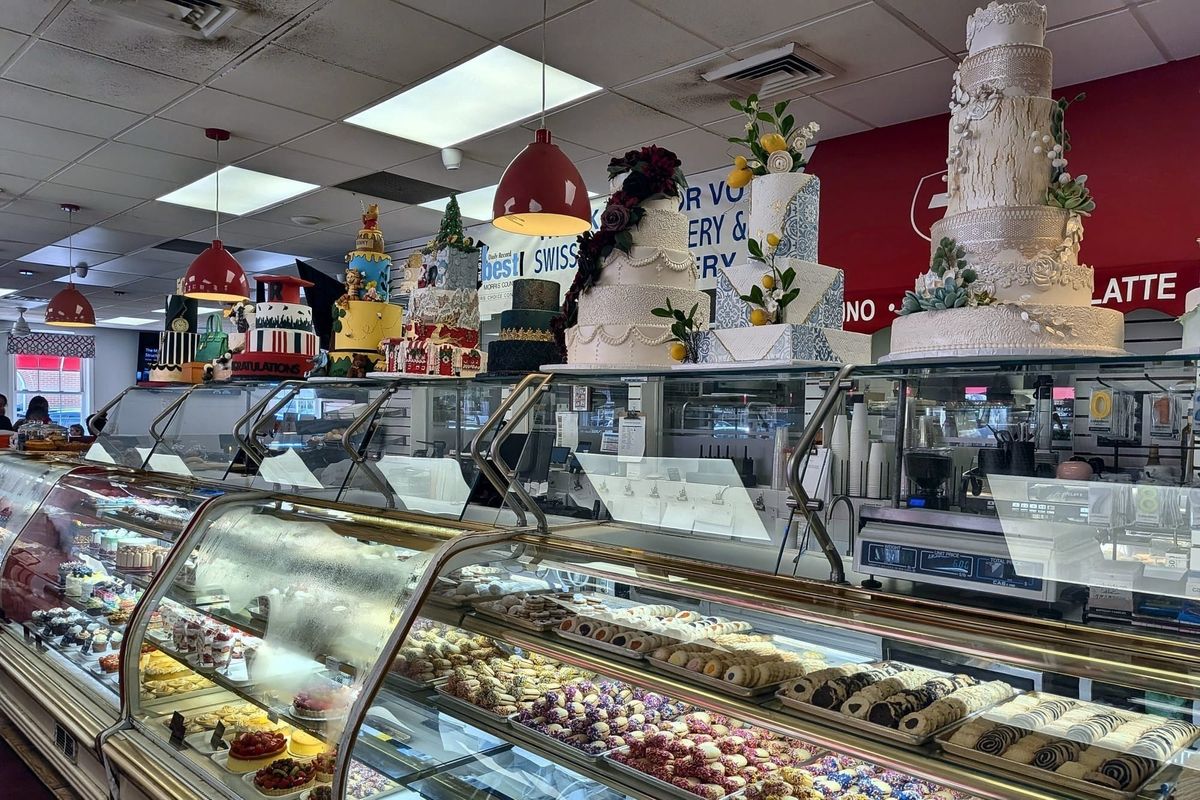
Cake pricing is the practice of setting a cake's price from three inputs: what it costs you to make (ingredients, packaging, and loaded labor), how the cake will be portioned and sold, and what your local market will actually pay. The method is the same for every cake you sell. What changes is which of those three inputs does the most work and that depends on whether the cake went into your display case, onto a custom order form, or onto a wedding table.
Most cake pricing advice starts with servings, style and complexity. That's the right list. It's also where most of it stops, and the gap between that list and an actual number is where owners lose money for years without noticing.
So let's close it. This is the high-level system — the one formula, the two numbers underneath it, and how to decide what your target should be. Then, because a display cake and a wedding cake genuinely need different math, there are three detailed guides linked further down, one for each.
What this guide answers
- How much should I charge for a cake?
- What's the formula for pricing a cake?
- How do I work out what a cake costs me to make?
- What percentage should I be aiming for?
- Why can't I just multiply my ingredient cost?
- How is pricing different for display, custom and wedding cakes?
- Can I charge more than the shop across town?
- How do I charge more without changing the cake?
- How much can I raise my prices before I lose customers?
- Am I charging too little?
- Where do I start?
Why one price list doesn't cover it
You sell cake three ways, and each one carries a different kind of risk.
The display case cake is made before anybody buys it. You baked twelve because you thought twelve would sell. Ten sold. That's an inventory problem, and the two you binned are a real cost that has to live somewhere in your price.
The custom cake is sold before you make it. No risk of it sitting, but you quoted a price three weeks before you knew how long that gold leaf was actually going to take. That's a labor problem.
The wedding cake is a custom cake with a consultation, a tasting, a contract, a delivery to a venue on someone else's schedule, and no second chance. That's a service problem, and it's priced completely differently from the other two.
Same oven. Same butter. Three different jobs.
The one formula underneath all of it
Every cake you sell is priced the same way: add up what it costs you to make, then divide by the share of the price you're willing to let that cost eat.
Here it is, and everything else in every guide is a variation on it:
Price = your direct cost ÷ the share of the price you'll let direct cost eat
That's it. Add up what the cake actually costs you to put in a box — ingredients, packaging, and labor at a real loaded rate — then divide by a target percentage.
If a cake costs you $70.50 and you've decided direct cost should be 45% of the price:
$70.50 ÷ 0.45 = $156.67, so you'd price it at $155 or $160.
The reason to run it as a division rather than a markup is that it answers the question you actually care about: after I've paid for this cake, is there enough left to pay for everything else?
Where this breaks: the formula assumes you sell everything you make. On display cakes you don't, so there's an extra step — divide by your sell-through rate first. And it only ever gives you a floor. It has no idea what your neighborhood will pay.
The two numbers you need before you start
You need your true ingredient-and-packaging cost per cake, and a loaded labor rate — two of them, one for bakers and one for decorators.
You can't use that formula until you know these two things properly. Most shops know the first and get the second badly wrong.
1. What the cake really costs in ingredients and packaging. Cost the recipe out — cake, filling, frosting, garnish — then add the board, the box and the label. Packaging is not a rounding error on a cake. A good box and board can be three or four dollars, and on a small cake that's a meaningful share of the cost.
2. Your loaded labor rate. A $20-an-hour baker does not cost you $20 an hour. Add employer Social Security and Medicare at 7.65% (IRS), unemployment, workers' comp, and any benefits. Then divide by productive hours rather than paid hours — nobody is in production for all 2,080 hours you pay for. Most independent shops land 12% to 25% above base wage. For scale, benefits alone average 30.1% of total compensation across US private industry (BLS, March 2026), and the median US baker earns $17.86 an hour (BLS).
Loaded hourly rate = (wages + payroll taxes + workers' comp + benefits) ÷ productive hours
And use two rates, not one. Your decorator is your most expensive pair of hands. On custom work she's most of the bill, and costing her time at baker wages is one of the most expensive mistakes in this business.
Every example across these guides uses $24/hour loaded for a baker, $32/hour loaded for a decorator, and $22/hour for counter and admin time. Put in your own.
If you haven't built your loaded rate yet, start with our guide to calculating labor cost per item. Everything here assumes you have that number.
Where this breaks: one blended labor rate is fine for a display case where the same person does everything. The moment a decorator touches the cake it understates you badly — she can cost 30% more an hour than your baker and do most of the work.
How to pick your target percentage
Work it out from your own overhead, top down. Don't borrow a number somebody quoted you.
The 45% in the formula isn't a rule. It's a decision, and you make it from the top down.
Take last year. Add up everything that isn't ingredients and direct labor: rent, utilities, insurance, equipment, software, marketing, delivery, your own pay, debt service, and the profit you actually want. Divide that by sales.
If all of that comes to 45% of your revenue, then direct cost has to stay under 55% — and you want a cushion, so you aim lower. Somewhere around 45% is a reasonable starting target for most independent shops.
For a sanity check, not a target: food cost alone runs about 35-40% at full-line bakery. But every bakery has different labor and rent structures, so use that to know you're in the right universe, nothing more.
Where this breaks: a target percentage only works when you apply it to total direct cost. Apply it to ingredients alone — the classic 3× or 4× food cost markup — and it fails on cakes. Multiplying food cost works on a muffin because ingredients dominate. On a decorated cake, labor is usually more than half the direct cost — so a 4× ingredient markup leaves you 45% of the price where the same multiplier on a muffin leaves you 58%. You'd be multiplying the smaller half.
The three kinds of cake, and where they differ
This is where the method splits. Here's the whole thing on one page, then a guide for each.
| Display / to-go | Custom | Wedding | |
|---|---|---|---|
| When it's sold | After you bake it | Before you bake it | Months before you bake it |
| Who carries the risk | You — unsold cakes are your cost | Customer commits up front | Customer commits, but you carry the date |
| Biggest cost driver | Waste and batch size | Decorating hours | Decorating hours plus service time |
| How it's cut | Generous, ~2" × 2½" | Party, 1½" × 2" | Wedding, 1" × 2" |
| A 10" round yields | ~14 big slices | 28 servings | 38 servings |
| The extra step in the formula | Divide by sell-through | Take the greater of servings or hours | Add the service, then uplift the rate |
| Same 10" round prices at | $48 | $217 | $399 |
| Your customer is | Price-shopping against the supermarket | Buying a design | Buying a day that goes right |
| Where the money leaks | Cakes in the bin | Decorations never charged | Revisions, guest-count changes, free setup |
All three prices are built from the same $24 loaded baker rate, $32 loaded decorator rate and 45% direct-cost target. Same pan, same batter — $48 to $399.
That last row is worth a second look. Three completely different failure modes, which is why one price list can't cover all three.
Display case and to-go cakes
The core idea: price against what you actually sell, not what you bake.
Price = (direct cost ÷ your sell-through rate) ÷ target percentage
If you bake twelve and ten move, your cost per cake sold is about 20% higher than your spreadsheet says. Two shops with identical recipes and identical wages can need prices $11 apart purely because one sells out and one doesn't.
Your customer here is price-shopping against the supermarket, so this is a volume game — price it tight and make your money on turns.
The full guide covers sell-through pricing, working backwards from price points your counter will bear, how shelf life changes the number, markdown rules that don't train your regulars to wait, and the break-even math on slices versus whole cakes.
Where this breaks: sell-through pricing assumes your waste is normal. If a fifth of the case is going in the bin, fix production before you fix the price — otherwise you're charging Saturday's customers for Tuesday's mistakes.
→ Read: How to Price Display Cakes and To-Go Cakes
Custom cakes
The core idea: ingredients are the small number. Decorating hours are the whole thing.
Price at whichever of these is higher, and never below your shop minimum:
the greater of (servings × your rate for that design tier) or (direct cost ÷ target percentage)
That two-route rule exists because per-serving pricing breaks badly on small, heavily decorated cakes. A 6-inch with seven hours of sculpting comes to about $204 on per-serving math and about $580 on hours. Quote the $204 and you've worked a Saturday for free.
The full guide covers a cost build at three sizes, where your minimum comes from, per-serving pricing, complexity tiers, base-price-plus-add-ons, a 22-line decoration menu priced by the hours each one eats rather than the materials it uses, and how to quote consistently when you're not the one answering the phone.
Where this breaks: a flat per-serving rate undercharges badly on small elaborate cakes, which is exactly what the greater-of rule is there to catch.
→ Read: How to Price Custom Cakes
Wedding cakes
The core idea: you're not selling servings. You're selling a day that goes right.
The portion is smaller, so the same pan yields more servings. And the rate per serving is higher anyway, because of everything wrapped around it — consultation, tasting, sketch, revisions, contract, venue delivery, on-site stacking.
The full guide covers portion charts and what to put on a quote, how to set and defend the wedding uplift, pricing tiers and internal structure, sugar flowers versus fresh at a venue, whether tastings should be free, what to charge for delivery and setup, and how deposits and contracts protect the price you agreed.
Wedding rate = your party per-serving rate × (1 + service cost per serving ÷ party rate)
Cost out the consult, tasting, sketch, revisions, delivery and setup for a typical wedding and you'll land around a 35% uplift — which turns the same 10-inch tier from a $217 birthday cake into a $399 wedding cake.
Where this breaks: that uplift is an average across weddings, not a rule for each one. A local pickup with no consult and no setup doesn't carry it.
→ Read: How to Price Wedding Cakes
The part no formula covers
Everything above gives you a floor. Now the harder half, and it applies to all three.
Your costs set the floor. Your market sets the ceiling. Where you land in between is a decision, not a calculation.
Two bakeries, same recipe, same skill, same cake. One sits in a neighborhood where the average wedding runs $57,000. One is three states over where it runs $17,000. Those are real figures — New Jersey and Wyoming, from The Knot's 2026 study. That's a 3.4× spread in what the customers around you are used to spending.
The cost side moves too, just less. The federal minimum wage is $7.25; in DC it's $18.40 (US Department of Labor). Two and a half times on the labor floor alone, before rent.
Two things follow, and they cut opposite ways.
If your market pays well, charge more than your costs justify. A cake that costs you $70 doesn't have to sell for $155 if your neighborhood happily pays $210. The cost was never the reason for the price. It was only ever the floor.
If your market doesn't pay, high costs don't help you. You can't walk into a $17,000-wedding town with a $900 wedding cake and explain your butter invoice. She has a number in her head and it came from her sister's wedding, not your spreadsheet. Your moves there are to change the product, change the cost, or change the customer — not to work for free and call it building a reputation.
The cake has a ceiling. The experience doesn't.
Here's the idea worth sitting with, and it's why the three guides diverge as much as they do.
A cake has a price ceiling. Above a certain number, a cake is just a cake and nobody will pay it. But the experience around the cake has no ceiling at all.
On the display case, accept it. She wants a slice of cake and her car keys.
On custom and wedding work, the lever isn't the cake — it's the consultation, the tasting, the response time, the written contract, the delivery and setup, the photo you text her the next morning, the ribbon on the box. None of that is on the ingredient list. All of it is on the invoice, if you decide it is.
Most of that list is really about being easy to buy from, which is a bigger lever on price than most owners think.
So the practical version: when you can't raise the price of the cake, build more experience and charge for that. It's usually easier than shaving cost.
How to find your ceiling: the 20% rule
You don't have to guess. Walk up to it.
Keep raising the price until you lose about 20% of the volume. That's your ceiling. Stop just under it.
Most owners flinch at that. The arithmetic says don't.
Take a $100 cake with $45 of direct cost, selling ten a week. You keep $55 each, so $550. Raise it 30% to $130 and lose a fifth of the orders — eight a week instead of ten:
- Revenue: $1,000 → $1,040
- What you keep: $550 → $680
- And you made two fewer cakes, so you got the hours back
You're 24% better off and you have Saturday afternoon back.
Break-even unit loss = 1 − (old contribution per cake ÷ new contribution per cake)
At a 30% increase that's 1 − ($55 ÷ $85) = a 35% unit loss before the rise stops paying. Stopping at 20% leaves you real cushion.
One warning. This only works on meaningful increases. Raise 10%, lose 20% of units, and you're slightly worse off. A small increase should cost you almost no volume — and if it costs you a lot, you were already at your ceiling.
Run it properly: one item at a time, no announcement, four to six weeks measured against the same weeks last year, and count units, not dollars. And the simplest test of all — if nobody ever hesitates at a custom quote, you're underpriced. A healthy price draws a pause about one time in five.
So what is a cake price, really?
Eleven things, not one.
- What the ingredients cost — the floor, and the smallest part of anything decorated
- What the labor costs — loaded, at two rates, and usually most of the bill
- How it's decorated — priced by the hours it eats, not by how it looks
- How it's cut — to-go slice, party slice, or wedding slice, on the same pan
- How much of it you actually sell — sell-through is a cost whether you count it or not
- How long it holds — one chance to sell it, or three
- Where you are — labor floors swing 2.5×, wedding budgets swing 3.4×
- Who you're selling to — a Thursday walk-in and a mother of the bride are not the same customer
- What experience you're selling — the cake has a ceiling, the experience doesn't
- What the bakeries around you charge — not to match, to know
- What your customers are actually comfortable paying — which you find by testing, not guessing
Change any one and the right price changes. That's why there's no single answer, and why anyone who hands you one is selling something.
Where to start this week
Don't rebuild the whole menu. Do this:
- Pick five cakes — your three best case sellers and your two most common custom orders.
- Cost them properly — ingredients, packaging, and labor at a loaded rate.
- Build your target from your own overhead, top down.
- Price those five — case cakes through sell-through, custom through the greater-of rule.
- Pick one and raise it 20%. Count units for six weeks.
Then go read whichever of the three guides matches the cake that's bothering you most.
One practical note before you go. Every method in these guides dies the same way: it lives in a spreadsheet and by month three nobody's opened it. What keeps it alive is boring data — how many you baked, how many actually sold, what you quoted, and what the cake really took. Keeping orders, production and sales in one place (which is what BakeStreet is built around) turns those from a monthly project into a report. But you don't need software to start. You need one cake, a stopwatch, and an honest loaded rate.
Cake pricing FAQ
How much should I charge for a cake?
Build it from your own costs, then check it against your market. Total your direct cost — ingredients, packaging, and labor at a loaded rate — then divide by the share of the price you'll let direct cost eat, usually around 45%. A cake that costs you $70.50 to make prices at about $155. That's your floor; what your neighborhood will pay decides how far above it you can go.
What's the formula for pricing a cake?
Price = direct cost ÷ target direct-cost percentage. Display cakes add one step — divide direct cost by your sell-through rate first, because you don't sell everything you bake. Custom cakes take the greater of that number or servings × your per-serving rate for the design tier.
Is there a standard cake price per serving?
No. Per-serving rates vary with your wages, rent, waste and market. For a national anchor, The Knot's 2026 study puts the average US wedding cake at $540 — about $5.40 a serving on a 100-serving cake, including grocery-store and sheet-cake weddings. Custom decorated work sits meaningfully above that. Build your own number rather than borrowing one.
Can I charge more than my costs justify?
Yes, and in a strong market you should. Cost sets your floor, not your price. If people ask for you by name or book you weeks out, the market is telling you there's room. The reverse holds too: high costs don't entitle you to a high price if your market won't pay it.
How much can I raise my prices?
Keep raising until you lose about 20% of the volume, then stop just under that. On a $100 cake at 45% direct cost, a 30% increase that costs you a fifth of your orders leaves you 24% better off and hands back the hours. Break-even is actually a 35% unit loss. The caveat: this only applies to meaningful increases — a 10% bump that loses 20% of units puts you slightly behind.
How do I know if my cake prices are too low?
If nobody ever hesitates at a custom quote, you're underpriced. A healthy price draws a pause about one time in five. Other signs: booked out for weeks and still tight on cash, or a shop that looks busy and profitable with no money left at month end.
How is pricing a wedding cake different from a birthday cake?
Three ways. The slice is smaller — about 1" × 2" versus 1½" × 2" — so the same pan yields more servings. The rate per serving is higher anyway, because a wedding carries a consultation, a tasting, a sketch, revisions, a contract, delivery and on-site setup. And there's no second chance. The same 10-inch round is a $217 birthday cake and a $399 wedding cake.
Why is my bakery busy but not making money?
Usually waste, not price. If a fifth of what you bake doesn't sell, your real cost is about 25% above your spreadsheet on every item — you're not underpriced against your costs, you're underpriced against your bin. Measure sell-through before you touch the price list.
What should I charge for an 8-inch cake?
It depends which kind of 8-inch. A display-case 8-inch built in a batch of twelve at a $14.90 direct cost prices around $33 at full sell-through and closer to $40 once waste is carried. A simple custom 8-inch — same cake, decorated to order, with the consult and handoff included — comes to about $155. Same pan, different jobs.
Should I put my cake prices on my website?
At minimum, publish a starting per-serving rate and your minimum. It costs you nothing, filters out customers who were never going to book, and stops you spending fifteen minutes quoting someone with a $40 budget. Full self-serve pricing is a bigger step, but a "custom cakes start at $X per serving, $Y minimum" line should be there today.
How often should I raise cake prices?
Two different things, and you need both. For keeping up with costs, small and regular — three percent twice a year is barely noticed, while eighteen percent after four years of holding is a story your customers tell each other. For finding your ceiling, a deliberate bigger move on one item, run as a test. The first is maintenance; the second is how you find out what you're worth.
Sources
- The Knot — Real Weddings Study, average wedding cost. Average US wedding cake $540 (2026 study); average total wedding spend $57,000 in New Jersey to $17,000 in Wyoming.
- US Bureau of Labor Statistics — Employer Costs for Employee Compensation, March 2026. Private industry benefits 30.1% of total compensation.
- US Bureau of Labor Statistics — Occupational Outlook Handbook: Bakers. Median pay $17.86/hour, May 2025.
- US Department of Labor — State Minimum Wage Laws. Federal $7.25; District of Columbia $18.40 as of July 1, 2026.
- Internal Revenue Service — Topic No. 751, Social Security and Medicare Withholding Rates. Employer share 7.65%.
Wage, tax and market figures current as of September 2026. All examples use a $24/hour loaded baker rate, a $32/hour loaded decorator rate and a 45% direct-cost target — substitute your own.