How to Set Up and Manage a Bakery Display Case (Layout, Temperature, Rotation, and What to Buy)
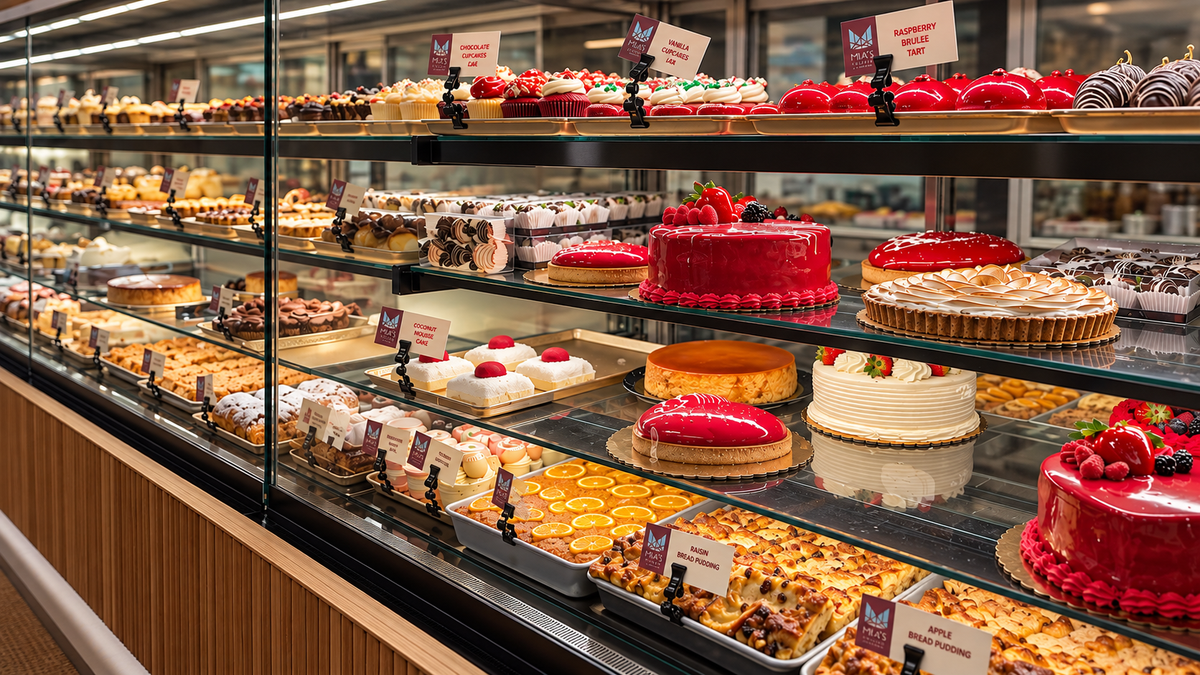
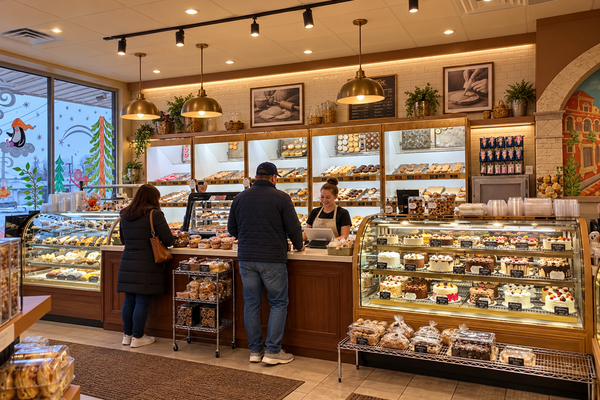
A bakery display case is the main selling space in your shop. Set up well, it shows what you make, helps people decide fast, and keeps waste low. Run on habit, it quietly costs you sales and product every day.
We talk to bakery owners all the time, and the display case is where the same problems keep showing up. Not because anyone's careless, but because nobody ever designed it. It just grew, one tray at a time.
So here's how we'd set one up, how to audit the one you have, and what real cases cost. Check the food safety rules against your local health department, because they vary by state and county.
Quick answers
Question | Short answer |
|---|---|
Best spot for top sellers | Eye level, roughly 48 to 60 inches off the floor |
Cold holding limit | 41°F (5°C) or below for cold TCS foods, per the FDA Food Code |
Typical refrigerated case range | 33 to 41°F, depending on model |
Ambient case for croissants, muffins, cookies | About 65 to 75°F |
Items to show at once | 12 to 20, stocked deeper |
Space between items | 1 to 2 inches side to side |
How often to check the case | Every hour during service |
Cost of a 48" refrigerated case | Roughly $1,100 to $15,000+ (see the buying section) |
How do customers actually buy from a display case?
They scan before they decide, and the scan has a pattern. Most people read left to right, start at eye level, and pick from the front. Whatever sits at the front edge at eye level gets seen first and bought most. Whatever sits at the back of the bottom shelf gets admired, if at all.
That gives you three zones to plan on purpose:
- Prime zone: eye level. Your money makers and showpieces.
- Supporting zone: raised stands and the top of the case. Height and abundance.
- Value zone: the lower shelf. Volume items people will bend down for.
Where should each item go?
Position | What goes there | Why |
|---|---|---|
Eye level | Signature cakes, fruit tarts, highest-margin pastries, your newest item for its first two weeks | Seen first, sells most |
Raised stands | One or two featured whole cakes, a croissant tower in the dry case | Height makes the case look generous |
Lower shelf | Muffins, scones, cookies, brownies, day-old markdowns | Easy yeses that don't need prime space |
Front edge | Minis and single cookies under about $5 | A four-second decision should be a point |
Behind the counter | Pre-ordered whole cakes | Stays out of the case so nobody sells it by accident |
Whole cakes: don't bury them. One beautiful cake on a stand near the door looks like craft. A row of identical whole cakes looks like stock.
Fruit tarts belong at eye level because they sell on the eyes. The color and the glaze are the whole pitch.
What goes next to what?
Group by how people buy, not how you bake.
- Breakfast together: croissants, danishes, muffins, scones.
- Dessert together: tarts, mousse cups, individual cakes, éclairs. This is the "something sweet for tonight" section.
- Gifting together: cookies, brownies, minis, with the boxes right beside them so the sale is one step.
- Look-alikes side by side: plain croissant beside almond, chocolate tart beside lemon. Contrast makes choosing easy and trading up natural.
Keep strong savory items away from delicate sweets. Smell and flavor carry in a closed case.
A worked example: one 48-inch case, step by step
Here's a layout for a typical shop with a 48-inch refrigerated case and a 48-inch dry case. It's an example to copy and adjust, not data from a specific bakery. The quantities are starting points, and the audit below is how you tune them.
Refrigerated case
Shelf | Left | Center | Right | Open with (L / C / R) |
|---|---|---|---|---|
Top (eye level) | New seasonal item | Fruit tarts | Featured whole cake on a stand | 4 / 6 / 1 |
Middle | Chocolate mousse cups | Cheesecake slices | Éclairs | 6 / 6 / 6 |
Bottom | Whole take-home cakes, two flavors | 2 of each | ||
Front edge | Mini desserts | 8 |
Dry case
Shelf | Left | Center | Right | Open with (L / C / R) |
|---|---|---|---|---|
Top | Plain croissants | Almond croissants | Pain au chocolat | 8 / 6 / 6 |
Middle | Danish | Muffins, two flavors | Scones | 6 / 6 each / 6 |
Bottom | Brownies | Cookies | Day-old markdown tray | 8 / 12 / varies |
Front edge | Single cookies | 6 |
That's about 18 distinct items across both cases, inside the 12 to 20 range. Refill the fast movers in small batches through the day rather than loading everything at 7am.
How far apart should items be?
You don't need a ruler, but these numbers work:
- Side to side: 1 to 2 inches. Closer looks like a warehouse. Past 3 inches looks like you ran out.
- Above each shelf: 3 to 4 inches over the tallest item, so a hand can reach in without crushing anything.
- From the glass: 1 to 2 inches, so glaze and cream don't smear.
- Between rows: stagger them a little. It makes each item individually visible.
The real test is simple. Can your staff pull any one item without touching the one next to it? If not, spread them out.
How many items should you show?
Fewer varieties, deeper stock, usually sells more. Thirty choices makes a lot of people choose nothing. Aim for 12 to 20 distinct items and a case that's 70 to 80 percent full by closing. That looks natural and keeps waste down.
A completely empty case at 2pm doesn't say "popular." It says you lost sales.
How often should you rotate and replace items?
Item | Display window | Rotation and end-of-day plan |
|---|---|---|
Croissants and laminated pastry | Same day | Rotate front to back every couple of hours. Day-old becomes almond croissants, bread pudding or markdown |
Muffins and scones | Same day | Day-old markdown tier if sell-through demands it |
Fruit tarts | Shortest life in the case | Fruit weeps and the shell softens. Replace or pull by end of day, refresh glaze if it dulls |
Cream-filled items, mousse | Per your health code | Oldest forward, label date and time |
Whole buttercream or ganache cakes | Two to three days refrigerated | Cut cakes sell or get pulled sooner, since the crumb dries |
Cookies and brownies | Longest | Still first in, first out |
Check the case every hour during service. Straighten, fill gaps, wipe fingerprints, pull anything tired. Ten minutes of that beats an hour of markdowns.
What temperature and humidity should a bakery case be?
Refrigerated case. The legal line is the FDA Food Code, section 3-501.16: cold TCS food must be held at 41°F (5°C) or below (Xenia food holding guide). Cream, custard, mousse and cheesecake are TCS foods. Most commercial bakery cases are built for that. The models we looked at list ranges like 33 to 41°F or 38 to 40°F.
Two things most owners miss:
- Check the food, not the dial. One food-safety study guide says equipment dials aren't 3-501.16 measurements, so probe the product with a calibrated thermometer (source). Minnesota's health department suggests a thin probe thermometer to find the warmest spot (Minnesota Department of Health).
- Know the time rule. Under 3-501.19, food that starts at 41°F or below can be held without temperature control for up to 6 hours, provided it never goes above 70°F (source). That needs a written procedure and labels, and your local code may differ.
Humidity in a refrigerated case, as common practice, sits around 50 to 65 percent. Too dry and cakes and tarts crust over. Too humid and the glass fogs and pastry goes soft. That's a rule of thumb, not a regulation.
Ambient (dry) case. For croissants, muffins, scones and cookies, room temperature is right, around 65 to 75°F. Refrigerating laminated dough and bread dulls the texture. In summer, keep the dry case away from the front window and the oven line.
How often should you clean the case?
- Glass, outside: open, midday and close. Fingerprints build up fast.
- Inside surfaces: daily, with a food-safe cleaner.
- Shelves and trays: wash daily, or at least every few days.
- Deep clean: weekly. Empty it, sanitize every surface, check seals and drains, wipe the tracks.
- Floor around and under the case: weekly. Crumbs attract pests.
- Coils and drains: monthly, and service on the manufacturer's schedule.
What should staff do at the case?
Put this in your SOP and train it on shift one. Our front-of-house training guide covers the words to say at the counter.
- Know every item. Name, flavor, texture, allergens. Taste everything.
- Use tongs, tissue or gloves, and a separate tool per item so allergens don't cross over.
- Pull from the back, serve from the front. Take the one about to age.
- Lift, don't drag. Dragging smears glaze and cream.
- Fill gaps right away.
- Turn items to face the customer when straightening.
- Offer before they ask if someone's been looking for 30 seconds.
What belongs in the case, and what doesn't?
In the case: items that sell on looks, hold well for a full service, and earn their space in margin. Tarts, individual cakes, croissants, danishes, cookies, a few signature items.
Outside the case:
- Whole breads. They sell on smell and bulk. Baskets or shelves behind the counter work better.
- Packaged goods like cookie boxes and gift sets, on open shelving near the register.
- Custom pre-orders. Keep them in the cooler until pickup.
- Very fragile or perishable items, like whipped cream desserts in hot weather. Make to order or hold colder.
- Cheap add-ons, in a small jar or basket at the register.
What's the best shape, height and layout?
- Shape: a straight, flat-front case is easiest to clean and has clear sightlines. Curved glass is classic but can distort what's inside and costs more to replace.
- Height: the top of the case around 40 to 44 inches for a standard service counter. Federal's ITR4826, for example, is 48 inches wide by 30 inches deep by 42 inches high.
- Depth: usually 28 to 39 inches. True's 48-inch curved-glass case is 39 inches deep. Deeper holds more, but staff still need to reach the back.
- Length: match it to your sales, not your wall. A short, full case beats a long, sparse one.
- Lighting: warm LED, around 3000 to 3500K, makes baked goods look golden. Federal lists 3500K LED top and shelf lights on that model.
How should customers and staff move around it?
- Customer path: door, case, register, exit, in a clear line. Don't make people backtrack.
- Queue space: 42 to 48 inches in front of the case, so a line can form without blocking the door.
- Staff side: at least 36 to 42 inches behind, wider if two people work it.
- Pick and pack: grab, bag and hand off in as few steps as possible. Keep bags, boxes, tissue and tongs within arm's reach.
- POS placement: at the end of the case, not the middle, so customers finish browsing before they pay and the line doesn't cut through the display. Keep a small impulse zone right there.
- Accessibility: keep clearances and counter heights that meet your local rules, ideally with a lower section.
What does a good bakery display case cost, and what should you buy?
Prices below are retailer listing prices we found on October 21, 2026, for 48-inch cases. They move often, so treat them as ranges and get quotes. One retailer's price was often well above another's for the same model.
Case | Type | Listed price | Notes |
|---|---|---|---|
Refrigerated countertop | $1,099 | Budget countertop option | |
Refrigerated, curved glass | $1,949 | Glass shelves, 44 lb capacity | |
Refrigerated, curved glass | $6,409 | Entry True model | |
Refrigerated, curved glass | $8,272 (another retailer: from $11,225) | Wire shelves rated 150 lb each | |
Refrigerated, flat glass | $14,468 (another retailer: $19,514) | Self-cleaning condenser brush | |
Refrigerated, straight glass | $17,619 | Stainless interior, 38 to 40°F | |
Refrigerated bottom, dry top | $15,530 | One unit for both jobs | |
Dry, curved glass | $9,153 | For croissants, muffins, cookies |
What the spec sheets and reviews tell you:
- Shelves matter more than they look. A small cake shop's reviewer on one Avantco case liked it but said they wouldn't order it if you use heavier trays or ceramic plates, because the shelves are glass (review). If you stack full sheet pans, compare shelf load ratings.
- A split case can replace two. Federal's combo unit has a refrigerated bottom and a non-refrigerated top, which suits a small shop short on floor space.
- Temperature range options. True's stainless model offers a standard 33 to 40°F range and an optional 42 to 65°F range for things like chocolate. Dry cases exist separately for items that shouldn't be chilled.
- Lead times are long. We saw 2 to 3 weeks on a dry Turbo Air, 4 to 6 weeks on a Federal and 7 to 9 weeks on a True. Order well before a holiday season, not during it.
- Scratch-and-dent and outlet listings exist for Avantco and others. A cosmetic ding on the back panel costs you nothing if the case is against a wall.
Before you buy, check:
- Type: refrigerated, dry, or both, for your actual menu.
- Interior and glass: stainless interior, tempered double-pane glass with anti-fog.
- Shelf rating: against the trays you really use.
- Staff access: rear sliding doors or front lift-up, matched to how you work.
- Cleaning access: removable shelves, reachable corners, a drain.
- Energy use and refrigerant: ask for the rating, and look at running cost, not only price.
- Size: measured against your space, doorways and delivery path.
- Warranty and service: who fixes it, how fast, what's covered. Terms differ by brand and change over time, so read the current ones.
- Reputation: ask other bakery owners, not just the rep.
A case runs ten to twelve hours a day for years. The cheapest one often costs more over its life.
A temperature monitor is cheap insurance. Basic wireless fridge sensor kits start around $40, and better-known WiFi sensors like the Temp Stick run about $149. Reviews are mixed on alerts, with one set of buyers saying text alerts stopped coming through, so trigger a test alert before you trust it. A sensor doesn't replace probing the product.
How to audit your case in two weeks
This is the step that turns every rule above into your own numbers.
- Make a tally sheet with one row per item and four columns: placed in case, sold, binned or marked down, sell-through.
- Count what goes in. Every tray at open and every refill counts as "placed."
- Count what leaves. Sold from your POS, binned from a clipboard by the bin.
- Do it for 14 days, so you capture two of every weekday.
- Work out sell-through for each item: sold ÷ placed.
- Sort the list from best to worst.
- Decide:
- Sells out before mid-afternoon: stock deeper, or move it up.
- Sells through most of the time: leave it alone.
- Binned often: lower the starting quantity.
- Poor two weeks running: cut it, or make it to order.
- Move your top three to eye level and drop your bottom three a shelf.
- Repeat in a month.
Those decision lines are our rules of thumb, so adjust them for your shop.
Worked example (illustrative numbers). Say fruit tarts cost you $3.10 to make. Over a week you place 42 and sell 31, with 11 in the bin.
- Sell-through: 31 ÷ 42 = 74%
- Real cost per tart sold: $3.10 ÷ 0.74 = about $4.19
That tart costs you 35 percent more than your spreadsheet says. The fix is usually fewer tarts at open and one refill, not a price change. We cover the full math in how to price display cakes and how to price cakes.
How to reset your case in 60 minutes
- Empty it (10 min). Pull everything onto trays and bin what's past its window.
- Clean it (15 min). Shelves out and washed, inside wiped, glass done inside and out.
- Probe the temperature (5 min). Check the warmest spot with a thermometer.
- Sort by sell-through (5 min). Best sellers get eye level.
- Place by zone (15 min). Showpieces up top, volume low, minis at the front edge.
- Label everything (5 min). Name, price, allergens.
- Check from the customer's side (5 min). Walk to the door and look at it the way a customer will.
Where the numbers should come from
The audit needs three numbers most shops keep in three places: how many you put in the case, how many sold, and how many went in the bin. Sales live in the POS, production on a whiteboard, waste in somebody's head. Pulling them together by hand is a monthly project, and eventually nobody does it.
You don’t need software to start tracking production and sales in one place. A simple paper slip in a bin next to the counter can do the job. But if you decide to use software, choose one built specifically for bakeries.
FAQ
What's the best way to arrange a bakery display case?
Best sellers at eye level, showpieces on raised stands, volume items low, cheap impulse items at the front edge. Group by how customers buy and leave 1 to 2 inches between items.
What temperature should a bakery display case be?
Cold TCS foods like cream and custard must be held at 41°F (5°C) or below under the FDA Food Code. Ambient cases for croissants and muffins sit around 65 to 75°F. Check your local health code.
How many items should a bakery display case hold?
Most independent bakeries do best with 12 to 20 distinct items, 3 to 6 of each at open, refilled in small batches.
How often should you rotate display case items?
Check hourly, rotate oldest forward, and pull perishable items like fruit tarts and cream items by end of day.
How much does a bakery display case cost?
For a 48-inch refrigerated case, from about $1,100 for a countertop model to roughly $15,000 or more for premium floor models, based on retailer listings in October 2026.
How often should you clean a display case?
Wipe the glass at open, midday and close, clean the inside daily, wash shelves daily or every few days, and deep clean weekly.
What's the best height for a display case?
Around 40 to 44 inches for a standard service counter, so customers can see in from above and staff can reach comfortably.
How do I know which items to put at eye level?
Run the two-week audit. Your highest sell-through and highest-margin items earn eye level.
Sources
- FDA Food Code sections 3-501.16 (cold holding at 41°F) and 3-501.19 (time as a public health control), as summarized by Xenia and a food safety textbook
- Minnesota Department of Health, cold holding risk control plan
- Manufacturer and retailer listings for Avantco, True, Turbo Air and Federal, linked in the price table (prices checked October 21, 2026)