Bakery Holiday Planning: The Complete Thanksgiving and Christmas Playbook
Bakery holiday planning comes down to running a different business for six weeks: a short menu you can batch, pre-orders taken online with hard caps and a real cutoff, production worked out against the oven and cooler you've actually got, and a pickup fast enough to move four hundred paid orders in a morning.
I've spent a lot of Novembers in bakeries. In the walk-in at six in the morning while somebody counts sheet pans out loud. At the counter on the Wednesday before Thanksgiving, watching a line go out the door and halfway down the sidewalk.
And the shops that come out of that week in good shape and the shops that come out of it wrecked are almost never separated by how good the baking is. They're separated by about nine decisions that got made in October.
Every owner I've ever met knows that. And almost every one of them still runs those sixty days exactly like a Tuesday in March, only faster and more tired.
That's the whole thing right there. The holidays aren't your normal week with the volume turned up. They're a different business. Different menu, different kitchen, different crew, a different way of taking the order and a completely different way of handing it over. Run the normal system harder and it doesn't stretch, it snaps. Usually about 11am on the Wednesday before Thanksgiving, line out the door, somebody's pumpkin pie nowhere to be found.
So here's the other system. All of it, in the order you'd actually build it.
What this covers
Jump to whichever one is your problem right now.
📈Start here
- Is the 2026 holiday season going to be bigger for bakeries?
- Are people buying dessert instead of baking it?
- Which days actually matter in a bakery's holiday season?
🥧The menu
- How many items should be on a bakery's holiday menu?
- Should a bakery add new items for the holidays?
- What should a bakery stop selling during the holidays?
- Should a bakery sell single pies or multi-pie boxes?
🔥The kitchen
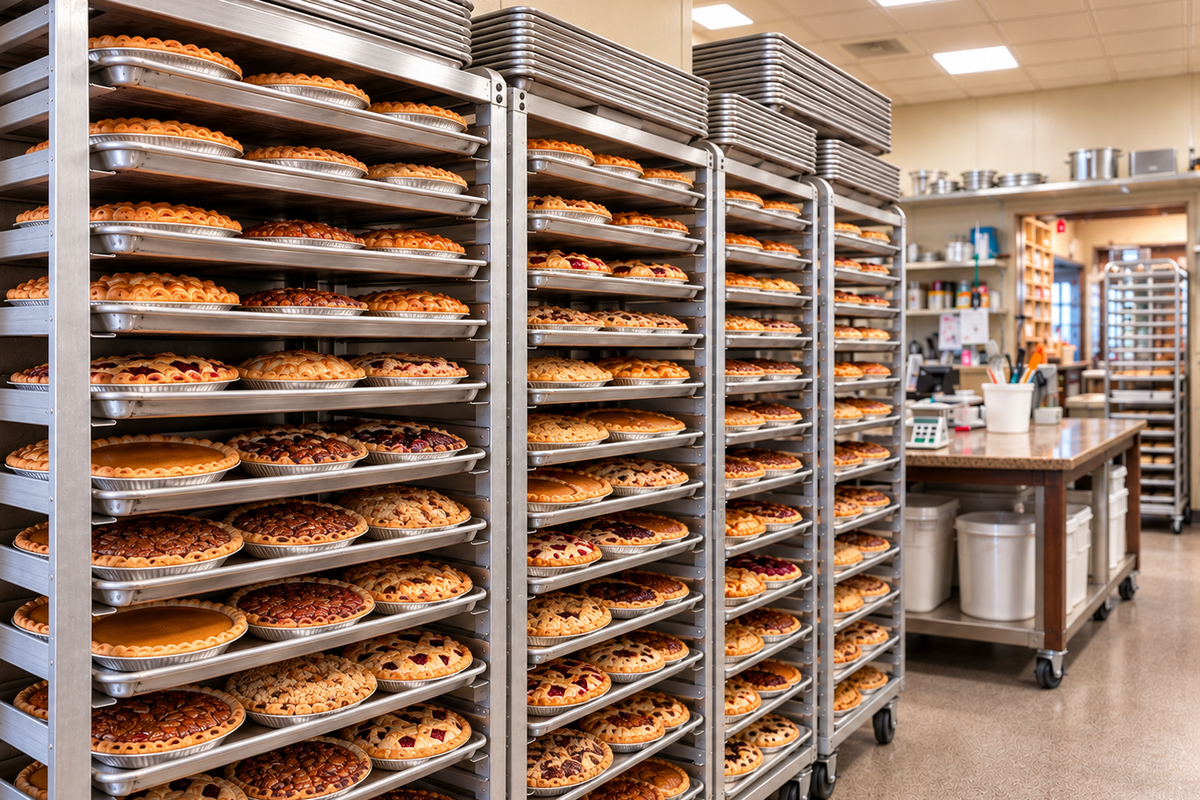
- How many pies can my bakery actually make and hold?
- How do I set holiday order caps and cutoffs?
- How far ahead can holiday items be baked?
- How should a bakery organize storage and labeling for the holidays?
- How many staff does a bakery need on peak holiday days?
📣Getting it sold
- When should a bakery launch its holiday menu online?
- What marketing emails should a bakery send for the holidays?
📦The big days
- How do I run holiday pickups fast?
- How do I run an outdoor or curbside holiday pickup?
- How much stock should a bakery keep for walk-in customers?
- How do I stop the phone eating holiday week?
- What should bakery staff say to customers at the holidays?
✅Afterwards
Short answers to all of it are in the FAQ at the bottom, and every figure quoted in this piece is in the numbers table with its source.
The numbers, in one place
Everything below is built on these. The forecasts are for the 2026 season, the behavior data is from 2025.
| What | Number | Source |
|---|---|---|
| US holiday retail sales forecast, Nov 2026–Jan 2027 | $1.70–1.71 trillion, up 4%–4.8% | Deloitte, Sept 10, 2026 |
| Alternative holiday growth forecast | ~4.5%, in-store +2.5%, online +9% | Bain & Company, Sept 3, 2026 |
| Last season's actual result | Past $1 trillion for the first time, up 4.1% | National Retail Federation, Jan 12, 2026 |
| Shoppers expecting to spend more than last year | 38%, up 14 points since 2021 | CivicScience, Aug 13, 2026 |
| Shoppers starting before Thanksgiving | 34%, the highest in six years | CivicScience, Aug 13, 2026 |
| Average gift spend | $708, down 2% | PwC Holiday Outlook 2026 |
| Thanksgiving meals including food bought from a foodservice operator | 11% | Circana, Nov 10, 2025 |
| Thanksgiving dinners eaten at someone else's home | 28% | Circana, Nov 10, 2025 |
| Average people per Thanksgiving gathering | 8 | Circana, Nov 10, 2025 |
| Share of annual baking-aisle sales in Q4 | About a third | Circana, Nov 10, 2025 |
| Recommended hold-back of peak-day production for walk-ins | 15%–25% | BakeStreet guidance |
Is the 2026 holiday season going to be bigger for bakeries?
Yes. Holiday spending is forecast up 4% to 4.8%, and more of it is going to the table than to the gift pile, which happens to be the half of the season a bakery sells into.
Deloitte put their forecast out on September 10, 2026: $1.70 to $1.71 trillion in US holiday retail for the November-through-January stretch, growth of 4% to 4.8%. And last year was no slouch either. The National Retail Federation had the 2025 season up 4.1%, past a trillion dollars for the first time ever.
Bain's outlook landed a week before that and says roughly the same thing, about 4.5%. What I find more useful is the way they split it. In-store up around 2.5%. Online up around 9%. People are still coming through your door. They're just making up their minds online first.
Then there's the one that should change what you do this month. CivicScience, August 2026: 38% of shoppers say they'll spend more than last year, which is up 14 points since 2021, and the share planning to spend less is the lowest it's been in six years. And 34% say they're starting before Thanksgiving. Highest in six years.
Sit with that one.
Now, not everything is up, and you should hear that here instead of figuring it out in December. PwC has average gift spending at $708, down 2% from last year, and total holiday budgets down 5%. Younger shoppers are cutting back the hardest.
So which is it, up or down? Both. And the gap between the two is where you live.
People are trimming the gift pile. Nobody is trimming the table. When money gets tight the thing that gets protected is the day itself, the meal, the people around it, the dessert somebody takes a picture of. A $48 pie box is a small safe purchase that's guaranteed to land, in a year when a $300 gift feels like a gamble.
Are people buying dessert instead of baking it?
More every year. Circana found that 11% of Thanksgiving meals now include something bought from a foodservice operator — sides, desserts, even a pre-cooked bird — and about a third of all annual baking-aisle sales happen in Q4, which is the same wave hitting from the other direction.
That same Circana analysis, November 10, 2025, found 97% of Thanksgiving dinners get eaten at somebody's home, 28% at somebody else's home, and the average table has eight people around it.
Which means better than a quarter of your customers aren't hosting anything. They're guests. And a guest has one very particular problem: she's been told "just bring dessert," and she is not walking into her mother-in-law's house with a grocery store clamshell. She wants to come through that door holding a box with your name on the side of it.
She isn't looking to make a decision about cake. She wants the problem gone. Keep her in mind, because she's why half of this thing exists.
The spike is steep, too. Transaction data across small-business food retailers for the 2024 season had pie sales in November running 67% above October, and half of all the pumpkin pie sold that entire year sold in that one month.
One month. Half the year's pumpkin pie. You either built the boat back in September or you watch the wave go past.
Which days actually matter in a bakery's holiday season?
A bakery's holiday season isn't six weeks of steady demand. It's about six specific days, and everything else is getting ready for them.
Every owner I've worked with starts with the menu, because the menu's the fun part. Don't. Start with a calendar, a paper one, November and December, and mark four things on it.
1. The peaks. Not "the holidays." The actual hours when the volume lands on you.
- Tuesday and Wednesday before Thanksgiving. That Wednesday is usually the single biggest pickup day of your year.
- The two Saturdays before Christmas.
- December 23 and 24. The 23rd is often the bigger of the two, and the 24th is the same amount of chaos crammed into five hours.
- New Year's Eve, if that's a thing where you are.
2. Your production days. Count back from each peak, mark every day you can actually bake, then start crossing off. The day you're closed. The day your decorator's at her sister's. Thanksgiving itself.
There are always fewer than you think. Most shops working toward that Wednesday have three real production days, not seven. Three. That's the number your capacity comes from, not whatever you were feeling optimistic about in September.
3. Your cutoffs. Count back from each peak by your longest lead time. Pencil, for now.
4. Launch and email dates. Pencil too.
Once it's on paper the season stops being a fog and turns into six days you have to be ready for.
How a holiday week differs from a normal week
Same bakery, run two ways. The left column is why holiday weeks fall apart. The right is what the rest of this builds.
| What changes | Normal week | Holiday peak week |
|---|---|---|
| Menu size | 40+ items | Under 20 lines |
| Everyday catalog | All of it | Partly paused |
| Demand signal | Guesswork and history | Pre-orders already paid |
| Capacity | Informal | Hard caps per item, per day |
| Payment | At the counter | In full, before pickup |
| Pickup | Whenever | Booked hourly windows |
| Counter roles | One or two people, all jobs | Four named roles |
| Case stock | Whatever's left | A protected reserved percentage |
| Phone | Answered at the counter | Rerouted, recorded, reduced |
How many items should be on a bakery's holiday menu?
A holiday menu wants to be fifteen or twenty lines all in, bundles and everyday core included. Five to Eight pies, a large cake or tart, two or three boxed sweets, three or four bundles. Short menus make more, waste less and sell easier.
Every instinct you have says add. A customer asks for something. Your decorator's got an idea she's excited about. Somebody saw a gingerbread thing on Instagram at eleven at night. And because none of those are bad ideas on their own, nobody says no to any of them, and by the first of November the holiday menu has thirty-one items on it.
Then Thanksgiving week shows up and you find out what thirty-one items actually means. Eleven different doughs. The oven needed at three temperatures at the same time. Your best baker standing there for forty minutes on a batch of six, because six is all anybody ordered. A walk-in where nothing stacks on anything, because every single item came with its own box.
Ten items you can make five hundred of will beat thirty items you can make forty of. Every time. And your crew will still be talking to each other on the 26th, which is worth something too.
Here's roughly the shape that works for a neighborhood shop at Thanksgiving:
| Category | How many | Notes |
|---|---|---|
| Pies | 5–8 flavors | Two classics you'd be crazy to drop, two strong regulars, one new |
| Large-format cake or tart | 1–2 | For the people who don't want pie |
| Boxed cookies or small sweets | 2–3 | Your gift and guest items |
| Bundles | 3–4 | Built out of the items above |
| Everyday core | 4–8 | Bread, croissants, a couple of case items |
Christmas is a different shape. More gifting, more boxes, more cookies, more things that have to survive a trip to somebody's office. Same discipline though. Short, batchable, sharing parts.
What tests should a holiday menu item pass?
Five questions, and an item has to get through all of them: does it batch, does it share parts with something else on the menu, does it hold a day or two, does it survive the car, and does the money still work once you count holiday labor.
Does it batch? Can you make a hundred about as easily as ten? If the answer involves hand-piping every one, that's a display item. Not a holiday item.
Does it share? Is it using a dough, a filling, a crust or a box you're already making anyway? Every shared part is a piece of your kitchen you don't have to run twice.
Does it hold? Can you make it Monday and have it right on Wednesday? Anything that has to be finished at 5am on the big day is competing for the scarcest hour you own.
Does it travel? It's going in a car, onto a counter at somebody's mother's house, maybe into a fridge overnight. Shows up looking sad and you didn't make a sale, you made a complaint.
Does the money work at volume? Your labor cost per item climbs at the holidays. Overtime, extra hands, people working odd hours. Run through how to calculate bakery labor cost per item before you price any of this, and how to price cakes for the bigger picture.
Passes all five, it goes on. Fails two, cut it. Even the one you love. Especially the one you love.
Should a bakery add new items for the holidays?
One or two, not six. Call it 80% proven items you've already sold and priced and made at volume, and the rest is your new thing — and the cheapest kind of new is a different filling in something you already make.
You do need something new. It's what you've got to talk about in the emails. It's the reason a regular bothers to open the menu instead of assuming she knows what's on it. It's what the local paper and the food accounts point a camera at. A menu that's identical to last year's is a menu nobody mentions.
But one new item is a feature and six is a gamble with the rent. New means no sales history, so you're guessing the quantity. No proven recipe at scale, and a batch of two hundred does not always behave like the batch of twelve you tested. It needs a photo, a box, a spot in the case, a training moment with the crew.
So do it the cheap way. Same dough, same pan, same bake time, same box, different filling or topping. A brown butter pecan version of the pie you already make is brand new to her and barely new to you.
⚠️Where this breaks: if your "new item" wants a different oven temperature or a different box size from everything else, it isn't a variant. It's a second production line. Price it that way or save it for February.
What should a bakery stop selling during the holidays?
Through your peak weeks, pause most of the everyday catalog and run the holiday menu plus a small core — usually bread, croissants and two or three case staples. This is the one change that makes everything else in this plan possible.
Not forever. Eight days or so around Thanksgiving, maybe ten at Christmas.
This is the part I get the most pushback on, and the conversation opens the same way in every kitchen I've had it in. What if my regular comes in Thursday for her scone and it isn't there?
Some of that does happen. And it costs you almost nothing next to the alternative, which is a kitchen trying to turn out four hundred pies and a full normal case on the same morning with ovens that can only be in one place. What happens then is everything comes out a little worse and a little late, and the pre-orders go last. The ones already paid for. The ones with somebody's name written on the box.
Your Thursday scone customer will forgive a sign that says back December 27th. The woman whose paid order isn't ready when she gets there will not, and she will tell people.
So write the sign now, while you're calm. Friendly, no apologizing:
Holiday hours: Our full everyday menu takes a short break November 22–29 so we can focus on holiday orders. Bread, croissants and cookies are here every day. Everything else is back the 30th. Thank you for making this our busiest week of the year.
Nobody reads that as a downgrade. It reads like a bakery that knows what it's doing.
Should a bakery sell single pies or multi-pie boxes?
Sell both. Lead with the box. A fixed multi-pie box takes the decision off a customer who's in a hurry, it raises the average order without adding a minute of handling, and because you picked what's in it, it tells you exactly what to bake.
Owners ask me this one more than anything else on the list, and it really isn't close.
Why bundles outsell single items at the holidays
Your holiday customer is not relaxed. She's ordering dessert in the gap between two errands, on her phone, with eleven other things sitting on the list behind this one. Every choice you hand her is work you've asked her to do.
Six pies on a page asks her: which one? For eight people with eight opinions, one of whom "doesn't like pumpkin"? She has no idea. So she takes the safe one, or she closes the tab and tells herself she'll sort it out at the weekend. You know how that ends.
A three-pie box answers it for her. One tap and everybody's covered. Same principle as meeting your customers where they are: every hoop you take away is somebody who actually finishes.
The money's better on both ends. One pie at $38 is one transaction. A three-pie box at $99 is also one transaction. Same order to process, same handoff, same two minutes at the counter, two and a half times the money. And the box is easier to produce than three random pies, because you chose the combination. Sell a hundred and twenty Classic Boxes and you know down to the unit how many apple, how many pumpkin, how many pecan. Meanwhile she walks away feeling like she got a deal, which she sort of did, on a discount of about eight percent.
Which holiday bundles should a bakery offer?
Four will cover nearly every holiday buyer: a sampler, a fixed multi-pie box, a small giftable guest box, and an office box.
The Sampler. A bit of everything in small sizes, four or six minis to a box. She doesn't have to commit to a whole anything. It runs away in most shops that try it, and I can't completely explain why — my best guess is that it's the only thing on the menu that asks her to make no decision at all. It's also the cheapest marketing you'll ever do, because it's a tasting flight that brings her back in December knowing exactly what she wants.
The Classic Three. Three full pies, fixed combination, small discount, your three best sellers. No substitutions, and I mean none. The minute you allow build-your-own you've handed back the production certainty that made the bundle worth building. If you want to give people choice, give them two or three fixed boxes instead. The Classic, The Chocolate, The Fruit. Three tidy decisions, not a hundred and twenty combinations.
The Guest Box. Smaller, giftable, cheap enough to grab without thinking twice. This is the 28% headed to somebody else's house. Make it obvious what it's for. Call it "Bringing Dessert?" and watch it move. Ribbon, a card, a box that doesn't need a bag around it.
The Office Box. Bigger, priced per head, bought by somebody spending company money. Bakeries forget this one constantly and it's often the best margin on the whole list, because that buyer isn't price sensitive. She's hassle sensitive. Give her a flat price, a headcount and a delivery slot and she will book it every year for the rest of her working life. Point-of-sale data research puts roughly 37% of a whole year's catering orders in the fourth quarter, most of them landing mid-week. That's a Tuesday in December doing Saturday numbers.
Two more things that cost you nothing.
Anchor high. Biggest bundle at the top of the page. The $99 box is what makes the $58 box look sensible. Put the $58 first and it just looks like your prices.
Add one thing at checkout. One. Not a menu, a single tick box. Add a dozen holiday cookies for $18? Plenty of people say yes, because they're already buying and it's one tap. Fifteen percent of four hundred orders saying yes to $18 is real money and you didn't have to invent an item to get it.
How many pies can my bakery actually make and hold?
Your real capacity is the lowest of three numbers: oven hours times items per rack, how many finished items fit in the cooler, and how many boxes one person can pack in the hours you've got. In most small shops it's the cooler that stops you, not the oven.
This is the mistake that hurts the most, and the cruel part is it feels like success the entire time it's happening. Menu goes up. Orders come in. It's going great, so you keep taking them. Then somewhere in the third week of November somebody finally sits down and does the arithmetic on Tuesday night, and the arithmetic says nineteen hours of oven time in a twelve-hour night.
Capacity isn't a feeling. It's a number and it takes about twenty minutes to work out. I ask for that number in every shop I walk into, and I'd say one owner in ten actually has it.
Get whoever runs your kitchen, get a piece of paper.
- Oven hours you've actually got. One double-rack running 6pm Tuesday to 6am Wednesday is twelve hours. Knock an hour off for preheat, changeovers and the chaos that always shows up. Eleven.
- What each item costs you in oven time. Rack of pies is 50 minutes plus 10 to load and unload. Call it an hour. Rack holds 12, so that's 12 pies an hour.
- Divide. Eleven hours by 12 pies is 132 overnight, plus whatever you baked Monday and Tuesday that holds.
So there's your number. Not "a lot." A hundred and thirty-two.
Now do the cooler, because this is the one everybody skips:
- How many finished pies fit in the walk-in? Go count. Pies to a sheet pan, pans to a rack, racks that fit. If the answer is 90, you cannot hold 132 overnight no matter how fast you bake them, and your real cap is 90 plus whatever goes out the door before the rest comes out of the oven.
- Hands. Every pie gets boxed, labeled and staged. Ninety seconds each, four hundred pies, that's ten hours of somebody's life. Whose, and when? That's a shift with a name on it, not something that "gets done."
Renting helps more than people expect. A refrigerated trailer for four days costs less than you'd guess and a whole lot less than turning away two hundred orders. Ask in October. They're gone by November.
⚠️Where this breaks: every number above assumes nothing goes wrong. Leave yourself at least 10%. One oven down for an afternoon or one baker out sick will eat a night's margin on its own.
How do I set holiday order caps and cutoffs?
Take your real capacity number, subtract the walk-in hold-back, and set a cap per item and per pickup day that your ordering system closes on its own when it's full. For cutoffs, count back from each peak by your longest lead time and add a buffer day. For most shops that's the Monday before Thanksgiving, and around December 21 for Christmas.
There are two ways to lose money here and they're opposites.
Oversell: you take 180 orders for a 132-pie night. Somebody doesn't get their order, or the whole morning runs late, or the crew works till 4am and hands in their notice in January.
Undersell: you got nervous, capped it at 80, sold out on the 18th of November, and spent three weeks turning away customers who now know the bakery across town exists.
Same fix either way. Know the number. Sell right up to it. When you hit it, close the item, or open a second batch if you genuinely have the room.
The cutoff only works if the system holds it, by the way. If the rule lives in somebody's head, then the real rule is whoever happens to answer the phone on December 22nd, and on December 22nd nobody remembers anything.
How far ahead can holiday items be baked?
Put every item in one of three buckets — freeze weeks ahead, bake two or three days ahead, or finish on the day. If that last bucket is more than about a quarter of your volume, the menu's wrong.
Volume only works if most of it already happened before the big day.
Weeks ahead: anything that freezes raw or par-baked. Pie shells, cookie dough logs, laminated dough, some fillings, ganache. Start in early November on the slow days.
Two or three days ahead: bakes that hold. Most fruit and nut pies are genuinely better on day two. Pound cakes, quick breads, most cookies.
Day of, no choice: cream pies, meringues, whipped cream, anything with fresh fruit on top, anything decorated.
A menu that's mostly day-of needs a miracle every peak morning. Go back and change it before you go any further.
How should a bakery organize storage and labeling for the holidays?
Map the walk-in before the season starts, label every boxed order the same way, and stage finished orders by pickup window rather than by item.
Map the walk-in. Actually draw it. This rack is finished pre-orders. This one's case stock. This shelf is dairy. This one stays empty because you need somewhere to put things down. Tape signs on the racks. When six people are moving fast, where does this go is the question that eats your morning.
Label everything the same way. Outside of every boxed order, in this order: pickup day, pickup time, last name, item, and a first initial if you've got two Johnsons. Big writing. One glance should do it.
Stage by pickup window. Once orders are boxed, don't group them pies-here-cakes-there. Group them by window. All the 9:00 to 10:00 on one rack, alphabetical by last name. The 10:00 to 11:00 on the next one.
Somebody walks in at 9:40 and says Jen. Your runner goes to one rack, looks under J, gone fifteen seconds. That's a twelve-minute line instead of a forty-minute one, and it's free.
If you're small enough that everything fits on two racks, staging by item is fine. Past that, by window, every time.
How many staff does a bakery need on peak holiday days?
On a peak day your counter isn't one job, it's four: somebody checking people in at the door, a pickup runner, a walk-in counter, and somebody on the phone away from all of it. Plus bakers, a boxer-labeler and a floater in the kitchen.
- The pickup runner does one thing. Gets pre-orders off the rack and to the counter. Doesn't take payments, doesn't answer the phone, doesn't get grabbed to decorate something.
- The check-in person meets people coming through the door, asks the name, sorts pre-orders from walk-ins, points them at the right line. On Wednesday morning this person is worth two of anybody else.
- The walk-in counter works the case, sells the extras, takes the money.
- The phone sits in the back. More on that further down.
Hire and train in October. Somebody you hired on November 15th is a passenger during the biggest week of your year. Somebody you hired October 10th has had five weeks of ordinary shifts and knows where the boxes live. Seasonal help is also cheaper and better in October, when you're about the only one hiring.
Build the shifts backwards from the handoff. Pickup starts 8am Wednesday, so everything's boxed and labeled and staged by 7. Staging is ninety minutes, boxing is three hours, last bake out at 2am, which means somebody starts at 11pm Tuesday. That's a real shift with a real person's name on it, decided in October. Not discovered on Tuesday night.
Feed people. Schedule the breaks. Order food in, and put break times on the schedule the same way you put shifts on it. A crew that works twelve hours without eating starts making mistakes around hour nine, and those mistakes end up on somebody's Thanksgiving table.
Say the number out loud, in advance. Wednesday we're handing over four hundred and ten orders between 8 and 2. A crew that knows the number shows up braced for it. A crew that finds out at 8:15 panics.
When should a bakery launch its holiday menu online?
Thanksgiving pre-orders go live in late October. Christmas by mid-November. CivicScience found 34% of shoppers plan to start before Thanksgiving, the highest in six years, so a menu that appears in mid-November has already missed a third of the market.
And remember Bain's split, online growing around 9% against in-store's 2.5%. The deciding happens online and it happens early, whether or not the money changes hands there.
There's a second reason to go early that nobody ever mentions. An early launch tells you what to bake. Three weeks of real orders before your first cutoff is the difference between a production plan and a guess. If pecan is running triple what it did last year, you've still got time to go get more pecans.
What does a bakery's holiday ordering page need?
Availability answered up front, a photo on every item, guest checkout, payment handled before pickup, pickup windows picked at checkout, and blackout dates, caps and cutoffs the system enforces without anybody having to remember them.
Answer "can I still get one" right away. Her first question isn't price, it's whether you've still got it. Pickup dates at the top, the gone ones showing as gone. Don't make her add items in cart to find out you're sold out.
A photo on every single item. No exceptions, no photo-coming-soon. People buy the picture.
Guest checkout. Nobody is creating a password to buy a pie. Turn on Apple Pay and Google Pay too. One tap instead of sixteen digits thumbed in finishes measurably more orders. Click here to learn more on how not to loose orders at checkout.
Rules that hold themselves up. Blackout dates, per-item caps, limited pickup slots, cutoff dates.
Pickup slot chosen at checkout. A real pick from real windows, not a note in a comments box. It's also the thing that stops three hundred people all turning up at 10am.
Works on a phone. Go and order from your own holiday page on your own phone right now. Count the taps. That number is your problem.
This is the exact thing BakeStreet was built for. Blackout dates, availability control, caps, cutoffs, pickup windows and reminder texts all living on the order itself instead of in somebody's head. But whatever you end up using, that's the test: do the rules hold on their own at 11pm on a Sunday when nobody's watching.
What marketing emails should a bakery send for the holidays?
Four sends. Menu live three to four weeks out, a bundle-led send at ten days, real scarcity at five days, last call the morning of your cutoff. Last year's holiday buyers get each one first.
Before you write a word of any of them, pull one list: everybody who bought a holiday item off you last year.
That list will beat everything else you do this season and it isn't close. These people already like your pie. They already know where to park. A lot of them are, right this minute, vaguely intending to order from you again and haven't got round to it.
Then everybody who ordered anything in the last twelve months. Then the general list. Send in that order, a day or two apart, and tell your best customers they're hearing first. It's true, and it's about the nicest thing you can say to a regular.
If you can't pull "last year's holiday buyers" as a list, fix that before the season starts. It's the most valuable list a bakery owns and most shops don't have it.
Send 1 — menu is live. Three to four weeks out. Short. Menu, pickup dates, cutoff, one button.
Our Thanksgiving menu is live. Pies, boxes and one new thing. Pickup Tuesday 24th and Wednesday 25th. Orders close Friday the 20th, or when we sell out — last year we sold out first. [Order now]
Send 2 — ten days out. This one's the workhorse. Lead with the bundles, because this is the send where the undecided finally decide.
Ten days to Thanksgiving. Here's the easy button. The Classic Three — apple, pumpkin, pecan — one box, $99. Bringing dessert to someone else's house? The Guest Box is $32 and comes ready to hand over. Wednesday's 9–11am window is nearly full. [Order now]
Send 3 — five days out. Scarcity, but only real scarcity. Name the items that are genuinely running low and the windows that are genuinely filling. Make it up once and every email you send after that gets quietly discounted.
Send 4 — last call, morning of your cutoff.
Orders close tonight at 8pm. After that we're baking, not taking. Anything left goes in the case Wednesday morning, first come first served. [Order now]
That last line is doing two jobs at once. It closes the pre-orders and it tells the walk-in crowd to turn up.
What else is worth doing outside email?
Get the menu and the holiday hours onto your Google Business Profile, because that's where "bakery near me" lands, and these days a lot of those people are asking an AI assistant instead, which builds its answer out of whatever you've actually published on your site and your profile.
Pin the menu post on Instagram and Facebook, order link in the bio, and take Instagram DMs as orders instead of sending people off.
Sign on the counter and a QR code by the register from November 1st, because plenty of your best customers never open an email but they're in every Saturday.
Tell the local paper and the neighborhood Facebook group about the new item, that's a free story.
And when something sells out, post it. "Pecan is gone for Wednesday" is the most persuasive thing you will publish all year.
How do I run holiday pickups fast?
Orders paid in full before pickup, limited windows instead of whole days, boxed orders staged by window and alphabetical by last name, pre-orders split from walk-ins at the door, and ask for the last name instead of an order number. Four minutes from the moment her car stops to the moment it pulls away.
A holiday pickup is a handoff. Treat it like one.
Send two messages, not one
- At order: confirmation with the day, the window, what she ordered, what she paid.
- Teaxt a day before: Your order will be ready for pick up tomorrow between 10am and 11am. See you!
That day-before message is the highest-return thing in this entire section. It kills the four questions every single customer would otherwise ask you at the counter, one at a time, on the busiest morning of the year, while eleven people stand behind her waiting.
So if your pickup setup is different from normal — side door, a tent, a different counter, a one-way route through the shop — that's where you say it, with a photo, and then you put a sign at every single point where somebody could go the wrong way. Nobody reads carefully in a parking lot in November. They follow signs and they follow whoever's in front of them.
The handoff, step by step
- A person at the door. Not a sign. A person. "Picking up, or shopping?" That one question sorts your entire morning.
- Two lines, clearly signed. PICK UP HERE. SHOPPING HERE. One line means the woman who paid three weeks ago is standing behind somebody deciding between two kinds of cookie.
- Name, not order number. Nobody has their alphanumric order number. Nobody has ever had their order number.
- Runner fetches from the staged rack. Fifteen seconds, because you staged by window and went alphabetical.
- Open the box in front of her. "Apple, pumpkin, pecan, that's you?" Catches the mix-up here instead of at her mother's house.
- Nothing to pay. Because the money's already in. That's where all your speed comes from.
- The offer. Same line every time. "Anything else while you're here? Cookies and bread up front."
- Out the door. "Happy Thanksgiving, Sarah."
Selling more at the pickup counter
A customer collecting a holiday pre-order is the warmest buyer a bakery will ever have, and most shops hand her the box and say have a good one while she's still looking around. That's the most commonly missed money of the whole season, and I watch it get missed every single November.
Put a small grab-and-go display right at the pickup point. Not up front where she'd have to fight back through the line, right there. Boxed cookies, a loaf, a tin, a few things under $20 that don't require a decision. Give the pickup person one sentence to say and have them say it all day. If she wants to properly browse, that's what the second line is for: "Grab whatever you like and Josh will ring you up over there."
And keep a short "available now" list at the pickup station, because do you have any apple left gets asked all morning long and nobody should be walking away to go and check.
When it goes wrong
Every peak day goes sideways once. Usually around 10:30, usually because two orders got crossed or a rack didn't get finished. Decide what happens now, and tell your crew now, so nobody has to improvise in front of a customer.
- Order isn't ready. Tell her straight away. Give her a real number of minutes, not "soon." Coffee on the house and something small in her hand. People forgive a delay they were told about. They don't forgive finding out by standing there.
- Order's wrong or missing. Whoever's on the counter fixes it right then, without coming to find you. Give them that authority in advance with a number on it: substitute or refund up to $60 without asking. Otherwise the line stops dead while somebody hunts for you and you're up to your elbows in something.
- Line's out the door. Send somebody along it with a tray of samples and a tablet, taking names ahead of time. A line feels about half as long once a person has spoken to you.
How do I run an outdoor or curbside holiday pickup?
Outdoor pickup works when the customer's whole path is signed and staffed: a street sign, somewhere to stop, a person checking names at the front of the line, one table for the handoff and a different table for everything else. Walk the route yourself, in the cold, the week before.
Street, into the lot, out of the car, to the line, to the handoff, back to the car. Every spot where you had to stop and think about where to go is a spot that needs a sign or a person standing in it.
- Sign at the street entrance. Big. Readable at 15mph. BAKERY PICKUP →
- Somewhere to park and somewhere to stop. Curbside needs a stopping lane that doesn't block the neighbors. Cones. And go talk to the businesses either side of you in October, because a tent blocking the shop next door on their busiest day of the year makes you an enemy for a decade.
- A person at the front of the line. Checking names, splitting pre-orders from walk-ins, radioing the name inside so the box is already moving before she gets to the table.
- One table for handoff, one for everything else. Never the same table.
- Signs at every fork. Where the line starts, where it goes, where to stand, where to leave.
The physical stuff people forget: weights for the tent, because an unweighted one goes across a parking lot the first time it gusts. Heaters and gloves, your staff are out there four hours. Power and a backup battery for the card reader. A hotspot, because your shop wifi does not reach the lot. Lights, because it's dark at 4:30 in December. Boxes and bags out there too. And a rota so people can come in and warm up.
Plus a radio or a group text between outside and inside. The single point of failure in every outdoor setup I've seen is somebody outside who can't reach somebody inside.
Have the bad-weather version already written. Decide the night before, text everyone at 7am: we're inside today, come to the front door.
How much stock should a bakery keep for walk-in customers?
Hold back 15% to 25% of peak-day production for the case, more on December 23rd and 24th, and set your online caps at total production minus that allocation so pre-orders can't quietly eat into it.
Here's a way to lose a customer for good. She's walked past your shop for four years. She comes in on the 23rd of December to get something for her family, and the case is bare because every last thing has somebody's name on it. She doesn't know about your pre-order system. All she knows is your bakery had nothing.
How much? Whatever you sold to walk-ins last year on those days, plus a bit. No data, start at 15 to 25%.
I used to tell people ten was plenty. Then I spent a 23rd of December in a shop that ran dry at one in the afternoon with people still coming through the door, and the owner standing at the counter apologising to her own neighbours. I moved my number up after that.
Protect it in the system. Case allocation is 60 pies, online cap is total minus 60. Otherwise "we'll keep some back" is quietly zero by Tuesday afternoon.
Put it out in batches. Not all at 8am. A batch in the morning, one around 11, one mid-afternoon, so the 3pm walk-in isn't looking at a picked-over shelf. A bakery that still looks full at 3pm on the 23rd looks like a bakery that's winning.
And have a sold-out answer that isn't just no. Never stop at "sorry, we're out":
"Pumpkin's gone for today, but I've got apple and pecan right here, and there's more pumpkin coming out tomorrow at 10 — I can put one aside for you if you want."
That's a save. It's also the moment you grab a name and a number and get her into the system, so next year she's getting the email in October.
How do I stop the phone eating holiday week?
Make the phone do less work. A voicemail and after-hours greeting that answers the top questions and points at your website, a text auto-reply carrying the online store link, customers who can text instead of call, and one person on the phone away from the counter.
Stand at a counter on December 23rd and just watch the phone for an hour. It rings. Somebody steps away from a customer to answer it. Four minutes: do you have pies left, what time are you open till, can I move my pickup. Meanwhile nine people are in the line watching a member of staff talk to a telephone instead of serving them.
Sixty times a day in peak week. That's four hours of counter labor and a hundred and eighty small moments of bad service, and you got maybe six orders out of it that you could have taken online for nothing.
Answering faster doesn't fix that.
The greeting that does the work
Your voicemail and after-hours greeting is the hardest-working thirty seconds you own in December. It should not be "sorry we missed your call."
"Thanks for calling Elm Street Bakery. Our full holiday menu, pickup times and everything still available is at elmstreetbakery.com — that's the fastest way to order, and it updates live. To change an existing order, reply to your confirmation text and we'll take care of it. We open at 7. Happy holidays."
That answers three of the top five questions and routes the fourth. Works at 9pm on a Sunday. Never gets tired. Put the same thing on your busy-line message, and switch on a text auto-reply with the order link if you've got one.
Let people text instead
Half the calls you get would rather have been a text. Texting's better for you as well, because it gets handled between customers instead of in front of them, and the thread stays attached to the order instead of living in one person's memory. That's the difference between "somebody told us to change the time" and a change everybody can see.
The three calls that eat all your minutes
- "Do you still have X?" → "Let me check. Yes, we've got apple for Wednesday. Fastest way to lock it in is the website, takes about a minute and you'll get a confirmation. Want me to text you the link?"
- "What time do you close?" → Answer it, then: "And everything we've got left is up on the site if you want a look before you drive over."
- "I need to change my order." → Take it, read it back, and make sure the change lands on the order where the kitchen and the counter both see it. This is the one where a sticky note ruins somebody's holiday.
What should bakery staff say to customers at the holidays?
Write one page of fixed questions and fixed answers, laminate it, and put a copy by the register, the pickup station, the phone and in the kitchen. A crew that's confident in the answers is faster, calmer and sells more. A crew that's guessing gives four customers four different answers.
Which is how three people end up convinced you promised them something you didn't. Nearly every holiday complaint I've helped an owner untangle started there — not with a bad pie, with two members of staff who answered the same question differently on the same afternoon.
Rules for the sheet. One answer per question, the actual words, not "something like." Never "I don't know" — the fallback is "great question, let me find out right now," and then they go and actually find out. And never guess a date, a price or a yes. Those three guesses cost real money.
Starter set below. Change the specifics, keep the shape.
"Do you have any pumpkin pies left for Wednesday?"
"Let me check for you. Yes, we've got some left for Wednesday. I can put one on an order right now, or you can grab it on the site in about a minute. After that I can't promise it'll still be there."
"Can I still order for Thanksgiving?" (before cutoff)
"Yes, orders are open until Friday at 8pm or until we sell out, whichever comes first. Want me to send you the link?"
"Can I still order for Thanksgiving?" (after cutoff)
"Pre-orders closed Friday so we can get everything baked. But we'll have pies and boxes in the case Wednesday morning from 8, first come first served, and there'll be a good amount. I'd come early — we usually sell through by noon."
"What time can I pick up?"
"You pick your window when you order. Tuesday and Wednesday, hourly from 8 to 2. The 9 and 10 o'clock ones go first."
"Can I change my pickup time?"
"Of course. What day and time works? … Done, you'll get a text confirming it in a minute. Anything else you want to change while I've got you?"
"Is it gluten free / nut free / dairy free?"
"Our [item] is made without gluten, but I have to be straight with you — it's baked in a kitchen where we use flour and nuts every day, so I can't call it safe for a serious allergy. If it's a medical allergy I'd rather tell you that now than have you worry on the day."
(Whatever your real answer is, agree it in advance, word for word, and let nobody improvise on this one.)
"Do you deliver?"
"We do, simply add the delivery in checkout when ordering on website. Delivery slots for the 23rd and 24th are limited and they go early. Want me to check what's open?"
"Do I have to pay now?"
"If you're ordering this close to the date, yes, in full. If you're booking further out you can leave a deposit and we'll charge the rest to your card a week before pickup. Either way there's nothing to settle when you get here — you give your name and you're gone."
"Where do I park?"
"The lot behind the building is open to customers all day, and on Wednesday we're doing pickups at the side door on Elm. Red awning, you can't miss it. It's all in the text we sent you this morning."
"Can you fit me in? It's my mom's birthday." (after cutoff, custom item)
"I wish I could, and I'd rather be honest than promise you something I can't do — we're full for that day. What I can do is [alternative from the case / a different date]. Would either of those help?"
"Why is it more expensive than the grocery store?"
"Because we make them here, from scratch, in small batches. The apples get peeled by a person at 5am. It's a different thing. Most people who try one don't go back."
The ten-minute huddle
Before every peak shift. Ten minutes, everybody standing up.
- The number. "Four hundred and ten orders today, busiest between 9 and 11."
- What's sold out, what we've got plenty of.
- Who's doing what, by name. Runner, check-in, counter, phone.
- The one thing we all say. "Anything else while you're here?"
- What to do when it goes wrong. "Tell them straight away, offer a coffee, only come get me if it's over $60."
What should a bakery do after the holiday season ends?
Twenty-minute debrief on the 26th or on January 2nd. Write down what sold out and when, add every question you couldn't answer to the script card, send the review requests, and save this year's holiday buyers as next year's first email list.
Get whoever worked the peak days in a room with a coffee and write down: what sold out and when. What didn't sell and how much of it you ate. Which pickup windows were brutal and which ones were empty. Every question a customer asked that wasn't already on your sheet. The exact moment it got hardest. And what you'd cut and what you'd add next time.
Then put it somewhere you'll actually look next September. The shops that do this pull away from the ones that don't, and it takes about a year and a half to show. That page is worth more than anything you'll read online, this one included.
Two more things while it's all still warm. Ask for reviews — a short message to everybody who picked up, a few days later, is the easiest review haul of your year, and those reviews are exactly what the "bakery near me" searchers and the AI assistants are reading next November. And save this year's holiday buyers as a list, because that's the first email you send next October.
What should I do this week?
If you only take five things out of all this:
- Print the calendar. Mark the peaks, the real production days, the cutoffs. An hour, today.
- Cut the menu. Under twenty lines. 80% proven, one or two new. Build three or four fixed bundles and lead with the box, not the single pie.
- Do the oven-and-cooler math with your kitchen lead and write down the real number of items you can make and hold on a peak day. Caps come off that number, and hold 15 to 25% back for walk-ins.
- Get the menu online with pickup windows, caps, cutoffs and blackout dates, and make sure the rules enforce themselves without a human having to remember them.
- Write the staff answer sheet now, in October, while you're calm. You will not write it well in November.
Do those five and the rest of this gets a lot easier.
I'll leave you with the thing I'm most sure of, after a lot of Novembers watching this from the other side of the counter. The bakeries that have a great holiday season are almost never the ones who worked hardest in December. They're the ones who did the boring parts in October — the counting, the cutting, the writing things down — and then spent December doing the thing they're actually good at.
You've got a wave coming. Go build the boat.
Frequently asked questions about bakery holiday planning
How do bakeries prepare for the holiday season? By changing the operating model rather than working the normal one harder: cutting the menu to under twenty batchable lines, working out real oven and cooler capacity, setting per-item and per-day order caps and a cutoff date, launching pre-orders online in late October, hiring and training seasonal staff in October, and treating pickup as a timed handoff instead of a counter transaction.
When should a bakery launch its holiday menu online? Late October for Thanksgiving, mid-November for Christmas. CivicScience found 34% of shoppers plan to start before Thanksgiving, the highest in six years, so a mid-November launch has already missed a third of the market. Going early also buys you three weeks of order data before your first cutoff, which is how you know what to bake.
How many items should be on a bakery's holiday menu? Fifteen to twenty lines for most neighborhood bakeries, bundles and everyday core included: four to six pie flavors, one or two large-format items, two or three boxed sweets, three or four bundles. Short menus produce more and waste less, because the items share doughs, fillings, boxes and oven time.
Should I add new items to my holiday menu, or stick to what I know? One or two new items, not six. You need something new to talk about in your marketing, but new items have no sales history, no proven yield at volume, and they cost you photos, training and box decisions. The cheap way to be new is a flavor variant of something you already make — same dough, same pan, same bake, different filling.
Should I stop selling my everyday items during holiday week? Most of them, yes, for about eight days around Thanksgiving and ten around Christmas. Run the holiday menu plus a small everyday core of bread, croissants and two or three case staples. A kitchen trying to turn out four hundred pies and a full normal case on the same morning delivers both late, and it's the paid pre-orders that suffer.
Should a bakery sell single pies or a three-pie box at Thanksgiving? Both, but lead with the box. A fixed three-pie box takes the decision off a customer who's ordering in a hurry, raises the average order without adding handling time, and because the combination is fixed, it tells you exactly what to bake. Offer two or three fixed boxes rather than build-your-own, which hands back all the production certainty that made the bundle worth doing.
What holiday bundles sell best for a bakery? Four will cover almost everybody: a sampler of minis for the customer who won't commit to a whole anything, a fixed multi-pie box, a small giftable "bringing dessert" box for the 28% headed to someone else's house, and an office box priced per head for the buyer spending company money in December.
How many pies should I make for Thanksgiving? Work it out rather than guess. Multiply available oven hours by items per rack for a bake ceiling, then check that against how many finished items fit in your cooler and how many boxes one person can pack in the hours available. Your real capacity is the lowest of those three, minus about 10% for things going wrong. In most small bakeries it's the cooler that's the true ceiling, not the oven.
When should my holiday order cutoff be? Count back from each peak day by your longest lead time and add a buffer day — usually the Monday before Thanksgiving, and around December 21 for Christmas. Put it in writing everywhere and let your ordering system enforce it, rather than relying on whoever happens to answer the phone.
How do I stop overselling holiday orders? Set per-item and per-day caps in your ordering system off your real capacity number, so items close themselves when they're full. Selling out is fine. Selling out on December 20th is a marketing event. Selling more than you can make is the only outcome that actually costs you customers.
What do I say when someone wants to order after the cutoff? Don't reopen it, and don't make an exception you'll then have to repeat. Say the pre-orders closed so everything can get baked, then point them at what you will have: case stock on the morning, from opening, first come first served, and tell them to come early. Taking one late order after a closed cutoff is how a planned night turns into an unplanned one.
How far ahead can I bake pies for Thanksgiving? Sort items into three buckets. Freeze weeks ahead: pie shells, cookie dough, laminated dough, some fillings. Bake two to three days ahead: most fruit and nut pies, which are genuinely better on day two, plus pound cakes and cookies. Finish on the day: cream pies, meringues, whipped cream, fresh fruit, anything decorated. If that last bucket is more than about a quarter of your volume, the menu needs changing.
How much stock should I keep back for walk-in customers? Hold 15% to 25% of peak-day production for the case, higher on December 23rd and 24th. Set your online caps at total production minus the case allocation so pre-orders can't quietly eat it, and put it out in batches through the day instead of all at 8am.
Should holiday pre-orders be paid in full or with a deposit? Paid in full at checkout if the order comes in within the last seven days before pickup. Further out than that, take a deposit and charge the balance to the card on file seven days before the order is due. Holiday pre-orders aren't wedding cakes. Getting the money in before pickup kills no-shows, removes the balance conversation at a counter with fourteen people waiting, and makes the handoff far faster because there's no transaction at pickup at all.
What's the fastest way to hand over holiday pickup orders? Have the money already in, either paid up front or charged to the card on file before the order is due. Then sell limited pickup windows instead of whole days, stage boxed orders by window and alphabetically by last name, put a person at the door splitting pre-orders from walk-ins, and run two clearly signed lines. Ask for the last name, not an order number, and open the box in front of the customer. Target four minutes, car to car.
How many staff do I need on the Wednesday before Thanksgiving? Front of house is four separate roles on a peak day: a check-in person at the door, a pickup runner who does nothing else, a walk-in counter, and somebody on the phone away from the counter. Behind that, bakers, a dedicated boxer-labeler and a floater. Build the shift times backwards from when orders have to be staged, not forwards from opening.
When should I hire seasonal bakery staff? October. Somebody hired on November 15th is a passenger during the busiest week of your year. Somebody hired October 10th has had five weeks of ordinary shifts and knows where the boxes are. Seasonal help is also cheaper and easier to find in October, before every other business is hiring.
How do I handle the phone during holiday week? Make the phone do less: a voicemail greeting that answers the top questions and points to your website, a text auto-reply with the order link, customers who can text rather than call, and one person assigned to the phone away from the counter. Never say you'll call back — in holiday week, you won't.
How do I run a curbside or outdoor pickup for holiday orders? Sign and staff the customer's whole path: a street sign readable at driving speed, a stopping lane that doesn't block the neighboring businesses, a person at the front of the line checking names and radioing them inside, one table for the handoff and a separate table for everything else. Weight the tent, bring heaters, a backup battery and a hotspot, and write the bad-weather plan in advance.
Is the 2026 holiday season expected to be bigger for bakeries? Overall spending is forecast up. Deloitte projects US holiday retail sales of $1.70 to $1.71 trillion, growth of 4% to 4.8%, and Bain forecasts about 4.5%. Gift budgets are tighter — PwC has average gift spend at $708, down 2% — but the table is where people hold their ground, and Circana found 11% of Thanksgiving meals now include something bought from a foodservice operator rather than made at home.
What desserts do people want at the holidays? Classics carry the volume. Pie is the anchor, with apple, pumpkin and pecan doing most of the work, and regional favorites mattering more than owners expect. The growth is in format rather than flavor: sampler boxes for people who won't commit, small giftable boxes for the guest bringing dessert, and per-head office boxes for December parties.
How do I get more out of each holiday customer without raising prices? Three moves, none of which touch your prices. Lead with a bundle instead of a single item, put one tick-box add-on at checkout, and set up a small grab-and-go display at the pickup point with one sentence your staff says to every customer collecting an order.
Sources
- Deloitte, Deloitte Forecasts Holiday Retail Sales to Reach $1.70 Trillion to $1.71 Trillion, September 10, 2026 — deloitte.com
- Bain & Company, 2026 Holiday Shopping Outlook, September 3, 2026 — bain.com
- CivicScience, Inside the 2026 Holiday Shopper: Spending Priorities & Purchase Drivers, August 13, 2026 — civicscience.com
- PwC, Holiday Outlook 2026 — pwc.com
- National Retail Federation / CNBC Retail Monitor, December Data Shows Strong Holiday Season Spending, January 12, 2026 — nrf.com
- Circana, Getting a Leg Up on Thanksgiving 2025, November 10, 2025 — circana.com
- Small-business payment platform transaction analysis of US pie sales, published November 2025, covering the 2024 season
- Restaurant point-of-sale catering data for Q4 2024, published March 2025
- Holiday e-commerce and store-pickup data for the 2025 season, published January 2026