Wedding Cake Industry Trends in 2026: What Changed, and What Bakeries Should Do About It

Weddings are smaller, direct inquiries are down, and a brand-new category of couple now buys a wedding cake online with no tasting and no consultation. The bakeries growing through it are not the ones with the prettiest cakes. They are the ones who publish their prices, reply in under two hours, and make the couple do almost no work.
This is a practical guide for bakery owners: what shifted, what to publish on your website, and what to automate first.
A note on the numbers in this article. Figures labeled Bakestreet data come from over 10,000 wedding cake orders processed through Bakestreet, across top bakeries in the US. Industry figures are sourced inline. Where we are describing a pattern rather than measuring one, we say so.
In this article
- What has changed in the wedding cake market since 2020?
- Why are direct wedding cake inquiries down?
- What are the four principles behind everything that follows?
- How should a bakery publish wedding cake pricing?
- How many servings does each wedding cake size give?
- How far in advance should couples order a wedding cake?
- Should bakeries charge for wedding cake tastings?
- How many wedding cake flavors should a bakery offer?
- Should you ask couples questions, or give them options?
- What deposit and payment plan should a bakery use?
- What should a bakery publish about delivery and setup?
- Should bakeries offer gluten-free, vegan, or nut-free wedding cakes?
- Is a wedding cake or a dessert table cheaper?
- How fast should a bakery reply to a wedding cake inquiry?
- How do couples find bakeries through AI search, and how do you get recommended?
- What does the wedding cake customer journey look like end to end?
- What should a bakery automate first?
What has changed in the wedding cake market since 2020?
Four things changed at once: guest counts fell, the number of vendors competing for the same wedding budget rose, intermediaries inserted themselves between couples and bakeries, and couples moved their entire research process online.
Micro-weddings are the clearest shift. A meaningful share of bookings are now ceremonies of roughly 30 to 60 guests, particularly in dense urban markets — New York, Los Angeles, San Francisco, Chicago — where smaller families and smaller apartments push weddings toward restaurants, hotel private rooms, and backyards.
Across BakeStreet bakeries, orders serving 50 guests or fewer made up 47% of wedding cake bookings in 2026 so far, up from 39% in 2025.
Five-tier orders have become rare over the same period. Two-tier cakes serving 30 to 50 guests are now the most common wedding cake order on the platform — also 45% of 2026 volume, measured by tier count rather than by guest count. One bakery owner put it plainly: “We used to get five-tier orders almost every other week. Now it’s a few times a year.”
The market itself has not shrunk. There were over 2 million marriages in the United States in recent years, according to the National Center for Health Statistics.
What changed is the path from engaged to cake booked, and that path has now split into two, which is the central point of this article:
- The full custom journey for larger weddings: inquiry, quote, tasting, design, months of relationship.
- The quick online buy for micro-weddings: pick a cake, pick a date, pay, done, in under five minutes.
Most bakeries are still built entirely for path one, and are losing path two to grocery-store bakeries and online-only sellers without ever seeing the order.
Why are direct wedding cake inquiries down?
Because more of the cake decision now happens somewhere the bakery cannot see: on a venue’s preferred-vendor sheet, in a planner’s spreadsheet, on a wedding marketplace, or in a search result the couple never clicks through.
Venues increasingly tell couples “don’t worry, we’ll handle the cake.” Planners arrive with their own vendor list. And couples discover bakeries on Instagram, Pinterest, and — new since 2024 — by asking an AI assistant, usually late at night, long before they contact anyone. The traditional appointment where a couple sits down with a binder of inspiration is now a fraction of total bookings.
Underneath that, two economic pressures.
Budgets are stretched across more vendors. Photography, video, florals, and content creators all take a larger share than they did five years ago. Cake competes harder for the same dollar.
The information advantage flipped. Couples used to have to come into your shop to find out anything — price, availability, what was possible. Now they expect to compare five bakeries on their phone before replying to any of them. A bakery that withholds information is no longer protecting a sales conversation; it is removing itself from the comparison.
What are the four principles behind everything that follows?
One: sell the experience, not the cake. The cake is the souvenir. Couples remember how you made them feel during a stressful planning season far longer than they remember the buttercream, and they pay more for the bakery that made the process easy.
Two: couples buy from whoever they trust most, and trust starts with price. Every bakery smiles and every bakery has pretty photos — that is noise. Publishing your prices, telling a couple honestly when their idea will not work, and being specific about what is and is not included are what separate you. Couples who trust you spend more than their stated budget, not less.
Three: the couple should do no work beyond giving you the basics. Date, venue, guest count, budget, two inspiration photos. Everything else is your job. Every question you push back onto them costs them mental energy they do not have.
Four: your cake has a ceiling; your service does not. Past a certain point, your cake is as good as anyone else’s at your price point and the couple genuinely cannot tell your buttercream from the shop down the street. There is no equivalent ceiling on how supported and unstressed you can make someone feel. Most bakeries spend the overwhelming majority of their improvement energy on the cake. That is the wrong allocation.
How should a bakery publish wedding cake pricing?
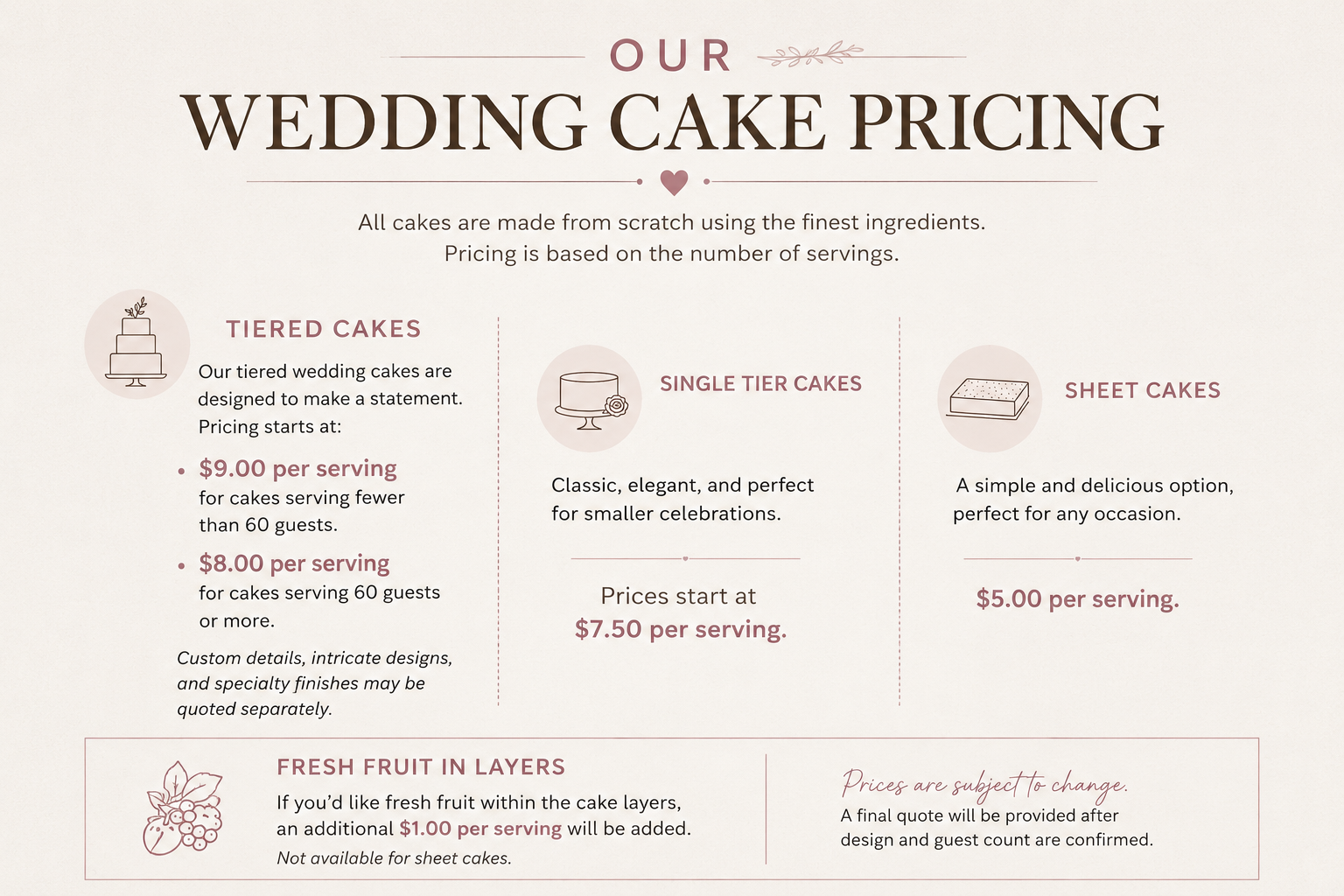
Publish a starting price and a tier-by-tier range on your website, in text, above the fold on your wedding cake page. This is the highest-leverage change most bakeries can make, and the one most resist.
The first thing a couple wants to know — before flavor, before design, before your story or your awards — is whether you are in their budget. If they cannot answer that on your site in under 30 seconds, they close the tab and do not come back. A “contact us for a quote” form reads as a bakery that will surprise you on the invoice.
The objection is always the same: every wedding cake is custom, we can’t publish a price. You do not need to publish an exact price for every possible cake. You need to publish a ladder. Here is the shape of it — substitute your own numbers; these illustrate the format, not market rates:
| What the couple is buying | What to publish |
|---|---|
| Entry point | “Our wedding cakes start at $450.” |
| Two tiers | “Two-tier cakes typically run $600–$1,200.” |
| Three to four tiers | “Most three and four-tier cakes land between $1,200–$2,500.” |
| Beyond that | “Larger or highly sculptural designs go up from there — we’ll quote precisely.” |
| Per-serving equivalent | “That works out to roughly $X–$Y per serving.” |
Publish the per-serving figure too. It is how planners and venues compare vendors, and it is the number an AI assistant will use when a couple asks it to compare bakeries.
Two things to add alongside the ladder, because they are the next two questions:
- What’s included — delivery within a stated radius, setup, cake stand rental, a cutting cake, or none of those.
- What’s not — tasting fee, travel beyond the radius, rush surcharge, sugar flowers, stand deposit.
“But not every couple shops on price.” True — but most do, and you should serve most. The couple who only cares about price self-selects out, which saves you both a week. The couple who is flexible sees that you were confident enough to publish, and trusts you more for it.
One consequence worth naming: publish these figures once, in one place, and keep every other page consistent with them. Contradictory ranges scattered across your site produce contradictory answers when an AI assistant summarizes you.
How many servings does each wedding cake size give?
Use the standard wedding slice — 1 inch by 2 inches by 4 inches tall — and the arithmetic is fixed. Publish this table on your site; it is one of the most-searched questions in the category and one of the least-answered.
| Cake | Approximate wedding servings |
|---|---|
| 6" round, single tier | 12 |
| 8" round, single tier | 24 |
| 6" + 8" two tier | 36 |
| 8" + 10" two tier | 62 |
| 6" + 8" + 10" three tier | 74 |
| 8" + 10" + 12" three tier | 118 |
| 6" + 8" + 10" + 12" four tier | 130 |
Note that these are wedding servings, which are cut smaller than party servings — state that assumption wherever you publish the table, because it is what makes the numbers usable.
What is a kitchen cake, and when should you recommend one?
A kitchen cake is an undecorated sheet cake, baked in the same flavor as the display cake and held in the venue kitchen, plated for guests while the tiered cake is cut for photographs. It exists because almost all the cost in a wedding cake is decoration labor, not cake.
For a 150-guest wedding, a three-tier display cake plus two kitchen sheet cakes will typically cost meaningfully less than a five-tier showpiece serving the same number, and no guest can tell the difference on the plate. Most couples have never heard of this. Telling them unprompted is one of the fastest ways to become the vendor they trust — and it usually protects your margin rather than eroding it, because you are selling less labor at a better rate.
How far in advance should couples order a wedding cake?
Most couples book their cake 8 to 14 months out, but the honest answer for your site is your own cutoff: state the minimum lead time you will accept, and the point at which your popular dates are typically gone.
Publish three things:
- Ideal window — “We recommend booking 8–12 months out, especially for May through October dates.”
- Minimum lead time — “We can usually accommodate custom cakes with at least X weeks’ notice.”
- Rush policy — whether you take short-notice orders at all, and the surcharge if you do.
The long booking runway matters for a second reason, covered below: it is what makes monthly payment plans work.
Should bakeries charge for wedding cake tastings?
Yes. Free tastings made sense when a baker did three or four a month; now that couples shop more vendors in parallel, free tastings consume the calendar of a growing business.
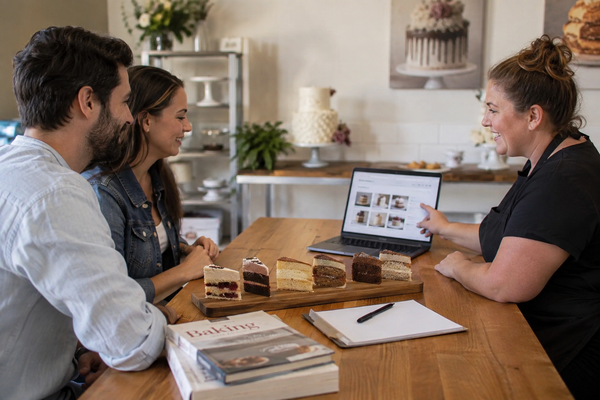
The model working as of 2026 is a paid tasting box, commonly $50 to $85, credited back against the order if the couple books. The couple gets four to six samples shipped or collected, then a 30-minute video consultation a couple of days later once they have actually tasted everything.
The video call is the part that changes the economics. Ten minutes on flavor feedback, fifteen on design and inspiration, five locking in next steps. No drive, no parking, no childcare — and you can run four in an afternoon instead of one. Couples planning destination weddings or working hybrid schedules now frequently prefer it.
It is also the moment a couple decides whether you get them, so listen more than you talk. Ask what they want guests to feel when the cake is cut; the answer will guide every design decision after it.
How many wedding cake flavors should a bakery offer?
Six to eight pre-paired combinations, not a mix-and-match menu. Twenty cakes by fifteen fillings by eight frostings is not generosity, it is decision fatigue — and it reliably produces couples who either default to something safe or pair things that fight each other and remember the cake as “fine.”
Offer a tasting menu, not a buffet. For example:
- Vanilla bean with raspberry compote and Italian buttercream
- Brown butter chocolate with salted caramel and chocolate ganache
- Lemon with elderflower curd and Swiss meringue
- Almond with apricot jam and amaretto buttercream
- Pistachio with rosewater cream and white chocolate ganache
- Red velvet with cream cheese frosting — no other filling, no other frosting
- Earl grey with vanilla bean cream and honey buttercream
- Carrot with brown butter cream cheese and toasted pecans
The pairings are locked, because the pairings are the product. Frame it warmly: “These are our signature pairings. We’ve tested every combination, and these are the ones guests ask about.” Couples exhale, pick one in five minutes, and the reviews start naming specific flavors — which brings in new couples asking for the pistachio rose because they had it at a friend’s wedding.
Teach while you do it: “We pair raspberry with vanilla rather than chocolate, because raspberry and chocolate compete in a way most people don’t notice until the second bite.” Now you sound like an expert, and your other recommendations inherit that credibility.
A bakery known for eight legendary pairings is in a stronger position than one known for “we can do anything.” Anything is forgettable.
Should you ask couples questions, or give them options?
Give them options with a recommendation attached. Treat every question you were about to ask as a small failure of service.
Buttercream or fondant? American or Swiss meringue? Round or square? Sugar flowers or fresh? To you these are basic prompts. To the couple, each one is a Google search, a Reddit thread, two YouTube videos, and a 45-minute conversation with their fiancé. You already know the right answer from their venue, season, guest count, and inspiration photos.
Instead of: “What kind of frosting do you want?”
Say: “For your June garden wedding we’d recommend Italian buttercream — it holds up in heat, finishes cleanly, and suits the textured look you sent us. If you want something more sculptural, we can do fondant over buttercream. Most couples in your situation choose the first.”
Two options, one recommendation, one reason. Fifteen seconds instead of three days. Choosing between two clear options is dramatically easier than answering an open question, and there are roughly thirty micro-decisions in a wedding cake order.
Applied across the board:
- Not “what flavor?” — three pre-paired options, one recommended
- Not “what design?” — three directions pulled from their own inspiration photos, one recommended
- Not “sugar flowers or fresh?” — “we’d use fresh florals from the florist you’ve already hired; here’s why it will look better and cost less”
- Not “round or square?” — pick it based on the venue and explain why
This sounds like taking choice away. It is taking confusion away. They will pay more for it.
What deposit and payment plan should a bakery use?
Take a small deposit to hold the date and bill the balance monthly. Lowering the amount due today does more for booking rates than almost any other change, and the long engagement runway is what makes it possible.
A $1,500 cake feels like a serious commitment as a lump sum. The same $1,500 as $250 today and five monthly payments of $250 feels like nothing. Identical total, completely different decision.
Three structures that work:
- 25% then monthly. A quarter today to lock the date, then equal monthly payments through 30 days before the wedding. The easiest to explain.
- Low-deposit hold. A small fixed amount today to hold the date, with the plan starting 60 days later. This closes couples who love your work but aren’t ready to move real money on the spot.
- Flat monthly. Total divided by the months between booking and wedding, charged the same day each month. Couples like this because it sits neatly beside their other wedding payments.
Frame it the way they already think about money: “You can book your cake today for $250 and pay it off over six months, no interest.” Venues, photographers, and jewelers have already conditioned couples to think monthly. Match that language.
Across more than 10,000 wedding cakes on Bakestreet, quotes offering a monthly payment plan converted 6% more than those with no payment plan.
Run the charges automatically on the same day each month so nobody has to chase anything.
Then keep the experience from turning transactional the moment money lands: send a warm confirmation immediately after the deposit, with a one-page roadmap of what happens next and when. Nothing reassures a couple more than seeing the path ahead.
What should a bakery publish about delivery and setup?
Publish your delivery radius, your fee structure, and who signs for the cake — before anyone asks. Delivery is the second or third question in most inquiries and it is trivially answerable on a web page.
State plainly:
- Radius and fee — free within X miles, then a per-mile or banded fee beyond it.
- What setup includes — assembly on site, placement of fresh florals, stand rental, and whether you return for the stand.
- Timing — how far ahead of the reception you arrive, typically 45 to 90 minutes before the planner expects the cake table finished.
- Who you coordinate with — the venue, not the couple. Confirm setup time, table location, and who signs for delivery directly with the venue coordinator. The couple should never relay messages between you and their venue.
On the day itself: arrive early, uniform clean, check in with the coordinator, and text a photo of the finished setup to the planner with a short note. That photo gets forwarded to the couple almost every time. Then leave — no fuss, no tip requests.
Bakeries with venue relationships should go further: offer three or four “house cake” designs sized to that venue’s typical guest counts, at fixed prices the venue can drop into its welcome packet.
Should bakeries offer gluten-free, vegan, or nut-free wedding cakes?
Offer what you can genuinely execute, and say so explicitly on your website — including what you cannot do. Dietary questions are among the most common reasons a couple contacts a bakery, and among the most common reasons they leave a site without contacting anyone.
Publish, in plain sentences:
- Which of gluten-free, vegan, dairy-free, and nut-free you offer, and whether it applies to the whole cake or a separate small cake for specific guests.
- Any surcharge, stated as a figure or percentage.
- An honest cross-contamination statement. If you bake with nuts and wheat in a shared kitchen, say that — couples with a genuine allergy need to know, and the honesty reads as competence rather than a limitation.
- Whether the flavor pairings above are available in those formats, or whether there’s a separate short list.
A separate small cake in the required format, matched to the display cake’s finish, is usually the better recommendation than converting the entire wedding cake. Make that recommendation for them rather than asking.
Is a wedding cake or a dessert table cheaper?
Per serving, a tiered cake is usually the cheaper option, and a dessert table of macarons, tarts, and mini pastries is usually the more expensive one — the opposite of what most couples assume.
The reason is where the labor sits. A tiered cake concentrates decoration labor into a handful of surfaces; the cost per serving falls as the cake gets bigger. Individually finished items carry their own labor in every single unit, so cost per serving stays flat no matter how many you make. Macarons in particular are among the most labor-intensive things per bite in a bakery.
The version to recommend to a budget-conscious couple: a modest tiered cake as the centerpiece, kitchen cakes behind it for volume, and a small dessert accent rather than a full table. Say it in those terms and you have saved them money while selling more cake.
How fast should a bakery reply to a wedding cake inquiry?
Within two hours during business hours. Not 24. Speed of first reply is a stronger predictor of who books the wedding than either price or portfolio.
Bakeries replying within two hours on an average booked 11% more wedding orders.
Couples are typically contacting four or five bakeries in one sitting. A thoughtful, personalized reply 90 minutes later arrives while you are still the bakery they were looking at, and it lands before anyone else’s. They tell their fiancé. They mentally book you before reading the price.
The reply itself should be short and confident: two or three recommended design directions based on their inspiration, a recommended flavor pairing, a clear price, what’s included, one next step. No walls of fine print, no “let’s hop on a call to talk through it.”
If their design is outside their stated budget, say so directly: “Your dream design is closer to $1,800. We have an option at $950 that gives you the same feeling at a smaller scale — here’s a sketch.” They have spent months getting vague money answers from venues and photographers. The vendor who is straight with them about cost becomes the vendor they trust.
Who should be sending those replies?
Whoever handles your inquiries is the business as far as the couple is concerned. The right person is calm, warm, and useful — reads between the lines, replies fast, and never makes anyone feel rushed or sold to.
Modern buyers do not want to be sold to; they want help making their own decision. Tesla is the clearest example in any industry: it removed the pressure, the haggling, and the back office, put the configurator and the price on the website, and sales rose rather than fell. When customers feel in charge of the decision, they decide faster; when they feel sold to, they slow down and walk away.
By the time a couple has the information they need, the booking should feel like their idea. That is the only kind of selling that works now.
How do couples find bakeries through AI search, and how do you get recommended?
Increasingly couples ask an assistant — ChatGPT, Gemini, or Google’s AI results — something like “wedding cake bakeries in Chicago under $1,000 for 40 guests,” and act on the shortlist it gives them. Getting into that shortlist is a different job from ranking on Google, and it rewards exactly the transparency this article has been arguing for.
What makes a bakery quotable by an AI assistant:
- Prices published as text, not baked into an image or PDF. A price inside a graphic is invisible. This is the single biggest determinant of whether you can be included in an “under $X” answer at all.
- Direct answers to the obvious questions, in complete sentences. Servings per tier, lead time, delivery radius, dietary options, deposit terms. An assistant can only tell a couple what your site actually states.
- Specific, checkable facts. “We deliver within 25 miles of downtown Chicago for $75” can be repeated. “We proudly serve the greater Chicago area” cannot.
- A consistent story across your site, Google Business Profile, and any marketplace listing. Contradictory hours, prices, or service areas make you a risky thing to recommend.
- Reviews with real photos. Still the strongest trust signal, and increasingly the raw material for how assistants characterize you.
Note what is not on that list: keyword density, blog volume, and clever copy. The bakeries getting recommended are the ones whose basic facts are legible.
What does the wedding cake customer journey look like end to end?
Eleven steps, from first inquiry to the anniversary follow-up a year later. Each one either builds trust or leaks it.
- Inquiry. Almost always your website or Instagram, usually late at night. Designs front and center, each with a photo, description, serving count, and a “Request a Quote” button beside it. Pre-answer price, dietary options, lead time, and delivery on the page.
- The small-wedding path. A separate “Intimate Weddings” section, next to the custom gallery: six to ten simple one and two-tier cakes serving 20, 30, 40, and 50 guests. Each with a photo, a flat price, a flavor pairing already chosen, a serving count, an add-to-cart button, and a delivery date selector. No quote, no call, no tasting — four minutes start to finish. This captures orders you are currently losing entirely, and it cleans up your custom pipeline because the small weddings stop arriving as low-value inquiries.
- The quote. Within two hours. Two or three design options, a recommended pairing, a clear price, what’s included, one next step.
- The tasting. Paid box plus a 30-minute video consult, fee credited on booking.
- Design. Two or three curated directions with reasons, not a menu of questions.
- Deposit and payment plan. Contract and payment link in the same email, signable from a phone in five minutes.
- Flavor finalization. One page, eight pairings, a “lock in your flavor” button.
- The upsell, once. A single email three months out — matching cutting cake, dessert accents, boxed slices for guests, an anniversary tier. No pressure; the couple already trusts you, which is the only reason it works.
- Wedding-day planning. A clear timeline two weeks out, easy to forward to a planner: final guest count date, bake date, delivery window, point of contact. Venue logistics confirmed by you, with the venue. A short warm note 72 hours before.
- Delivery and setup. Early, clean, coordinated with the venue, photo to the planner, then gone.
- The review, then something unexpected. Two weeks after the wedding, a warm email with a direct review link and a specific request for a photo. Then, three to four weeks after, send something nobody asked for — a handwritten card, a voucher for a free anniversary tier, a small box of macarons in their wedding flavor. This is the step nearly every bakery skips and where lifelong customers are made. Those couples go on to buy anniversary cakes, shower cakes, and first-birthday cakes, and they refer every engaged friend they have.
On reviews specifically: aim for 50-plus photo reviews before spending a dollar on advertising. Couples read nearly every review before reaching out, and Google reviews with real wedding photos outperform any ad you will run. A bakery with 300 photo reviews looks established; one with 12 looks like a coin flip.
Treat the online small-wedding buyers exactly as well as the custom couples. Same quality, same care, same delivery experience. They refer heavily, and there are a lot of them right now.
What should a bakery automate first?
Map your own journey on paper, then automate every step where the couple currently has to do something. This is the highest-return exercise available to a wedding cake bakery and almost nobody does it.
Write “Inquiry” at the top of a page and “Anniversary follow-up” at the bottom. List every step in between — auto-reply, first human reply, quote, quote follow-up, tasting box order, delivery, consult scheduling, consult, design recommendation, contract, deposit, plan setup, flavor finalization, upsell email, guest count request, venue confirmation, 72-hour note, delivery, setup, planner photo, review request, anniversary note.
Next to each step, answer two questions:
- What does the couple have to do here?
- Could a system do part or all of this instead of a person?
Most owners discover their “process” asks the couple to do around thirty small jobs across nine months. Each one is a chance for friction, and a chance for a system to do the work instead.
Start here:
- Make it easy to request quote
- Quote templates/pre filled information in system, so a custom quote takes minutes instead of hours
- Online scheduling for tastings and consults
- Quote with payment link and policy link, needing only a tap to book
- Recurring monthly billing that runs without anyone pressing a button
- Sequences for the upsell, the two-week confirmation, the 72-hour note, the thank-you, the review request, and the anniversary follow-up - fully automated
- A one-page flavor selection with the eight pairings and a lock-in button
- Pre-filled logistics emails for the venues you work with most
Every task automated removes a touchpoint where the couple had to lift a finger and removes labor cost from your business. Both sides win at once, which is rare.
A system is what holds this together — every inquiry logged, every couple’s status tracked, every follow-up fired on schedule. BakeStreet makes wedding cake quotes simple: customer requests and staff pricing through to one-tap payments, payment plans, automated follow-ups, and reminders. Your team only needs to set the price — Bakestreet handles the rest.
Also worth having in place: targeted Google Ads on “wedding cake near me” and “wedding cake [your city]”, starting at $300–$500 a month, paired with consistent Instagram posts of real cakes at real weddings, with the venue, planner, and photographer tagged.
The bottom line
People pay more for five-star service not because the product is twice as good, but because the experience is twice as easy.
Couples have not stopped buying wedding cakes — there are still over 2 million weddings a year to serve. They have changed how they shop, and the bakeries growing in this market changed with them: published prices, two-hour replies, eight great flavor pairings instead of forty mediocre combinations, a four-minute online path for small weddings, video consults, payment plans, photo reviews, and a system that remembers every couple.
Underneath all of it, the same three moves.
Sell the experience, not the cake. Be the vendor they trust most, not the one who smiles most. And do the work yourself, so the couple never has to.